
Take a single breath. That gulp of oxygen you just inhaled exists because of forces buried deep beneath your feet — and scientists are only now beginning to understand how those forces and the air above them have been dancing together for half a billion years.
A new study led by NASA researchers has identified a striking pattern: Earth’s magnetic field strength and atmospheric oxygen levels have risen and fallen in near-lockstep across the entire span of complex life on this planet — roughly 540 million years. It is one of the most sweeping geological correlations ever documented, and it raises a question that scientists are still wrestling to answer: which one is driving the other?
The finding is not just a curiosity for geologists. If the magnetic field and oxygen are genuinely linked, it could reshape how we understand the conditions that allowed complex life — including us — to survive and thrive on Earth.
What NASA’s Researchers Actually Found
The study combined two enormous geological records that had previously been studied separately. The first tracks the virtual geomagnetic axial dipole moment — essentially a measure of how strong Earth’s global magnetic field has been at different points in deep time. The second reconstructs atmospheric oxygen concentrations using chemical signatures preserved in ancient rocks and sediments.
When researchers lined the two records up side by side, the similarity was hard to ignore. Both curves show a broad upward trend across the Phanerozoic eon — the geological era that encompasses all complex animal life. More specifically, both records show a major shared surge occurring roughly between 330 and 220 million years ago, a period during which atmospheric oxygen may have climbed to around 35% of the atmosphere. For comparison, oxygen makes up about 21% of the air today.
The statistical correlation between the two datasets sits at approximately 0.7 on a scale where 1.0 would represent a perfect match. In geological terms — where records are incomplete, ancient, and reconstructed from indirect evidence — that is a remarkably strong signal.
The researchers themselves described the two datasets as “very similar,” a measured but significant statement given the complexity of the data involved.
The Numbers Behind the Pattern
| Metric | Detail |
|---|---|
| Time period covered | ~540 million years (entire Phanerozoic eon) |
| Statistical correlation | ~0.7 (scale of 0 to 1) |
| Period of major shared surge | Approximately 330 to 220 million years ago |
| Peak estimated atmospheric oxygen | ~35% during the surge period |
| Current atmospheric oxygen | ~21% |
| Records combined | Geomagnetic axial dipole moment + atmospheric oxygen proxies |
The breadth of the data is what makes this finding so significant. This is not a short-term blip or a regional anomaly — it is a pattern that holds across hundreds of millions of years of planetary history.
The Question That Makes This Story So Strange
Here is where the science gets genuinely unsettling in the best possible way: researchers have identified the pattern, but the direction of causation is still an open question.
Does a stronger magnetic field somehow promote higher oxygen levels? Or does more oxygen in the atmosphere influence the magnetic field? Or are both being driven by a third factor entirely — something happening deep inside the Earth, like shifts in the behavior of the planet’s molten core?
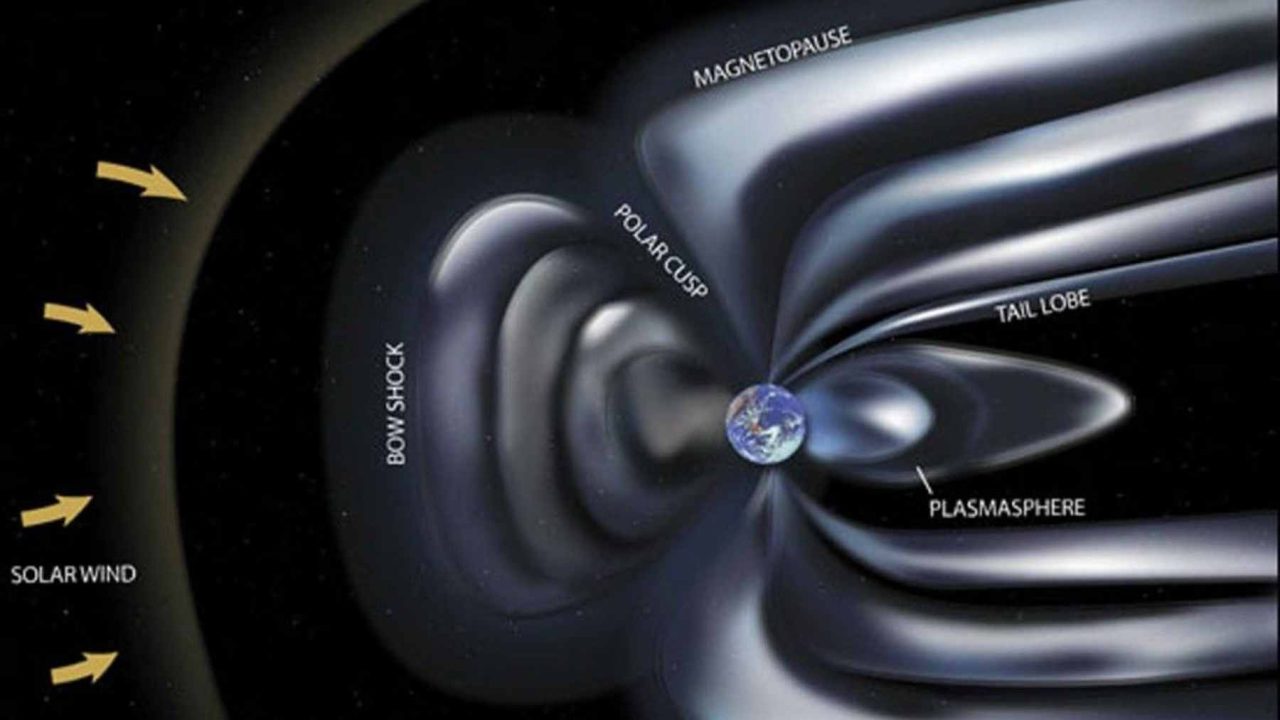
- Magnetic field driving oxygen: A stronger magnetic field provides better protection from solar wind, which strips away atmospheric gases. In theory, a more robust magnetic shield could help retain oxygen over geological time.
- Oxygen influencing the magnetic field: Higher oxygen levels fuel more complex biological and geological activity, which could theoretically affect processes linked to the magnetic field — though the mechanism here is far less clear.
- A shared deep-Earth driver: Changes in the planet’s interior — the dynamics of the liquid outer core that generates the magnetic field — could simultaneously influence surface geology and atmospheric chemistry in ways scientists are still mapping out.
None of these explanations has been confirmed. The study establishes the correlation; the mechanism remains an open and genuinely fascinating scientific puzzle.
Why This Matters Beyond the Laboratory
It is easy to think of Earth’s magnetic field as background infrastructure — something that exists, points compasses north, and otherwise stays out of the way. But this research suggests it may have played a far more active role in shaping the conditions that made complex life possible.
The Phanerozoic eon — the 540-million-year window this study covers — is the era during which animals, plants, and eventually humans emerged. If oxygen levels during that period were genuinely tied to magnetic field strength, then the story of life on Earth is also, in part, a story about planetary magnetism.
There are also implications for the search for life elsewhere. Planets with weak or absent magnetic fields — which includes Mars — may face compounding disadvantages: not only increased radiation exposure, but potentially suppressed atmospheric oxygen as well. Understanding the Earth-based relationship between magnetism and oxygen could sharpen the criteria scientists use when evaluating whether other worlds might support complex life.
What Comes Next for This Research
The study opens more questions than it answers, which is exactly what foundational research is supposed to do. Scientists will now need to investigate the physical mechanisms that could explain the correlation — whether that means modeling the behavior of Earth’s core, examining the biological processes that generate and consume oxygen, or developing more refined proxies for ancient atmospheric conditions.
Improving the resolution of both geological records will also be critical. The further back in time researchers look, the harder it becomes to reconstruct precise conditions from rock chemistry alone. Refining those records could either strengthen the observed correlation or reveal nuances that complicate the picture.
For now, the headline finding stands: across 540 million years, Earth’s magnetic shield and the oxygen in its atmosphere have moved together in a pattern too consistent to dismiss — and the question of why may turn out to be one of the most important in planetary science.
Frequently Asked Questions
What did NASA researchers discover about Earth’s magnetic field and oxygen?
They found that Earth’s magnetic field strength and atmospheric oxygen levels have risen and fallen in a similar pattern across approximately 540 million years, with a statistical correlation of about 0.7.
When did the biggest shared surge in magnetism and oxygen occur?
Both records show a major shared surge between roughly 330 and 220 million years ago, when atmospheric oxygen may have reached around 35% — significantly higher than today’s 21%.
Does this mean the magnetic field controls how much oxygen we have?
That has not been confirmed. The study establishes a correlation, but whether the magnetic field drives oxygen levels, oxygen influences the magnetic field, or both are shaped by a third factor remains an open scientific question.
Why does this finding matter for everyday life?
It suggests that the conditions allowing complex life — including breathable air — may be tied to the planet’s magnetic behavior, deepening our understanding of what makes Earth habitable.
Could this research affect the search for life on other planets?
Potentially yes. If magnetic field strength is linked to oxygen retention, planets with weak magnetic fields like Mars may face compounding barriers to supporting complex life, which could refine how scientists evaluate habitability elsewhere.
What happens next with this research?
Scientists will need to investigate the physical mechanisms behind the correlation and refine the geological records used in the study to better understand the relationship between Earth’s magnetic field and atmospheric oxygen over time.




Leave a Reply