
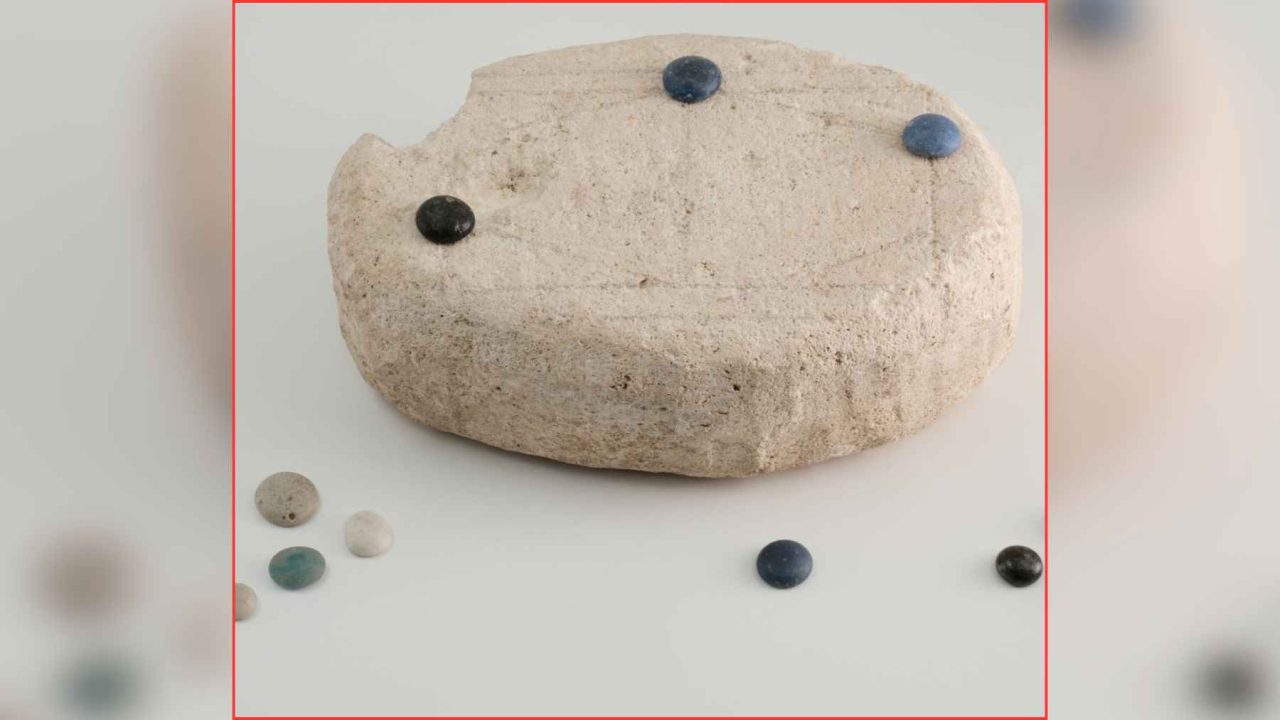
A small limestone slab sat in a Dutch museum for over a century without anyone quite knowing what to make of it. Was it an architectural fragment? A decorative piece? Something purely ornamental? A new study published in February 2026 suggests the answer was far simpler — and far more interesting — than anyone had assumed.
Researchers now believe the object is a Roman game board, and the method they used to reach that conclusion is as remarkable as the finding itself: a combination of microscopic wear analysis and thousands of artificial intelligence simulations. If they are right, the implications stretch well beyond one museum artifact. The discovery could push an entire category of European board games back into the Roman era.
It is the kind of story that reminds you how much of the ancient world is still hiding in plain sight — sometimes literally on a museum shelf with an inventory number and no clear explanation.
The Object That Never Quite Fit
The artifact is catalogued as “Object 04433” at Het Romeins Museum in Heerlen, the Netherlands. It is a carefully shaped piece of white Jurassic limestone, measuring roughly 8.35 by 5.71 inches and about 2.80 inches thick — or 212 by 145 by 71 millimeters for those working in metric. It weighs approximately 7.45 pounds, or 3.38 kilograms.
That weight and those proportions matter. This is not a rough chunk of building material. Every side of the object has been shaped with care, which is exactly what made it so difficult to classify for so long.
The stone itself comes from the Norroy quarries in northeastern France — white Jurassic limestone that Romans frequently used for high-status architectural work because it could mimic the appearance of marble while being somewhat easier to carve. That prestigious material background only deepened the mystery. Why would someone use fine decorative stone to make something this small and this precisely shaped, if it were just a structural element?
For more than a century, the object resisted a clean answer. Then researchers decided to bring modern technology to bear on it.
How AI Helped Crack a 2,000-Year-Old Mystery
The research team’s approach combined two complementary methods. First, they conducted microscopic wear analysis on the surface of the stone — examining patterns of use and contact that would be invisible to the naked eye. Second, they ran thousands of artificial intelligence simulations to model how the object would have functioned under different scenarios.
The goal was to let the evidence speak rather than forcing the artifact into a predetermined category. By running so many simulations, the researchers could test whether the wear patterns on the stone matched what you would expect from a game board being used repeatedly — pieces sliding across a surface, hands resting on edges, the particular friction of play.
According to the study, published online on February 11, 2026, the results pointed strongly toward the game board interpretation. The wear patterns and the simulations aligned in ways that other explanations — architectural sketch, decorative object — could not account for as cleanly.
Researchers argue the stone was most likely used as a Roman game board, and one with potentially significant historical consequences for how we understand the timeline of board games in Europe.
Key Facts About the Artifact at a Glance
| Detail | Specification |
|---|---|
| Museum | Het Romeins Museum, Heerlen, Netherlands |
| Catalogue ID | Object 04433 |
| Dimensions | 8.35 × 5.71 × 2.80 inches (212 × 145 × 71 mm) |
| Weight | Approx. 7.45 lbs (3.38 kg) |
| Material | White Jurassic limestone |
| Stone origin | Norroy quarries, northeastern France |
| Study published | February 11, 2026 |
| Estimated age | Approximately 2,000 years old |
Why This Could Rewrite Board Game History
The researchers do not just claim to have identified a game board. They argue the finding could push an entire category of European board games back into the Roman era — a claim that, if supported by further study, would require historians to rethink the origins and spread of certain games across the continent.
Board games have a longer and more complex history than most people realize. Ancient Romans were enthusiastic players, and game boards and gaming pieces have been found at Roman sites across Europe. But the specific category of game this artifact may represent — based on the board’s configuration and the wear analysis — appears to have been thought of as a later development.
If Object 04433 genuinely belongs to that category, then Romans were playing a version of it roughly 2,000 years ago, far earlier than previously documented. That is not a minor footnote. It changes the lineage of the game entirely.
The use of AI to reach this conclusion is also worth noting on its own terms. Archaeology has traditionally relied on physical examination, expert comparison, and painstaking manual analysis. Running thousands of simulations to model artifact use represents a meaningful shift in how researchers can approach objects that have resisted conventional classification.
What Researchers Are Saying — and What Comes Next
The study’s authors argue that the simplest explanation — that this is a game board — turned out to be the most defensible one once the data was examined rigorously. The microscopic wear patterns and the AI simulation results together made a case that more than a century of visual inspection had not been able to settle.
The research is published and available for other scholars to examine and challenge. In academic terms, that is where the real work begins. Independent researchers will need to assess the methodology, the simulation parameters, and whether the wear analysis conclusions hold up under scrutiny.
If the findings are confirmed, Het Romeins Museum in Heerlen will find itself home to something considerably more significant than a puzzling limestone block — a genuine piece of Roman leisure history that spent over a hundred years waiting for the right question to be asked of it.
What that says about how many other misidentified artifacts are sitting in museum storage right now is a question worth sitting with.
Frequently Asked Questions
Where is the artifact currently held?
The object, catalogued as Object 04433, is held at Het Romeins Museum in Heerlen, the Netherlands.
What material is the artifact made from?
It is carved from white Jurassic limestone sourced from the Norroy quarries in northeastern France, a material Romans commonly used for high-status decorative work.
How did researchers use AI to study the artifact?
The team combined microscopic wear analysis with thousands of artificial intelligence simulations to model how the object would have functioned, comparing results against different possible uses including as a game board.
When was the study published?
The study was published online on February 11, 2026.
What would this discovery change about board game history?
Researchers argue it could push a specific category of European board games back into the Roman era, suggesting Romans were playing a version of the game approximately 2,000 years ago — earlier than previously documented.
Has the finding been independently confirmed?
The study has been published for peer review, but independent confirmation by other researchers has not yet been reported in the available source material.



Leave a Reply