
A chunk of ice and rock racing through our solar system at more than 130,000 miles per hour has scientists asking one of the most audacious questions in modern astronomy: what if the cheapest way to travel between stars isn’t a spacecraft we build — but one nature already made for us?
That is the idea swirling around 3I/ATLAS, only the third confirmed interstellar object ever detected passing through our solar system. Discovered in July 2025, this comet doesn’t belong to the Sun. It came from somewhere else entirely, and it’s on its way back out — carrying with it water, organic molecules, and a vision of what interstellar travel might one day look like.
The science here is real, the object is real, and the implications are genuinely strange in the best possible way.
What 3I/ATLAS Actually Is — and Where It Came From
To understand why scientists are excited, you first need to understand what makes 3I/ATLAS so unusual. Most comets and asteroids in our solar system travel on closed, elliptical orbits — they loop around the Sun and keep coming back. 3I/ATLAS does not. Its orbit is open, meaning when astronomers trace its path backward through time, it doesn’t connect to our Sun at all.
It is a genuine visitor from another star system, carrying material that formed somewhere else in the galaxy — possibly billions of years ago, around a completely different star.
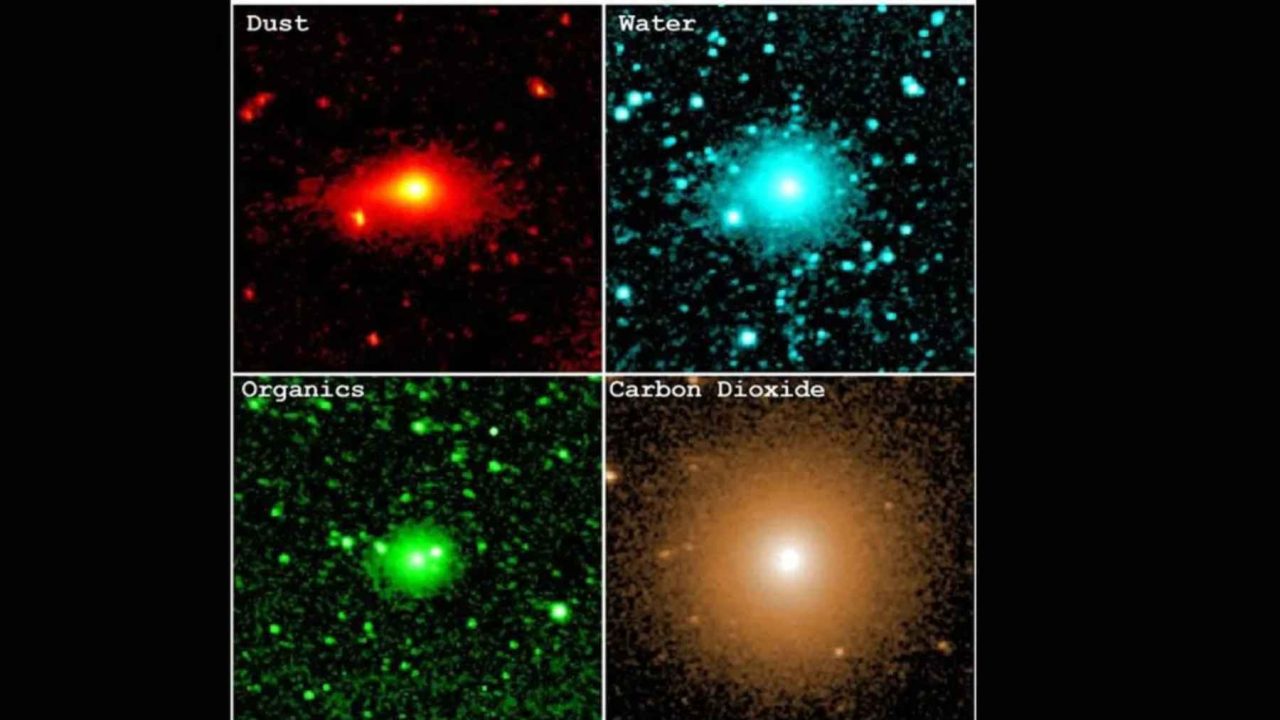
It was spotted by the ATLAS survey telescope in Chile in July 2025, making it the third such confirmed interstellar interloper ever identified, following 1I ʻOumuamua and 2I Borisov. Each discovery has taught astronomers something new about what’s drifting between the stars. 3I/ATLAS appears to be the most active of the three, actively spraying water and organic molecules into space as it warms near the Sun.
Its solid icy core is estimated to be somewhere between roughly 440 meters and 5.6 kilometers across — a wide range that reflects how hard it is to pin down an object moving this fast and this far away.
The Numbers That Make This Object So Remarkable
| Feature | Detail |
|---|---|
| Object name | 3I/ATLAS |
| Discovery date | July 2025 |
| Discovery instrument | ATLAS survey telescope, Chile |
| Interstellar origin | Confirmed — orbit does not belong to the Sun |
| Estimated core size | ~440 meters to 5.6 kilometers across |
| Speed relative to the Sun | More than 130,000 miles per hour |
| Galactic crossing time (estimated) | Less than one billion years |
| Notable emissions | Water and organic molecules |
| Confirmed interstellar objects before it | 1I ʻOumuamua, 2I Borisov |
That speed figure deserves a moment of reflection. Moving at over 130,000 miles per hour, 3I/ATLAS is fast enough that astronomers estimate it could cross the disk of the Milky Way in less than a billion years. On a cosmic timescale, that’s a reasonable commute.
Why 3I/ATLAS Could Be the Cheapest Ticket Across the Galaxy
Here’s where the science gets genuinely provocative. Some researchers have begun exploring whether objects like 3I/ATLAS — interstellar comets already moving at extraordinary speeds through the galaxy — could serve as natural platforms for deep space travel.
The logic is straightforward, even if the engineering remains firmly in the realm of speculation. Accelerating any object to interstellar speeds requires an almost unimaginable amount of energy. A conventional spacecraft carrying humans or even just instruments would need to generate that energy from scratch, which is why interstellar travel remains so far out of reach with current technology.
But 3I/ATLAS is already moving. It arrived in our solar system with that velocity built in, generated by the gravitational dynamics of whatever star system it came from. The energy cost of hitching a ride on something like this — in theory — would be a fraction of what it would take to launch an equivalent mission from rest.
Space agencies have already taken notice of 3I/ATLAS in a more immediate sense. NASA and the European Space Agency have both directed missions toward it, with observations conducted near the Sun and from the vantage point of Mars. Ground-based telescopes have also tracked the object closely, building up a picture of its composition and behavior.
The water and organic molecules it’s releasing make it scientifically valuable on their own terms — they offer a direct sample of chemistry from another planetary system, the kind of data that can reshape our understanding of how common the building blocks of life might be across the galaxy.
What This Means for the Future of Interstellar Science
The arrival of 3I/ATLAS is a reminder that the galaxy is not static. Objects move between star systems. Material from one planetary neighborhood can end up in another. And with the right instruments — or one day, the right mission — we could learn an enormous amount from catching one of these travelers.
The detection of three interstellar objects in relatively quick succession suggests they may be more common than previously thought. Each one that passes through gives astronomers a narrow window to study material that would otherwise be completely inaccessible.
Scientists argue that objects like 3I/ATLAS represent something genuinely new in our toolkit for understanding the cosmos — not just as things to observe, but potentially as vehicles. The idea of using a naturally fast-moving interstellar body as a platform for exploration is still theoretical, but the fact that serious researchers are raising it signals how much this discovery has shifted thinking.
For now, 3I/ATLAS will continue on its open trajectory, leaving our solar system behind. Whether it carries only ice and rock — or one day carries something more — is a question this generation of scientists has only just begun to ask.
Frequently Asked Questions
What is 3I/ATLAS?
3I/ATLAS is the third confirmed interstellar object detected passing through our solar system. It was discovered in July 2025 by the ATLAS survey telescope in Chile and is confirmed to have originated outside our solar system.
How fast is 3I/ATLAS moving?
The comet is traveling at more than 130,000 miles per hour relative to the Sun — fast enough to cross the disk of the Milky Way in less than a billion years.
What is 3I/ATLAS made of?
It appears to have a solid icy core estimated between roughly 440 meters and 5.6 kilometers across, and it has been observed releasing water and organic molecules into space.
Which space agencies are studying 3I/ATLAS?
Both NASA and the European Space Agency have directed missions toward the object, alongside ground-based telescopes. Observations have been made from near the Sun and from the vantage point of Mars.
What were the first two interstellar objects detected?
The first was 1I ʻOumuamua and the second was 2I Borisov. 3I/ATLAS is the third confirmed object known to originate from outside our solar system.
Could a spacecraft actually ride an object like 3I/ATLAS between stars?
This remains firmly theoretical at this stage. Some scientists are exploring the concept because such objects already travel at interstellar speeds, which would eliminate the enormous energy cost of acceleration — but no confirmed mission or technology currently exists to do this.




Leave a Reply