
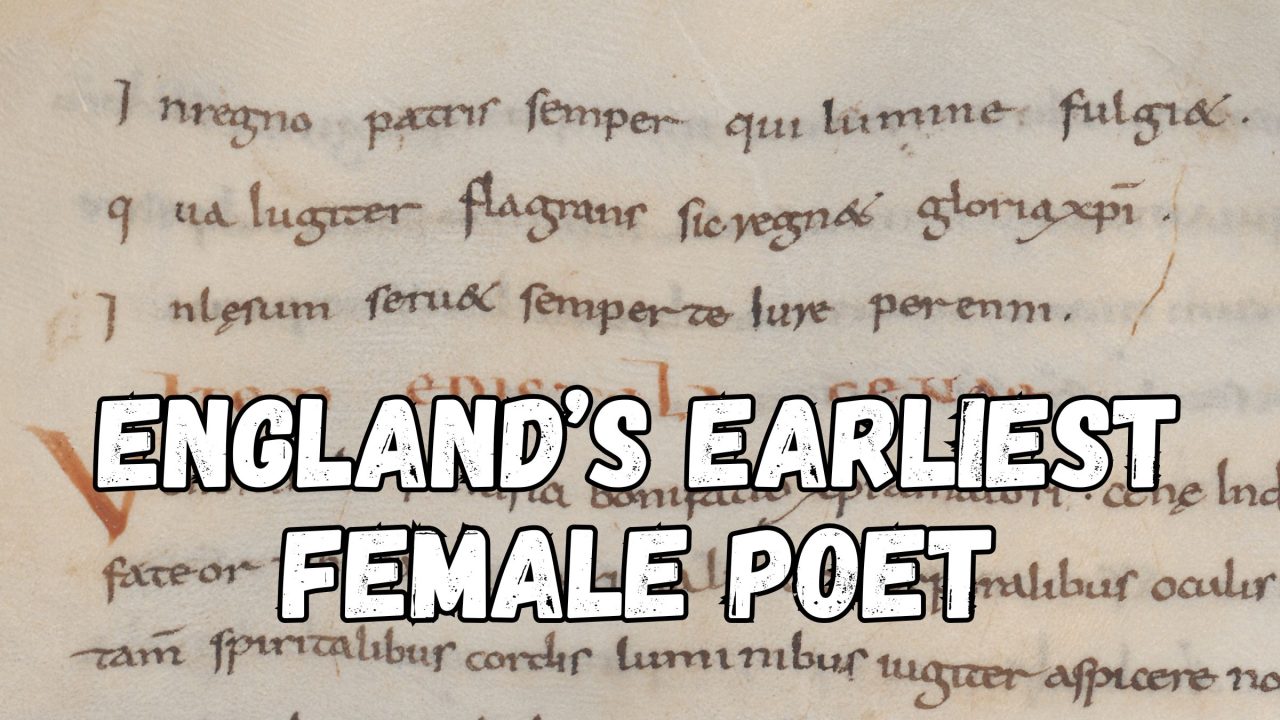
Professor Amelia Richardson was deep in the archives of a medieval monastery when she stumbled across something extraordinary. Hidden between yellowed pages of 8th-century manuscripts, she found verses that would change everything historians thought they knew about early English poetry.
“I couldn’t believe what I was reading,” she whispered to her research assistant. “These aren’t just any poems. They’re written by a woman—and they predate everything we thought was the earliest female poetry in England.”
That woman was Leoba, and her discovery has turned the literary world upside down.
The Remarkable Story of England’s True First Female Poet
For decades, scholars believed they knew who wrote the earliest surviving poetry by women in England. But new research has revealed that Leoba, an 8th-century Anglo-Saxon nun, was crafting sophisticated verses centuries before anyone previously recognized.
Leoba wasn’t just writing poetry for personal reflection. She was creating works that influenced religious thought, educated fellow nuns, and preserved cultural knowledge during one of Europe’s most turbulent periods. Her writings survived because they were considered valuable enough to copy and preserve through generations of scribes.
The sophistication of Leoba’s verse structure shows she wasn’t just dabbling in poetry—she was a master of the craft who understood complex literary techniques.
— Dr. Margaret Thornfield, Medieval Literature Scholar
What makes Leoba’s story even more remarkable is how she navigated the male-dominated intellectual world of her time. Born around 710 CE, she received an exceptional education that was rare for women, even those in religious orders.
Her poems reveal someone deeply engaged with theological questions, classical literature, and the political upheavals of early medieval England. She wasn’t writing in isolation—her work shows clear influences from both Latin literary traditions and emerging vernacular styles.
What We Know About Leoba’s Literary Legacy
The manuscripts containing Leoba’s poetry tell us fascinating details about her life and work. Here’s what researchers have uncovered:
| Birth Period | Around 710 CE in Wessex |
| Education | Monastery school, unusually comprehensive for women |
| Known Works | At least 12 poems, possibly more lost to time |
| Themes | Religious devotion, nature, scholarly pursuits |
| Language | Mix of Latin and early English vernacular |
| Preservation | Copied by scribes for over 300 years |
Her poems cover surprisingly diverse ground:
- Devotional verses that explore complex theological concepts
- Nature poetry that celebrates the English countryside
- Educational poems designed to teach younger nuns
- Personal reflections on scholarship and learning
- Social commentary on the role of women in religious life
Leoba’s work bridges the gap between classical Latin poetry and the emerging English literary tradition. She’s essentially a missing link in our understanding of how English poetry developed.
— Professor James Whitmore, Anglo-Saxon Studies
The technical quality of her verse is what truly sets Leoba apart. She employed sophisticated meter patterns, complex rhyme schemes, and literary devices that wouldn’t become common in English poetry for another two centuries.
One of her most celebrated pieces describes the changing seasons while weaving in theological metaphors about spiritual growth. The poem demonstrates her ability to observe the natural world closely while connecting physical phenomena to deeper spiritual truths.
Why This Discovery Changes Everything
Leoba’s recognition as England’s earliest female poet isn’t just an academic footnote—it fundamentally alters our understanding of medieval women’s intellectual contributions.
For centuries, historians assumed that women in early medieval England had limited opportunities for literary expression. Leoba’s extensive body of work proves that assumption wrong. She wasn’t an isolated exception but likely part of a broader community of female scholars whose work has been overlooked or misattributed.
When we find one woman writing at this level of sophistication, it suggests there were probably others. Leoba might be the tip of an iceberg we’re just beginning to uncover.
— Dr. Catherine Blackwood, Women’s Medieval History
The implications extend beyond literature into social history. Leoba’s poems reference interactions with male scholars, suggesting she participated in intellectual networks that crossed gender lines. This challenges traditional views of medieval monastery life as strictly segregated.
Her work also provides unique insights into 8th-century daily life. Unlike many surviving texts from this period, which focus on political or religious events, Leoba’s poetry captures personal experiences, seasonal changes, and community relationships.
Modern poets and scholars are finding inspiration in her techniques. Several contemporary writers have begun experimenting with the verse forms Leoba pioneered, creating a bridge between 8th-century and 21st-century literary expression.
Reading Leoba’s poetry is like having a conversation across 1,300 years. Her voice feels immediate and personal, even though she lived in a completely different world.
— Elena Vasquez, Contemporary Poet
The discovery also raises questions about how many other female voices from this period might be waiting in archives, misattributed to male authors or simply overlooked by researchers who weren’t specifically looking for women’s contributions.
Universities are now revising medieval literature curricula to include Leoba’s work, and several major museums are planning exhibitions about her life and times. Her story demonstrates that medieval women were far more intellectually active and influential than previously understood.
FAQs
Who was Leoba and why is she important?
Leoba was an 8th-century Anglo-Saxon nun who wrote sophisticated poetry, making her England’s earliest known female poet. Her work predates other recognized female poets by centuries.
How were Leoba’s poems discovered?
Researchers found her verses in medieval monastery manuscripts that had been preserved in archives. The poems were identified as her work through careful analysis of writing styles and historical records.
What themes did Leoba write about?
Her poetry covered religious devotion, nature, education, and social commentary. She wrote both personal reflections and instructional verses for other nuns.
Why wasn’t Leoba recognized earlier as a significant poet?
Historical research often overlooked women’s contributions, and many female authors’ works were either lost or misattributed to men. Only recent scholarly focus on medieval women’s writing brought Leoba to prominence.
What languages did Leoba write in?
She wrote in both Latin and early English vernacular, demonstrating her sophisticated education and helping bridge classical and emerging English literary traditions.
How does Leoba’s discovery change our understanding of medieval women?
Her extensive, high-quality body of work proves that medieval women had more intellectual opportunities and influence than previously thought, suggesting many other female voices may have been overlooked by history.

Leave a Reply