
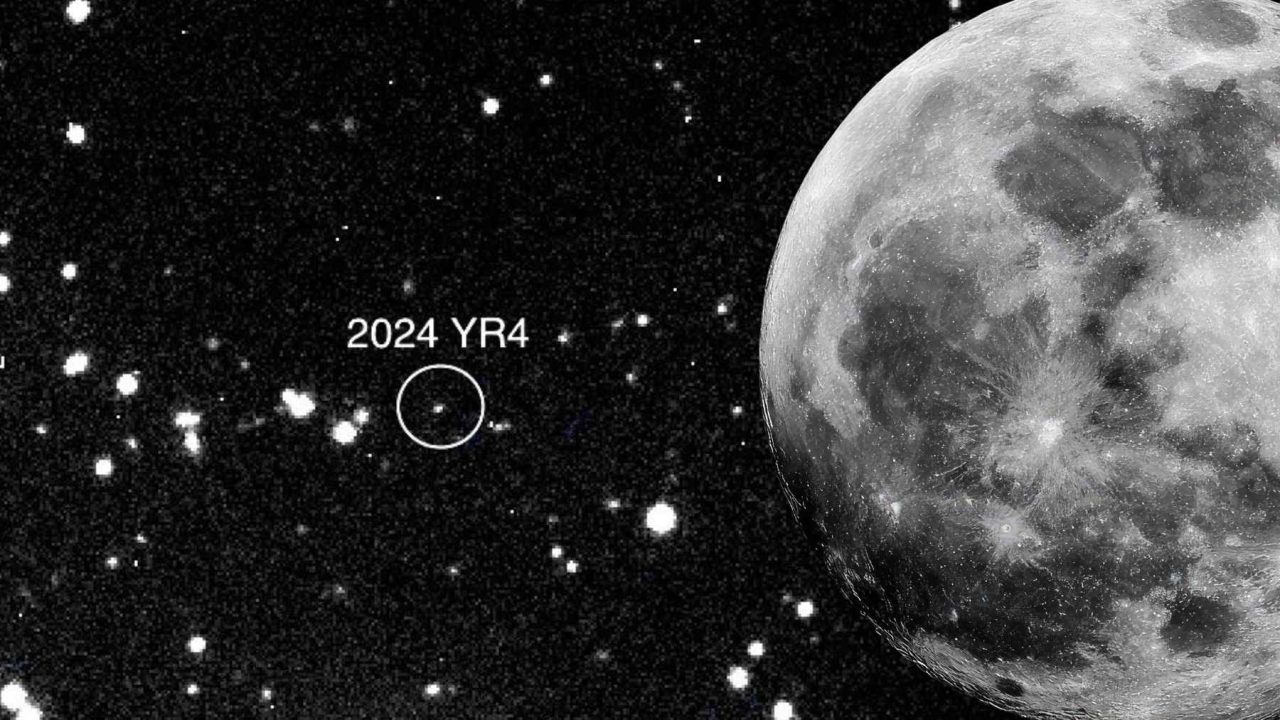
A building-sized asteroid has a small but measurable chance of slamming into the Moon on December 22, 2032 — and if it does, the explosion would be visible to the naked eye from Earth for several minutes. That’s not science fiction. That’s the current assessment from researchers studying asteroid 2024 YR4, a space rock roughly 60 meters across that has captured the attention of planetary scientists around the world.
Earth is not in danger. NASA has officially ruled out any impact with our planet in 2032 or beyond. But the Moon is a different story — and what happens on the lunar surface could have real consequences much closer to home, including risks to the satellites that power everyday life on Earth.
Here’s what we know, what’s still uncertain, and why this particular asteroid is worth watching.
How a “City Killer” Became a Lunar Threat
Asteroid 2024 YR4 was discovered on December 27, 2024, by the ATLAS survey operating out of Chile. Almost immediately, it set off alarms. Early orbital calculations gave it approximately a 3.1% chance of hitting Earth in 2032 — the highest recorded impact probability ever calculated for an object of its size. That’s a number that gets planetary defense scientists out of their chairs.
Follow-up observations using large ground-based telescopes and the James Webb Space Telescope allowed researchers to refine the asteroid’s orbit with much greater precision. Those improved calculations eliminated the Earth impact threat entirely. The relief was significant, but the story wasn’t over.
Once Earth was ruled out, scientists turned their attention to where 2024 YR4 might actually go — and the Moon emerged as a genuine, if still unlikely, candidate. The asteroid’s revised trajectory places it in a position where a lunar impact on December 22, 2032, remains a real possibility.
What a Lunar Impact Would Actually Look Like
At roughly 60 meters in diameter — about the height of a 15-story building — 2024 YR4 isn’t a planet-killer. But it carries an enormous amount of kinetic energy, and the Moon has no atmosphere to slow it down or burn it up.
According to researchers studying the scenario, a direct hit would release energy comparable to several million tons of TNT. The explosion would carve out a crater approximately one kilometer wide — a scar that would be visible through amateur telescopes for years to come.
More dramatically, the impact flash would be bright enough to see with the naked eye from Earth. Scientists estimate the flash would last somewhere between 200 and 300 seconds, appearing as bright as a planet in the lunar night sky. For anyone looking up at the right moment, it would be an unforgettable sight.
The likely impact zone, based on current trajectory modeling, is near the Tycho crater region — one of the most recognizable features on the Moon’s surface.
The Numbers Behind Asteroid 2024 YR4
| Detail | Data |
|---|---|
| Asteroid name | 2024 YR4 |
| Discovery date | December 27, 2024 |
| Discovery location | ATLAS survey, Chile |
| Diameter | Approximately 60 meters (15-story building) |
| Initial Earth impact probability | ~3.1% (highest ever recorded for an object this size) |
| Earth impact status | Ruled out by NASA |
| Potential lunar impact date | December 22, 2032 |
| Projected crater size if lunar impact occurs | Approximately 1 kilometer wide |
| Energy released on impact | Several million tons of TNT equivalent |
| Flash duration (naked eye visible) | 200–300 seconds |
| Projected impact region | Near Tycho crater |
The Threat You Might Not Have Expected: Your Satellites
A lunar impact might sound remote — literally and figuratively — but researchers have identified a consequence that hits much closer to home. When 2024 YR4 strikes the Moon, it won’t just leave a crater. It will blast an enormous quantity of debris into space at high velocity.
That debris field could create intense meteor storms around Earth, and more critically, it could pose a serious temporary risk to the satellites orbiting our planet. Those satellites are not abstract infrastructure. They power GPS navigation, weather forecasting, financial transactions, internet connectivity, and the streaming services millions of people use every day.
Researchers describe this satellite risk as temporary but serious. The debris wouldn’t permanently alter Earth’s orbital environment, but in the short window following a lunar impact, the concentration of high-speed particles in near-Earth space could be dangerous for operational spacecraft.
This is one reason planetary scientists aren’t simply filing this away as a Moon problem. The downstream effects of a lunar strike by an object this size would ripple outward in ways that affect life on the ground.
What Happens Between Now and December 2032
The story of 2024 YR4 is still being written. The James Webb Space Telescope has already contributed critical data to refining the asteroid’s orbit, and additional observations are expected as the object moves through the inner solar system in the years ahead.
As tracking data improves, scientists will be able to either confirm or eliminate the lunar impact scenario with much greater confidence. Historically, most asteroids that generate early impact scares see their probability drop to zero as more data comes in. That may well happen here.
But the December 2032 date also gives researchers, space agencies, and satellite operators meaningful time to prepare contingency plans if the probability holds or increases. The planetary defense community will be watching this one closely.
- Further observations with ground-based telescopes and space assets like JWST will continue refining the orbital path
- Satellite operators may begin developing contingency protocols if the lunar impact probability remains significant
- The December 22, 2032, date provides roughly six years for preparation and planning
- If the impact does occur, it will be one of the most observed astronomical events in human history
For now, the sky is not falling — and neither is this asteroid, at least not toward Earth. But 2024 YR4 has already rewritten the record books once, and it may not be done surprising us yet.
Frequently Asked Questions
Is asteroid 2024 YR4 going to hit Earth?
No. NASA has officially ruled out any impact with Earth in 2032 or beyond. The asteroid’s refined orbit eliminates Earth as a target.
When could 2024 YR4 hit the Moon?
The potential lunar impact date is December 22, 2032, based on current trajectory modeling.
How big is asteroid 2024 YR4?
The asteroid is approximately 60 meters in diameter, roughly equivalent to the height of a 15-story building.
Would a lunar impact be visible from Earth?
Yes. Researchers estimate the impact flash would be visible to the naked eye and would last approximately 200 to 300 seconds, appearing as bright as a planet in the lunar night.
Why would a Moon impact matter to people on Earth?
A lunar impact would blast debris into space that could trigger intense meteor storms and temporarily threaten the satellites that power GPS, communications, and other everyday services.
Who discovered asteroid 2024 YR4?
It was discovered on December 27, 2024, by the ATLAS survey based in Chile, and was quickly flagged due to its unusually high initial probability of hitting Earth.



Leave a Reply