
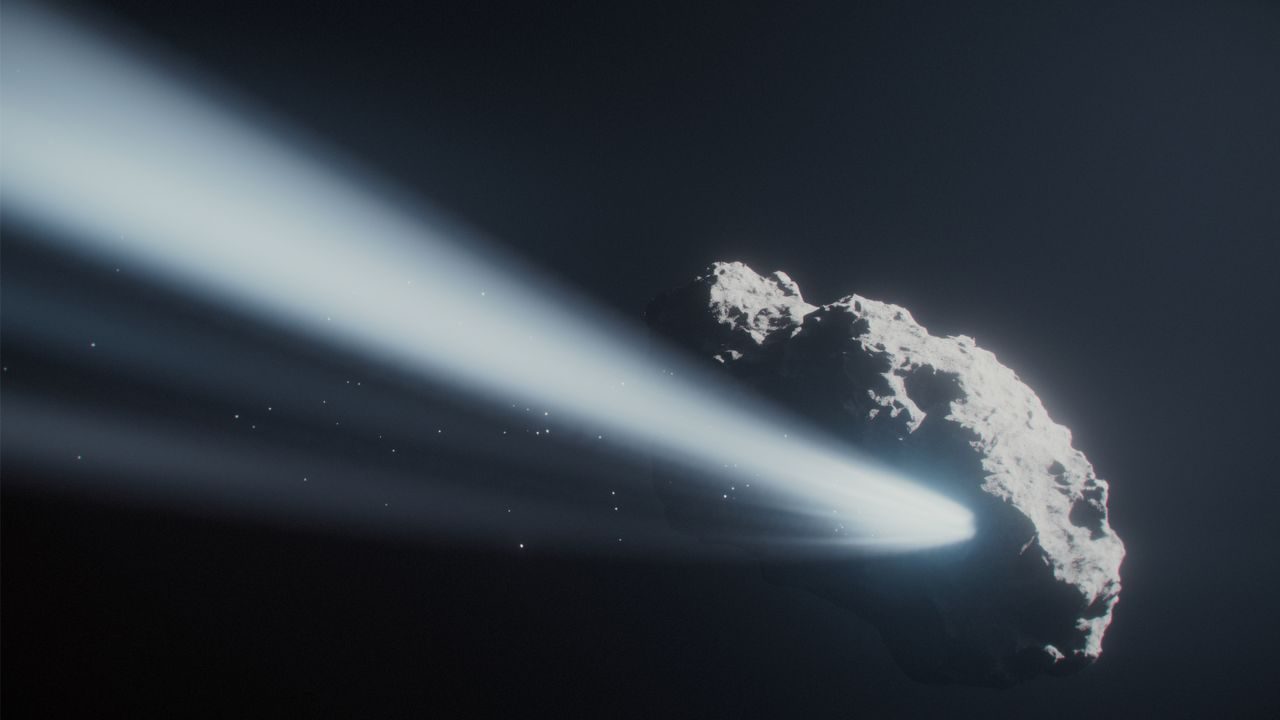
For the first time in recorded astronomical history, a comet has been caught doing something scientists never expected to witness: reversing the direction of its own spin. And the culprit, according to newly analyzed images from the Hubble Space Telescope, appears to be the comet’s own internal activity — powerful jets of gas and ice erupting from its surface like a cosmic engine running out of control.
The discovery, drawn from archival Hubble photos, centers on a close flyby of Earth that took place in 2017. What researchers found buried in that old data has rewritten what we thought we knew about how comets behave — and raised the possibility that this particular icy wanderer may not survive much longer.
It is the kind of find that reminds us how much the universe still has left to surprise us, even when the data has been sitting in an archive for years.
What Hubble Actually Captured
The Hubble Space Telescope has been one of humanity’s most reliable eyes on the cosmos for decades, but this discovery came not from a new observation — it came from going back through old images and looking more carefully at what was already there.

Astronomers analyzing archival Hubble photographs identified something extraordinary: a comet that had measurably changed both the speed and direction of its own rotation during its 2017 approach to Earth. That kind of spin reversal had never been documented in a comet before.
The mechanism behind it appears to be what scientists call outgassing — a process where heat from the Sun causes frozen materials beneath a comet’s surface to vaporize and shoot outward as jets. These jets are not just visually dramatic. They carry enough force to act like tiny thrusters, pushing and pulling on the comet’s body in ways that can alter its movement through space.
In this case, those jets appear to have done something remarkable: they spun the comet in one direction, then effectively reversed it.
Why Outgassing Is More Powerful Than It Sounds
The term “outgassing” might sound gentle, but the reality is anything but. When a comet swings close to the Sun — or, in this case, close to Earth — solar radiation penetrates the icy surface and triggers violent sublimation events beneath it. Frozen gases, water ice, and other volatile compounds transform directly from solid to vapor and burst outward through cracks and vents.
These outgassing jets are the same phenomenon responsible for a comet’s iconic tail — that glowing streak of material that trails behind it across the night sky. But the jets do more than create a light show. They exert real physical force on the comet’s nucleus, and over time — or in a single dramatic close approach — that force can change how the comet moves, tumbles, and rotates.
What makes the 2017 event so significant is the scale and speed of the rotational change. A spin reversal is not a gradual drift. It is a measurable, directional flip — and capturing it in Hubble imagery gives researchers a concrete record of just how dramatically a comet can be reshaped by its own activity.
Key Facts About the Discovery at a Glance
| Detail | What We Know |
|---|---|
| Data source | Archival images from the Hubble Space Telescope |
| Event observed | Comet reversing its spin direction and speed |
| When the flyby occurred | 2017, during a close approach to Earth |
| Cause identified | Outgassing jets of icy material from the comet’s surface |
| Historic significance | First time a comet spin reversal has ever been documented |
| Possible future outcome | The comet may be at risk of self-destruction |
- The spin reversal was confirmed through careful analysis of existing Hubble archival data, not a new dedicated observation.
- The outgassing jets responsible are described as shooting an icy mix of material from the comet’s interior.
- NASA, ESA, and CSA are credited in connection with the imagery and illustration released alongside the findings.
- This marks the first documented case of a comet reversing its rotational direction.
The Self-Destruction Warning Scientists Are Taking Seriously
Perhaps the most striking element of this story is not the spin reversal itself — it is what that reversal might signal about the comet’s future. Researchers have suggested the comet may soon self-destruct.
That is not hyperbole. Comets are not solid, stable objects. They are loosely bound collections of ice, rock, and dust, held together by their own weak gravity and internal cohesion. When outgassing jets become powerful enough to reverse a comet’s spin, they are also stressing the structural integrity of the nucleus itself.
A comet spinning faster and faster — or lurching through directional reversals — can reach a point where centrifugal forces and internal pressures exceed what the body can withstand. The result is fragmentation: the comet splits apart, sometimes spectacularly, scattering debris across its orbital path.
The fact that this comet experienced such a dramatic rotational event during a single close approach suggests its internal activity may be intensifying. Whether it survives future passes near the Sun or Earth remains an open question — but scientists are now watching it with fresh urgency.
What This Means for Comet Science Going Forward
This discovery matters well beyond the fate of one comet. It demonstrates that Hubble’s archival data — images already taken, already stored, already largely forgotten — still contains scientific revelations waiting to be found. Researchers did not need a new telescope or a new mission. They needed time, patience, and a closer look at what already existed.
It also deepens our understanding of how comets evolve. If outgassing jets can reverse a comet’s spin during a single flyby, that changes how scientists model cometary behavior over longer timescales. Predictions about where a comet will be, how fast it will be moving, and how long it will survive all depend on accurate models of rotational dynamics — and those models just became more complicated.
For space agencies tracking near-Earth objects, that complexity has practical implications. A comet whose spin and trajectory can shift unpredictably due to its own outgassing is harder to track with confidence over long periods.
Frequently Asked Questions
What caused the comet to reverse its spin?
The spin reversal is believed to have been triggered by powerful outgassing jets — eruptions of icy material from the comet’s surface — that exerted enough force to change both the speed and direction of its rotation.
When did this event happen?
The comet’s unusual behavior was observed during a close flyby of Earth in 2017, though the discovery was made through later analysis of archival Hubble Space Telescope images.
Has a comet ever been seen reversing its spin before?
No. According to the findings, this is the first time a comet spin reversal has ever been documented.
Could the comet actually self-destruct?
Researchers have raised the possibility that the comet may be at risk of self-destruction, though a confirmed timeline or outcome has not been established in the available source material.
Which telescope captured the images?
The discovery came from archival images taken by the Hubble Space Telescope, which is operated jointly by NASA, ESA, and CSA.
Why does a comet’s spin matter to scientists?
A comet’s rotational behavior affects its trajectory, structural stability, and long-term survival — making accurate spin data essential for tracking near-Earth objects and understanding how comets evolve over time.




Leave a Reply