
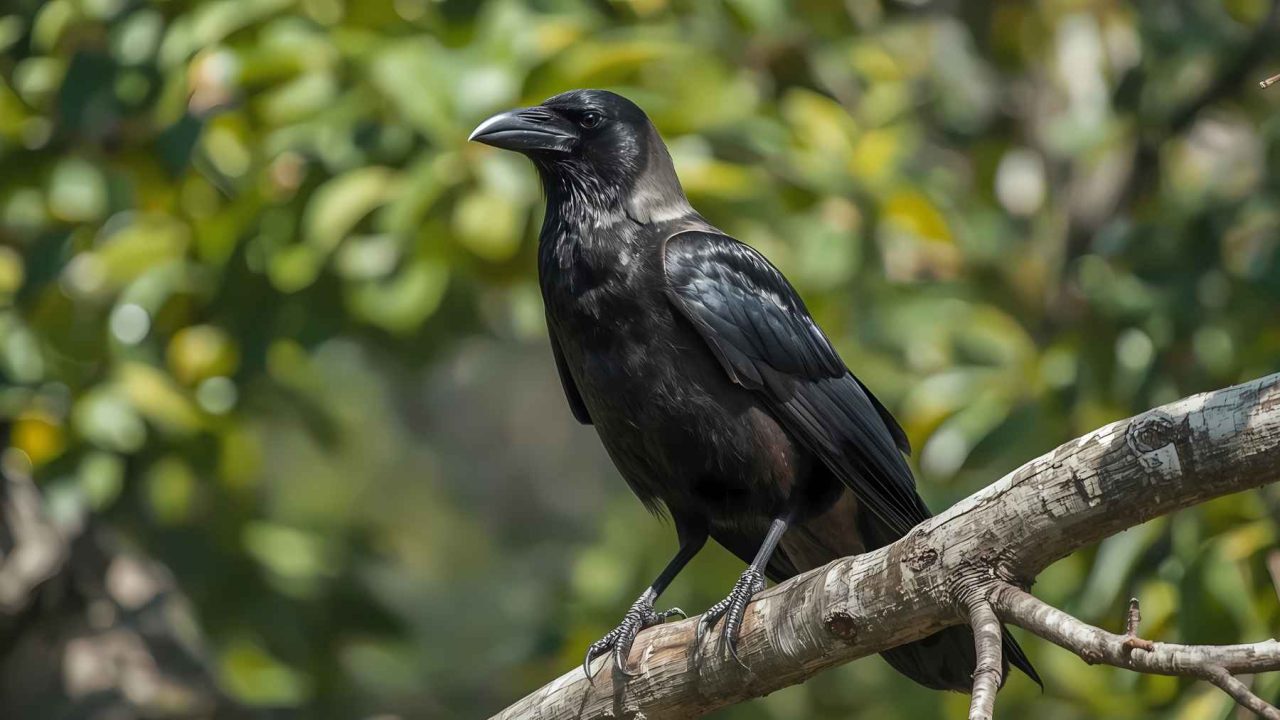
When researchers at the University of Tübingen sat two carrion crows in front of touchscreens and showed them a visual puzzle, they expected to learn something interesting. What they found was far more startling: the birds could solve a geometric reasoning task that scientists had long believed was unique to humans — and they beat monkeys at it.
The study, published in 2025, didn’t just nudge the boundaries of what we know about animal cognition. It shattered a long-standing assumption about geometric intuition — the ability to recognize an odd shape among similar ones based on subtle mathematical differences. Until now, that skill was thought to live exclusively in the human mind.
Two black crows changed that story entirely.
What the Crows Were Actually Asked to Do
The setup sounds simple, but the challenge was anything but. Each crow sat before a touchscreen displaying six shapes at once. Five of the shapes were identical. One was the intruder — slightly different, subtly wrong, the odd one out. The crow’s job was to peck the shape that didn’t belong.
When a crow got it right, a feeder released a reward. A mealworm, typically. Small motivation, enormous implications.
In the early rounds, the differences between shapes were obvious. Think a crescent moon sitting among five identical stars — the kind of contrast any creature with functional vision might notice. But the University of Tübingen team wasn’t interested in easy wins. They gradually made the task harder, replacing simple shapes with warped squares, skewed diamonds, and other quadrilaterals — the kinds of complex geometric forms humans normally encounter in math class, not in nature.
These weren’t shapes a crow would ever see in the wild. There was no evolutionary shortcut, no learned association to fall back on. The birds had to reason through something genuinely novel.
The Numbers That Make This Finding So Remarkable
Here’s where the results get hard to dismiss. In a test where random pecking would produce the correct answer roughly one time in six — about 16.7% of the time — the crows landed on the right shape close to half the time, and sometimes more.
That’s not luck. That’s not a fluke. That’s a pattern of correct reasoning that held up even on the very first encounters with entirely new quadrilateral sets the birds had never seen before.
| Performance Measure | Expected (Random Chance) | Crow Performance |
|---|---|---|
| Correct answer rate (6 shapes shown) | ~16.7% (1 in 6) | Close to 50%, sometimes higher |
| Performance on first encounter with new quadrilaterals | ~16.7% | Significantly above chance |
| Number of crows tested | — | 2 carrion crows |
| Research institution | — | University of Tübingen |
The fact that performance held on first exposure to novel shapes is critical. It rules out simple memorization. The crows weren’t recalling a previously rewarded answer — they were actively identifying geometric difference in real time.
Why Crows Outperforming Monkeys Is the Part That Stops You Cold
Primates — our closest relatives — have long been the benchmark for non-human intelligence. When researchers want to know whether a cognitive ability is uniquely human, monkeys and apes are usually the comparison group. So when crows not only matched but outperformed monkeys on this specific geometric reasoning task, it forced a genuine rethink.
For a long time, researchers suspected that this kind of geometric intuition belonged only to our species. The crow findings don’t just challenge that assumption — they suggest the cognitive tools required for geometric reasoning can emerge in a brain that looks nothing like ours, built on entirely different architecture, in a lineage that split from mammals hundreds of millions of years ago.
Crows belong to the corvid family, a group that has repeatedly surprised scientists with tool use, planning, and social reasoning. But geometric abstraction — the ability to perceive and act on subtle differences in shape and proportion — is a different category of thinking. It’s the kind of reasoning that underlies mathematics, spatial navigation, and visual problem-solving in humans.
The fact that two birds in a German lab demonstrated it, on shapes they had never encountered before, using a brain the size of a walnut, is the kind of result that makes researchers sit back and reconsider their assumptions from the ground up.
What This Means Beyond the Lab
The implications here reach further than crow cognition. If geometric intuition isn’t exclusive to humans — and isn’t even exclusive to primates — then the evolutionary story we’ve been telling about intelligence needs revision.
It raises a genuinely unsettling question: how many other cognitive abilities, currently filed under “uniquely human,” are actually more widely distributed across the animal kingdom than we’ve ever tested for? The answer may be that we’ve been asking the wrong species the right questions, or the right species the wrong questions, for decades.
There’s also a practical dimension. Understanding how a crow’s brain achieves geometric reasoning — through what neural mechanisms, using what visual processing — could inform how we build artificial systems that recognize patterns and classify shapes. Biology has a long history of teaching engineering something useful.
What Researchers Will Be Watching Next
The study involved two carrion crows, which means the scientific community will want to see these results replicated with larger groups before drawing sweeping conclusions. Two subjects is a striking proof of concept, not a definitive population study.
Researchers will likely want to test whether other corvid species show the same ability, how the crows’ performance compares to different primate species under identical conditions, and whether the birds can extend this geometric reasoning to three-dimensional objects or more complex visual environments.
The University of Tübingen findings open a door. Walking through it fully will take years of follow-up work. But the door is open now, and the view on the other side is genuinely surprising.
Frequently Asked Questions
What kind of crows were used in this study?
The study used carrion crows, tested at the University of Tübingen in Germany.
How did the crows interact with the test?
The crows pecked at a touchscreen displaying six shapes — five identical and one different — and received a food reward, such as a mealworm, when they correctly identified the odd shape.
What made the task difficult?
Researchers progressively introduced complex quadrilaterals — warped squares, skewed diamonds, and other shapes that differed only in subtle angles and side lengths — forms the birds would never encounter in nature.
How well did the crows perform compared to random chance?
Random chance would produce a correct answer about one in six times, or roughly 16.7%. The crows chose correctly close to half the time, and sometimes more, even on their first encounter with new shape sets.
Why does it matter that they outperformed monkeys?
Primates are typically used as the benchmark for non-human cognition, so crows surpassing monkeys on a geometric reasoning task challenges the assumption that this ability is either uniquely human or tied to primate brain structure.
When was this study published?
The study was published in 2025, according to the source reporting on the research.



Leave a Reply