
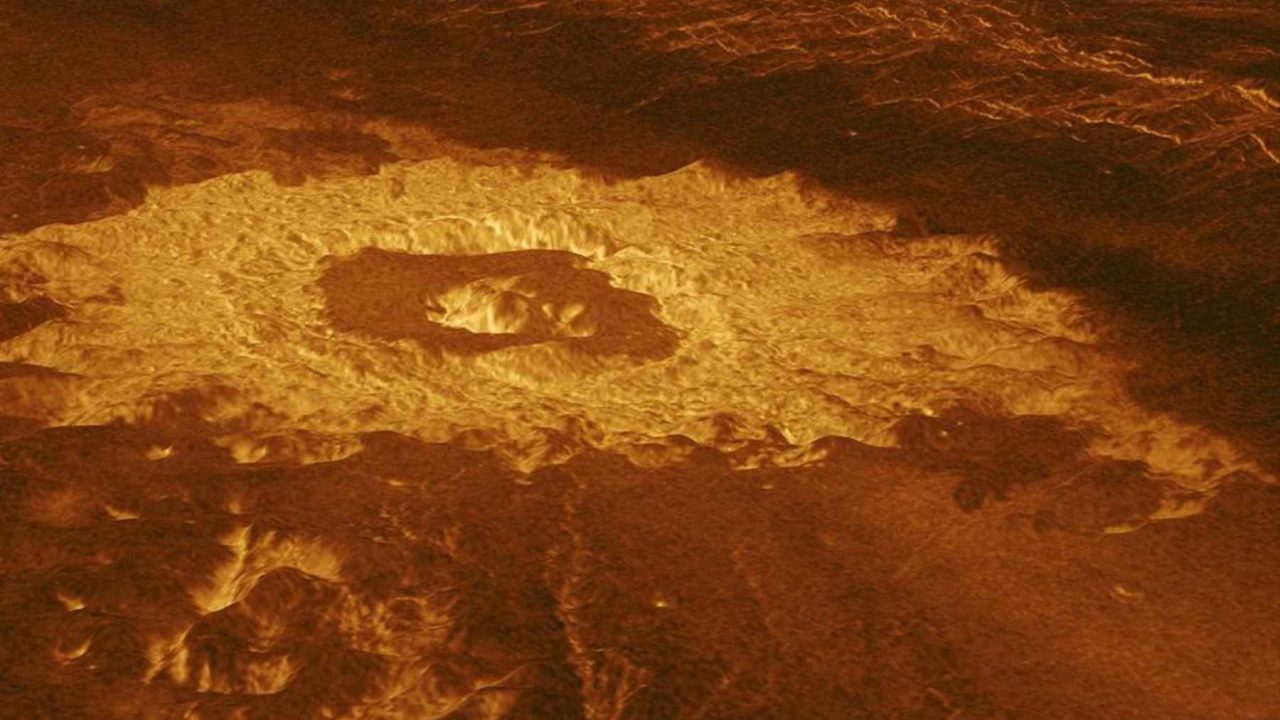
Beneath the scorched surface of Venus, scientists have found something that changes what we thought we knew about Earth’s closest neighbor: a giant underground cave, carved by ancient volcanic fire, confirmed for the first time through radar data collected decades ago.
The discovery comes from a team at the University of Trento, who went back to images captured by NASA’s Magellan mission and found evidence that a massive lava tube exists beneath the flanks of a Venusian volcano. Their findings were published in the journal Nature Communications, and they represent the first direct radar evidence of a subsurface conduit on Venus.
It’s the kind of find that reframes an entire planet — and raises new questions about what Venus might still hold beneath its hostile, cloud-choked exterior.
What Scientists Actually Found Beneath Venus
The structure sits on the western flank of Nyx Mons, a shield volcano stretching roughly 362 kilometers wide. In radar imagery, the area shows a dark pit surrounded by a chain of similar collapsed depressions — a telltale sign of volcanic activity that once moved underground.
The standout feature is what researchers call “pit A.” Most pits on planetary surfaces produce a simple radar return: a steep hole, a dark shadow, nothing unusual. Pit A behaves completely differently.
Its radar echo includes a bright, asymmetric streak that extends well beyond the rim of the pit itself. According to the research team, that pattern matches exactly what happens when radar waves enter a skylight — a collapsed section of a lava tube’s roof — bounce along the length of an underground tunnel, and then scatter back toward the spacecraft’s sensors.
In plain terms: pit A is almost certainly a skylight, an opening into a vast underground passage that once carried flowing molten rock beneath the Venusian surface.
Why a Volcanic Cave on Venus Is Such a Big Deal
Lava tubes are not unique to Venus. They exist on Earth and have been identified on the Moon and Mars. But confirming one on Venus — using radar evidence — is a scientific first, and the implications go beyond simple geology.
On Earth, lava tubes form when the outer shell of a flowing lava stream cools and hardens while molten rock continues moving underneath. When the eruption ends, the inner flow drains away, leaving behind a hollow tunnel that can stretch for kilometers. These structures are remarkably stable and can persist for millions of years.
On Venus, where surface temperatures hover around 465 degrees Celsius and atmospheric pressure is roughly 90 times that of Earth, any cave system would offer a dramatically different environment from the planet’s exposed surface. Researchers have long speculated that such structures could exist there — now, for the first time, there is direct evidence that they do.
The Magellan mission, which mapped Venus using synthetic aperture radar in the early 1990s, collected data that scientists are still mining for new insights. This discovery is a powerful reminder that answers to major questions can sometimes already be sitting in archived data, waiting for the right analytical approach.
Key Facts About the Discovery at a Glance
| Detail | Information |
|---|---|
| Research institution | University of Trento |
| Published in | Nature Communications |
| Data source | NASA’s Magellan mission radar imagery |
| Location on Venus | Western flank of Nyx Mons |
| Nyx Mons diameter | Approximately 362 kilometers |
| Key feature identified | Pit A — likely a lava tube skylight |
| Radar signature | Bright, asymmetric streak beyond pit rim |
| Significance | First direct radar evidence of a subsurface conduit on Venus |
- The pit is part of a chain of similar collapsed depressions on Nyx Mons
- Pit A’s radar return is distinctly different from other nearby pits
- The radar pattern is consistent with waves bouncing through an underground tunnel
- The structure is described as a probable skylight into a lava tube system
What This Means for Our Understanding of Venus
For decades, Venus has been treated as a planetary cautionary tale — a world that could have been Earth-like but spiraled into runaway greenhouse conditions. Most of the scientific focus has been on its toxic atmosphere and crushing surface environment.
This discovery shifts some of that attention underground. If large, stable lava tube systems exist beneath Venus, they represent geological features that have survived billions of years of volcanic activity. Understanding how they formed, and whether they remain structurally intact, could tell scientists a great deal about the planet’s volcanic history and interior dynamics.
The researchers argue that the radar signature at pit A is not ambiguous. The bright, asymmetric echo extending past the rim is the kind of signal that only makes sense if there is a hollow tunnel beneath the surface — one large enough for radar waves to travel through and reflect back in a detectable pattern.
It also raises a broader point about planetary exploration: some of the most significant findings may not require new missions. They may require new eyes on old data.
What Comes Next for Venus Exploration
Several missions to Venus are currently in various stages of planning and development, including NASA’s DAVINCI and VERITAS concepts, as well as ESA’s EnVision mission. The confirmation of subsurface cave structures adds another layer of scientific interest to those efforts.
Future radar instruments — more powerful and precise than Magellan’s — could map these underground features in far greater detail. The question of how extensive Venus’s lava tube network might be, and how deep those structures reach, remains open. This study has confirmed that at least one exists. How many others are waiting to be found is something the next generation of missions may finally be able to answer.
For now, the University of Trento team’s work stands as a landmark result: the first time science has looked beneath the surface of Venus and seen a cave staring back.
Frequently Asked Questions
What is the volcanic cave on Venus and where is it located?
It is a lava tube identified beneath the western flank of Nyx Mons, a shield volcano approximately 362 kilometers wide on Venus.
How did scientists confirm the cave exists?
Researchers from the University of Trento reanalyzed radar images from NASA’s Magellan mission and identified a distinctive bright, asymmetric radar echo at a feature called pit A, consistent with radar waves bouncing through an underground tunnel.
What is a lava tube skylight?
A skylight is a collapsed section of a lava tube’s roof that creates an opening into the underground passage below — which is what pit A appears to be on Nyx Mons.
Is this the first time a subsurface cave has been found on Venus?
Yes. According to the published research, this is the first direct radar evidence of a subsurface conduit on Venus.
Where were the findings published?
The research was published in the journal Nature Communications.
Will future missions explore this cave further?
This has not yet been confirmed, but several Venus missions are in planning stages that could use more advanced radar instruments to study underground structures in greater detail.



Leave a Reply