
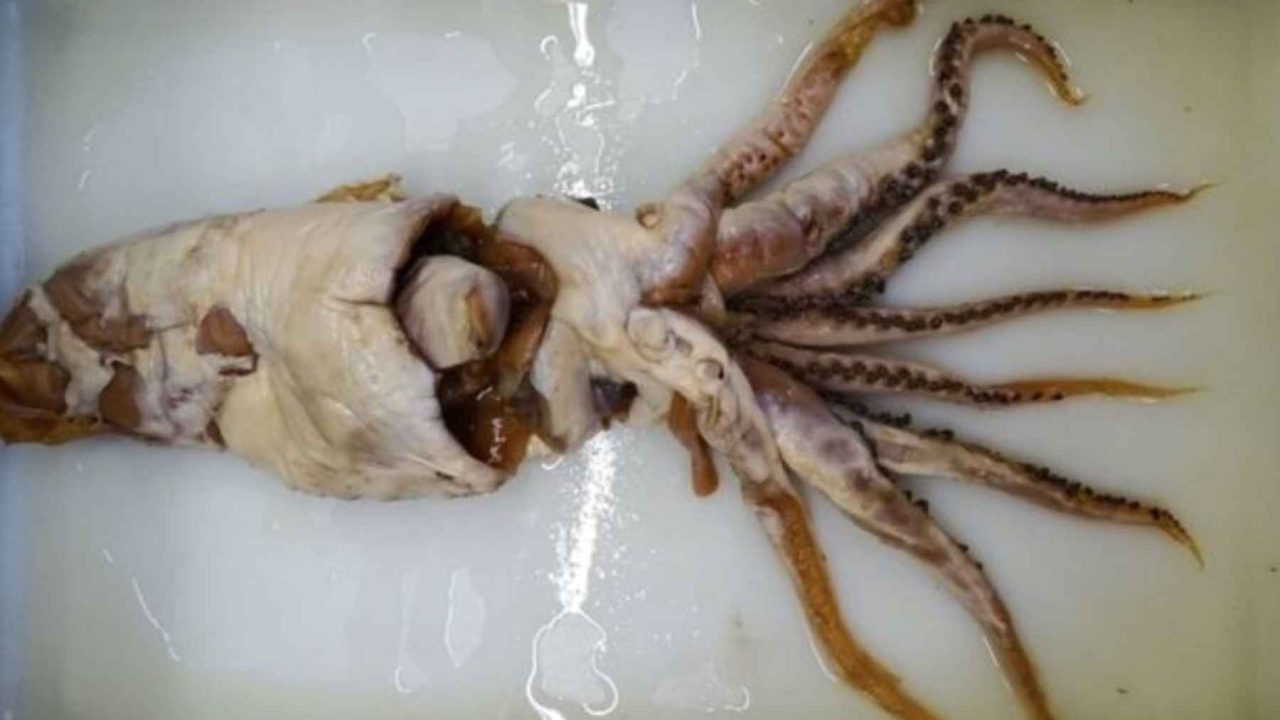
A preserved lump of squid-like tissue, pulled from the stomach of a sperm whale sometime between 1955 and 1956, sat unexamined and mislabeled for decades. Nobody flagged it as extraordinary. It looked like just another piece of cephalopod, catalogued during the era of commercial whaling and then quietly forgotten in a museum jar.
That jar, it turns out, contained something that rewrote part of the squid family tree. The animal inside has now been formally named Mobydickia poseidonii — and it is not just a new species. Scientists determined it was different enough to warrant an entirely new squid family. It earned a spot on the World Register of Marine Species “Top Ten Remarkable Marine Species of 2025” list, released on March 19, 2026.
It is one of the more unusual origin stories in modern marine biology: a major discovery that began not with cutting-edge sonar or remotely operated vehicles, but with a whale’s digestive system and a storage shelf.
How a Sperm Whale’s Stomach Became a Scientific Archive
Sperm whales are voracious hunters of deep-sea squid, and for much of the twentieth century, commercial whaling operations gave scientists an unexpected window into the deep ocean. When whalers brought animals to the surface, researchers could examine stomach contents — material that would otherwise be impossible to collect from the crushing depths where sperm whales hunt.
The specimens that would eventually become Mobydickia poseidonii were collected during this period, between 1955 and 1956. At the time, the squid-like mass was not recognized as anything out of the ordinary. It was preserved and stored, where it remained — overlooked, mislabeled, easy to pass over — for years that stretched into decades.
The reexamination that changed everything was led by Sam Arnold and Fernando Ángel Fernández-Álvarez at the Institute of Marine Sciences of Spain’s National Research Council, based in Barcelona. Their team works with preserved marine specimens, and it was this painstaking archival work — not a new expedition — that cracked open the discovery.
What Makes Mobydickia poseidonii So Unusual
New species are described regularly. The World Register of Marine Species logged almost 2,600 newly described marine species in the same year this discovery was recognized. Most of those additions slot neatly into existing families, filling gaps in known groups.
Mobydickia poseidonii did not fit anywhere neatly. The researchers determined it was distinct enough to establish an entirely new squid family — a far rarer outcome than a standard species description. That distinction is what pushed it onto the “Top Ten Remarkable Marine Species of 2025” list alongside the year’s other standout finds.
The name itself carries meaning. Mobydickia is a clear nod to Herman Melville’s white whale, the cultural symbol most associated with sperm whales and the deep ocean. Poseidonii references the Greek god of the sea. For a creature recovered from inside one of the ocean’s most powerful predators, the naming feels deliberate and fitting.
Key Facts at a Glance
| Detail | Information |
|---|---|
| Species name | Mobydickia poseidonii |
| Original specimens collected | 1955–1956 |
| Source of specimens | Sperm whale stomach contents |
| Research institution | Institute of Marine Sciences, Spain’s National Research Council, Barcelona |
| Lead researchers | Sam Arnold and Fernando Ángel Fernández-Álvarez |
| Classification significance | New species and new squid family |
| Recognition | World Register of Marine Species Top Ten Remarkable Marine Species of 2025 |
| List release date | March 19, 2026 |
| Total new marine species logged that year | Nearly 2,600 |
Why Museum Collections Still Matter More Than Most People Realize
This discovery is a reminder of something the scientific community has argued for years: natural history collections are not static archives. They are living research tools. Specimens preserved a century ago — or, in this case, seventy years ago — can yield answers to questions that did not even exist when the material was first collected.
Modern analytical techniques, improved taxonomy, and fresh scientific eyes can transform a mislabeled jar into a landmark finding. The Barcelona team did not need a new expedition or new technology to make this discovery. They needed the original specimen, the expertise to recognize what they were looking at, and the willingness to question an old assumption.
For marine science, where the deep ocean remains one of the least explored environments on the planet, this approach carries real weight. Not every answer is waiting at the bottom of the sea. Some of them are already in storage, waiting for someone to look again.
What Comes Next for This Discovery
The formal recognition of Mobydickia poseidonii on the World Register of Marine Species list brings wider scientific attention to the find. Researchers will now have the opportunity to search existing collections around the world for additional specimens that may have been similarly misidentified or overlooked.
Whether living populations of this squid can be studied directly remains an open question. Given that the original material came from deep-sea hunting by sperm whales, locating and observing this animal in its natural habitat would be a significant challenge — and a significant next step for the scientists involved.
For now, a jar that sat quietly on a shelf for the better part of seventy years has changed how scientists classify a branch of the squid family tree. That is not a minor footnote. It is the kind of result that reminds researchers — and the rest of us — that the ocean still holds surprises, and sometimes those surprises have already been collected. We just haven’t looked closely enough.
Frequently Asked Questions
What is Mobydickia poseidonii?
It is a newly named squid species — and a new squid family — identified from preserved specimens that were originally collected from sperm whale stomachs in 1955 and 1956.
Who discovered and named the species?
The reexamination was led by researchers Sam Arnold and Fernando Ángel Fernández-Álvarez at the Institute of Marine Sciences of Spain’s National Research Council in Barcelona.
Why did it take so long to identify?
The specimens were preserved and stored after collection but remained mislabeled and overlooked for decades before researchers took a closer look at the material.
What makes this discovery more significant than a typical new species?
Beyond being a new species, Mobydickia poseidonii was found to be different enough to establish an entirely new squid family, which is considerably rarer than a standard species description.
Was the species recognized by any official scientific body?
Yes. It was included on the World Register of Marine Species “Top Ten Remarkable Marine Species of 2025” list, which was released on March 19, 2026.
How many new marine species were described in the same period?
The World Register of Marine Species logged nearly 2,600 newly described marine species in the same year this discovery was formally recognized.




Leave a Reply