
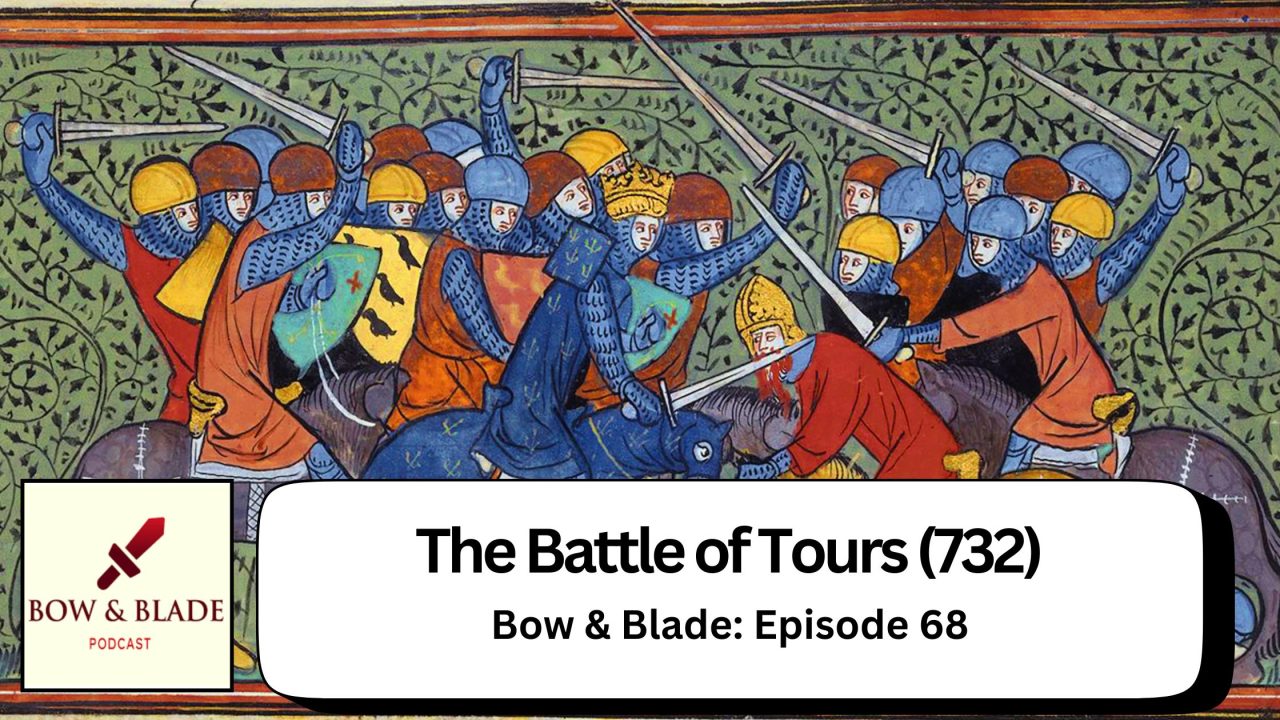
Few battles in medieval history carry as much weight — or as much mystery — as the Battle of Tours in 732. Widely considered one of the most consequential military engagements of the Middle Ages, it is a conflict that historians have debated for centuries, yet the basic facts of where it happened and exactly what unfolded there remain stubbornly unclear.
That tension between historical importance and historical uncertainty is precisely what makes Tours so fascinating. Here is a battle that some scholars argue helped shape the course of Western civilization, and yet the surviving evidence is thin enough that researchers still cannot pin down the battlefield’s precise location.
The podcast Bow & Blade, produced through Medievalists.net, recently turned its attention to this very question — examining the limited historical record to explore what can reasonably be known about the battle and what likely occurred there.
Why the Battle of Tours Still Matters After 1,300 Years
The Battle of Tours took place in 732, during a period when Umayyad forces from the Iberian Peninsula were pushing northward into Frankish territory. The Frankish leader Charles Martel met these forces somewhere between the cities of Tours and Poitiers in what is now central France, and the resulting confrontation has been cited ever since as a turning point in European history.
The battle is often framed as the moment that halted the northward advance of Islamic military expansion into Western Europe. Whether that framing holds up to serious scrutiny is itself a subject of ongoing scholarly debate — but there is no question that contemporaries and later historians alike regarded the outcome as significant.
Charles Martel’s forces emerged victorious, and the Umayyad advance did not continue further into Frankish territory. What remains genuinely uncertain is the scale of the engagement, the precise tactics used, and even the exact location where the fighting took place.
What the Historical Record Actually Tells Us
This is where the story gets complicated. The Bow & Blade hosts — medievalists Kelly DeVries and Michael Livingston — emphasize that the evidence surrounding the Battle of Tours is limited. The sources that survive from the period are fragmentary, and later accounts have a tendency to embellish or interpret events through the lens of their own political or religious contexts.
DeVries is a Professor Emeritus at Loyola University in Maryland and serves as Honorary Historical Consultant at the Royal Armouries. Livingston teaches at The Citadel and has authored numerous books on medieval history. Together, they bring serious academic weight to the task of separating what the sources actually say from what tradition has added over the centuries.
Their approach on the episode is straightforward: work with what the limited evidence allows, acknowledge what cannot be confirmed, and resist the temptation to fill gaps with assumption.
The Problem of the Battlefield Location
One of the most striking details about the Battle of Tours is that historians are not entirely certain where it was fought. The name itself suggests Tours, but the engagement is also commonly referred to as the Battle of Poitiers — reflecting the fact that the fighting likely occurred somewhere in the corridor between these two cities.
Pinpointing a medieval battlefield is notoriously difficult. Without extensive archaeological evidence or highly detailed contemporary accounts, researchers must work from textual clues that are often vague, translated across languages, and copied by scribes who may have introduced errors or interpretations of their own.
The uncertainty around Tours is not unusual for battles of this era, but it is particularly notable given how much historical significance has been attached to the engagement. The gap between the battle’s legendary status and the thinness of the actual record is one of the central tensions the Bow & Blade episode explores.
Key Facts About the Battle of Tours at a Glance
| Detail | What Is Known |
|---|---|
| Date | 732 AD |
| Location | Somewhere between Tours and Poitiers, France — exact site uncertain |
| Also known as | Battle of Poitiers |
| Frankish commander | Charles Martel |
| Historical significance | Widely cited as halting Umayyad northward expansion into Western Europe |
| State of the evidence | Limited — sources are fragmentary and often contradictory |
Why Honest Uncertainty Is the Most Valuable Thing a Historian Can Offer
There is a temptation, when dealing with a battle as famous as Tours, to paper over the gaps. Popular history often does exactly that — presenting confident narratives about troop numbers, tactical decisions, and decisive moments that the sources simply do not support.
What DeVries and Livingston model in their Bow & Blade discussion is something more rigorous and, ultimately, more useful: a willingness to say “we don’t know” when the evidence runs out. That intellectual honesty is what separates serious medieval scholarship from myth-making.
The Battle of Tours has accumulated centuries of interpretation, nationalist meaning, and religious symbolism. Stripping that back to examine what the primary sources actually allow is harder than it sounds — and more important than it might seem.
For anyone interested in medieval military history, the episode serves as a reminder that the most famous battles are not always the best-documented ones, and that uncertainty is not a failure of history but an honest reflection of what survives.
Frequently Asked Questions
When did the Battle of Tours take place?
The Battle of Tours was fought in 732 AD.
Where exactly was the Battle of Tours fought?
The precise location is uncertain. Historians believe it took place somewhere between the cities of Tours and Poitiers in what is now central France, which is why it is also referred to as the Battle of Poitiers.
Who were the hosts discussing the Battle of Tours on Bow & Blade?
The episode featured Kelly DeVries, Professor Emeritus at Loyola University in Maryland and Honorary Historical Consultant at the Royal Armouries, and Michael Livingston, who teaches at The Citadel and has written numerous books on medieval history.
Why is so little known about the Battle of Tours?
The surviving historical sources from the period are limited and fragmentary, making it difficult to confirm specific details about the battle’s location, scale, or tactics.
Why is the Battle of Tours considered historically significant?
It is widely cited as the engagement that halted the northward advance of Umayyad forces into Western Europe, though scholars continue to debate the full scope of its historical impact.
Is the Battle of Tours the same as the Battle of Poitiers?
Yes — the two names refer to the same 732 engagement, reflecting the fact that the battle likely took place in the corridor between Tours and Poitiers rather than at either city specifically.



Leave a Reply