
A spacecraft launched nearly five decades ago, now traveling almost 25 billion kilometers from Earth, is still sending signals home — and this time, it wasn’t a massive government antenna that picked up the call. A team of amateur astronomers managed to detect the faint carrier signal from Voyager 1, confirming that humanity’s most distant creation is still alive and transmitting from interstellar space.
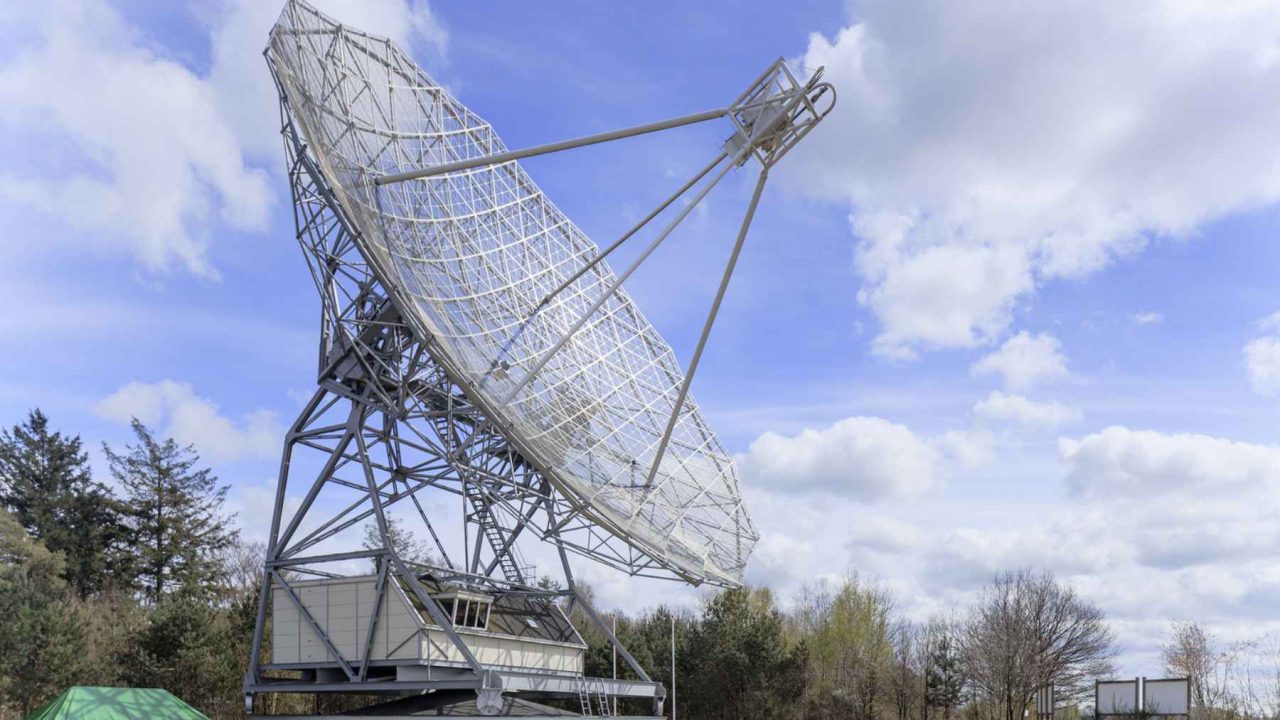
That alone is remarkable. What makes it even more striking is the tool they used to do it: a vintage radio telescope built in 1956, operated today by a volunteer-run foundation in the Netherlands.
For decades, deep space communication was the exclusive domain of NASA’s Deep Space Network — enormous, purpose-built antennas capable of pulling whispers from billions of kilometers away. This achievement suggests the gap between professional and amateur capabilities in space science may be narrowing in unexpected ways.
The Telescope That Should Not Have Been Able to Do This
The Dwingeloo Radio Telescope was constructed in 1956 in the Netherlands. Today it is operated by a volunteer organization called Stichting Radiotelescoop Dwingeloo, more commonly known by its acronym CAMRAS. It is a piece of living scientific history — and, on paper, not the ideal instrument for this kind of work.
Voyager 1 transmits its engineering signal at 8.4 GHz, a frequency that poses real challenges for an aging metal mesh dish. At higher frequencies like this, the surface of a dish reflects radio waves less efficiently. Every small imperfection in the structure, every slight warp or irregularity in the mesh, eats into a signal that is already vanishingly faint after traveling nearly 25 billion kilometers.
The fact that the Dwingeloo team pulled it off anyway speaks to both the determination of the volunteers involved and the extraordinary sensitivity required to even attempt it. This was not a casual weekend project. It required pushing the telescope to the very edge of what its aging hardware could physically manage.
Why Voyager 1’s Signal Is So Hard to Hear
Voyager 1 holds a record that no other human-made object can claim: it is the farthest spacecraft ever launched, and the only one to have crossed into true interstellar space — the region beyond the Sun’s protective bubble of charged particles.
The distance involved is almost impossible to picture in practical terms. At roughly 25 billion kilometers away, a signal traveling at the speed of light still takes well over 20 hours to make a one-way trip. By the time that signal reaches Earth, it has spread across an enormous area of space, and the portion that actually lands on any single antenna is a tiny fraction of what was originally sent.
NASA’s Deep Space Network handles Voyager communications using massive dish antennas specifically engineered for this purpose. The Dwingeloo telescope was never designed for this. Its original purpose involved lower radio frequencies, and the 8.4 GHz band Voyager uses is significantly more demanding for a structure of its age and design.
| Detail | Fact |
|---|---|
| Distance of Voyager 1 from Earth | ~25 billion kilometers |
| Voyager 1 transmission frequency | 8.4 GHz |
| Dwingeloo telescope construction year | 1956 |
| Operating organization | CAMRAS (Stichting Radiotelescoop Dwingeloo) |
| Standard agency handling deep space comms | NASA’s Deep Space Network |
What This Achievement Actually Means
There is something quietly profound about a volunteer-run telescope from the 1950s picking up a signal from the edge of the solar system. It is not just a technical curiosity — it is a demonstration that citizen science, when organized and committed, can reach into territory that once belonged only to government space agencies.
The detection confirms that Voyager 1 is still operational and still transmitting. That matters because the spacecraft has experienced technical difficulties in recent years, and each confirmation of its continued function is a small victory for the mission teams and space enthusiasts who have followed its journey for decades.
It also demonstrates that the Dwingeloo telescope — despite its age and its original design limitations — retains real scientific value. Volunteer-run observatories around the world often struggle for relevance as professional facilities grow more powerful. This detection is a reminder that older instruments, in the right hands, can still contribute something meaningful.
Amateur Astronomy’s Growing Role in Deep Space Monitoring
The Dwingeloo achievement fits into a broader pattern of amateur and community-based astronomy pushing into areas once considered out of reach. Advances in signal processing, computing power, and collaborative networks have lowered the barriers to serious radio astronomy work significantly over the past two decades.
CAMRAS has built a reputation for tackling ambitious projects with limited resources. The organization’s willingness to attempt something as technically demanding as receiving a Voyager 1 signal — and to succeed — reflects both the quality of the people involved and the enduring scientific value of the Dwingeloo dish itself.
For anyone who has ever looked up at the night sky and wondered what lies beyond the edges of our solar system, this story offers a specific, tangible answer: a spacecraft the size of a small car, launched in 1977, is still out there — and a team of dedicated volunteers just proved it.
Frequently Asked Questions
What is Voyager 1 and where is it now?
Voyager 1 is a NASA spacecraft launched in 1977. It is currently traveling in interstellar space at approximately 25 billion kilometers from Earth, making it the most distant human-made object ever.
What signal did the amateur astronomers detect?
The team detected Voyager 1’s engineering carrier signal, which it transmits at a frequency of 8.4 GHz, confirming the spacecraft is still operational and transmitting.
What is the Dwingeloo Radio Telescope?
The Dwingeloo Radio Telescope is a historic dish built in 1956 in the Netherlands. It is currently operated by a volunteer organization known as CAMRAS, or Stichting Radiotelescoop Dwingeloo.
Why is detecting Voyager 1’s signal so difficult?
After traveling nearly 25 billion kilometers, the signal is extraordinarily faint. The 8.4 GHz frequency Voyager uses is also particularly challenging for older dish antennas, which reflect that band less efficiently than purpose-built modern instruments.
Does NASA’s Deep Space Network still communicate with Voyager 1?
Yes. NASA’s Deep Space Network remains the primary means of communicating with Voyager 1. The Dwingeloo detection was a separate, independent achievement by amateur astronomers rather than a replacement for official communications.
Has anything like this been done before?



Leave a Reply