
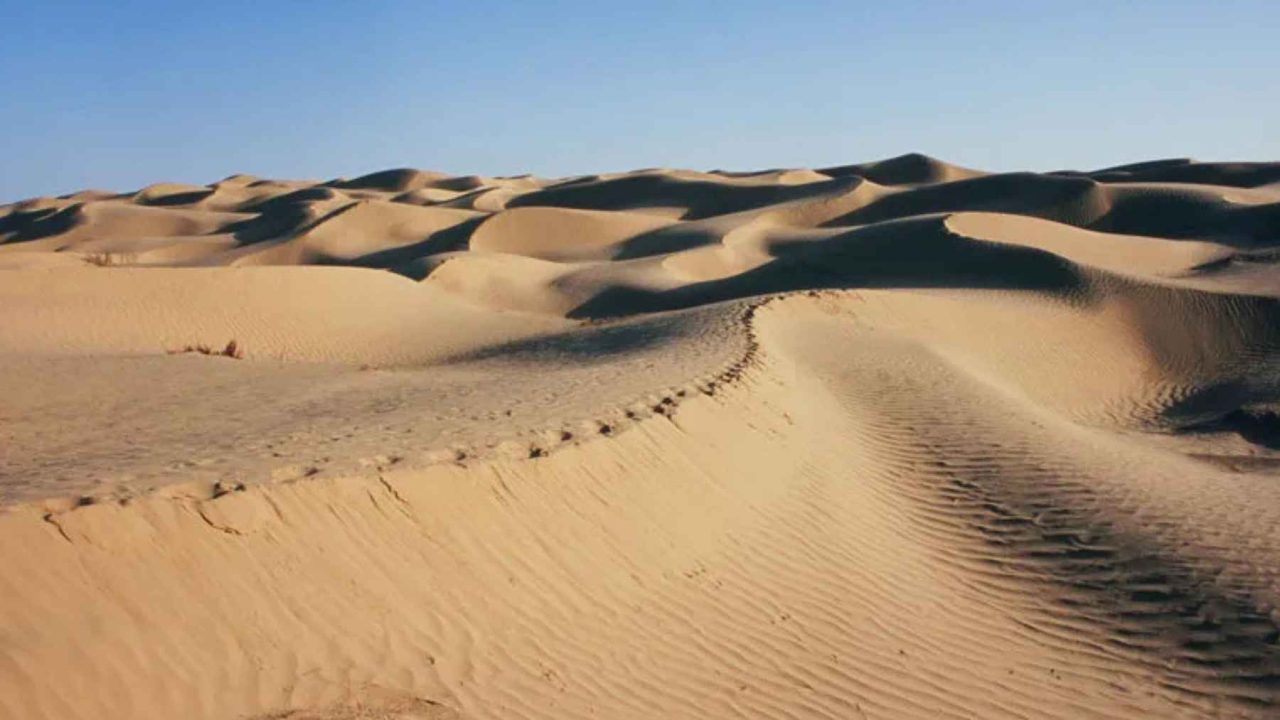
A desert once known as the “Sea of Death” is starting to breathe — and new research suggests it may actually be helping the planet breathe a little easier too. Along the edges of the Taklamakan Desert in northwest China, decades of large-scale tree and shrub planting have quietly transformed what was once considered a biological wasteland into a functioning carbon sink.
The numbers behind this shift are striking. Since 1978, China has planted approximately 66 billion trees as part of its long-running ecological engineering programs. The results, confirmed through a combination of 25 years of satellite records, ground measurements, and global carbon cycle models, show that the outer rim of this vast desert has flipped from releasing carbon dioxide to absorbing more than it emits.
For a desert covering roughly 337,000 square kilometers — an area nearly the size of Poland — that is a remarkable turnaround.
The Desert That Scientists Once Called a Biological Void
The Taklamakan sits in northwest China, covering about 130,000 square miles of shifting sand dunes. Surrounded by tall mountain ranges that block moist air from reaching its interior, it earned a reputation as one of the most inhospitable places on Earth — a landscape so barren it was described by researchers as a “biological void” with almost no vegetation capable of surviving its conditions.
The nickname “Sea of Death” was not poetic exaggeration. For centuries, the desert’s combination of extreme aridity, scorching temperatures, and relentless sandstorms made sustained plant life at its core essentially impossible.
But the story at its edges has changed dramatically. China’s afforestation campaigns, which began in earnest in 1978, have steadily pushed a green ring around the desert’s perimeter. Researchers studying the transformation describe the result as a “lung in the sand” — a living border that now processes carbon dioxide rather than simply baking under the sun.
What the Research Actually Found
The findings draw on a rich dataset: a quarter century of satellite imagery tracking vegetation changes, surface-level measurements, and modeling of carbon flows. Together, they build a clear picture of what large-scale ecological intervention can accomplish over decades.
Several specific outcomes stood out:
- Vegetation cover around the desert’s edges has measurably increased.
- Rainfall during the wet season has multiplied by 2.5 times in affected areas.
- Local CO2 concentrations have dropped from 416 parts per million to 413 parts per million.
- The desert’s outer rim has shifted from a net carbon source to a net carbon sink.
- The transformation is directly tied to the large-scale tree and shrub planting programs rather than natural variation alone.
A three-part drop in local CO2 levels may sound modest in isolation, but it represents a measurable atmospheric shift driven by human planting activity in one of the world’s harshest environments. That is not a small thing.
Key Facts at a Glance
| Metric | Detail |
|---|---|
| Desert size | ~337,000 km² (approximately the size of Poland) |
| Trees planted since 1978 | ~66 billion |
| Wet season rainfall change | Multiplied by 2.5 times |
| Local CO2 before intervention | 416 ppm |
| Local CO2 after intervention | 413 ppm |
| Research data span | 25 years of satellite and ground records |
| Carbon status change | Outer rim shifted from carbon source to carbon sink |
Why This Matters Beyond China’s Borders
The Taklamakan project is not just a regional environmental story. It sits inside a much larger global conversation about whether large-scale tree planting can meaningfully combat climate change — a debate that has grown louder as carbon emissions continue to climb worldwide.
What makes this case particularly significant is the evidence base behind it. The claim is not based on projections or models alone. Researchers combined satellite data, physical measurements, and carbon cycle analysis over 25 years to reach their conclusions. That kind of longitudinal, multi-method verification is exactly what critics of afforestation programs often say is missing from bolder claims about tree planting’s climate benefits.
The rainfall increase is arguably just as important as the carbon data. When vegetation takes hold in arid regions, it can alter local weather patterns — creating a feedback loop where more plants lead to more moisture, which supports more plant growth. A 2.5-times increase in wet-season rainfall suggests that loop may already be operating around the Taklamakan’s edges.
Supporters of large-scale ecological restoration point to results like these as evidence that ambitious, long-term intervention in degraded landscapes can produce real, measurable environmental benefits — not just on paper, but in the atmosphere itself.
What Comes Next for the World’s Largest Desert Greening Project
China’s afforestation efforts, sometimes grouped under initiatives like the “Three-North Shelter Forest Program,” have been running for nearly five decades. The Taklamakan work represents one of the most extreme test cases — planting in and around one of the driest places on the planet.
The research does not suggest the desert’s interior will ever become green. The shifting sand dunes at the Taklamakan’s core remain as hostile as ever. But the evidence now confirms that the desert’s perimeter is functioning differently than it did before human intervention began.
Whether other countries facing desertification — across Africa, Central Asia, and the Middle East — can draw practical lessons from China’s experience remains an open question. The scale of China’s program, both in resources and in political will sustained over decades, is difficult to replicate quickly. But the underlying science now offers something concrete: proof that a place once called a biological void can, with enough time and enough trees, start to act like a lung.
Frequently Asked Questions
What is the Taklamakan Desert?
The Taklamakan is a vast desert in northwest China covering approximately 337,000 square kilometers — roughly the size of Poland — and is one of the most arid places on Earth, historically described as a “biological void.”
How many trees has China planted in and around the desert?
According to the research, China has planted approximately 66 billion trees since 1978 as part of its large-scale ecological engineering programs.
How much has rainfall changed?
Rainfall during the wet season has multiplied by 2.5 times in areas affected by the greening effort, according to the study’s findings.
Has the CO2 reduction been significant?
Local CO2 levels dropped from 416 parts per million to 413 parts per million — a modest but measurable shift directly linked to the planting programs.
How was the research conducted?
The study combined 25 years of satellite records, ground-level measurements, and global carbon cycle models to track and verify the environmental changes at the desert’s edges.
Does this mean the desert itself is disappearing?
No — the desert’s interior remains largely unchanged. The transformation described in the research applies to the outer rim of the Taklamakan, which has shifted from a carbon source to a carbon sink due to vegetation growth.



Leave a Reply