
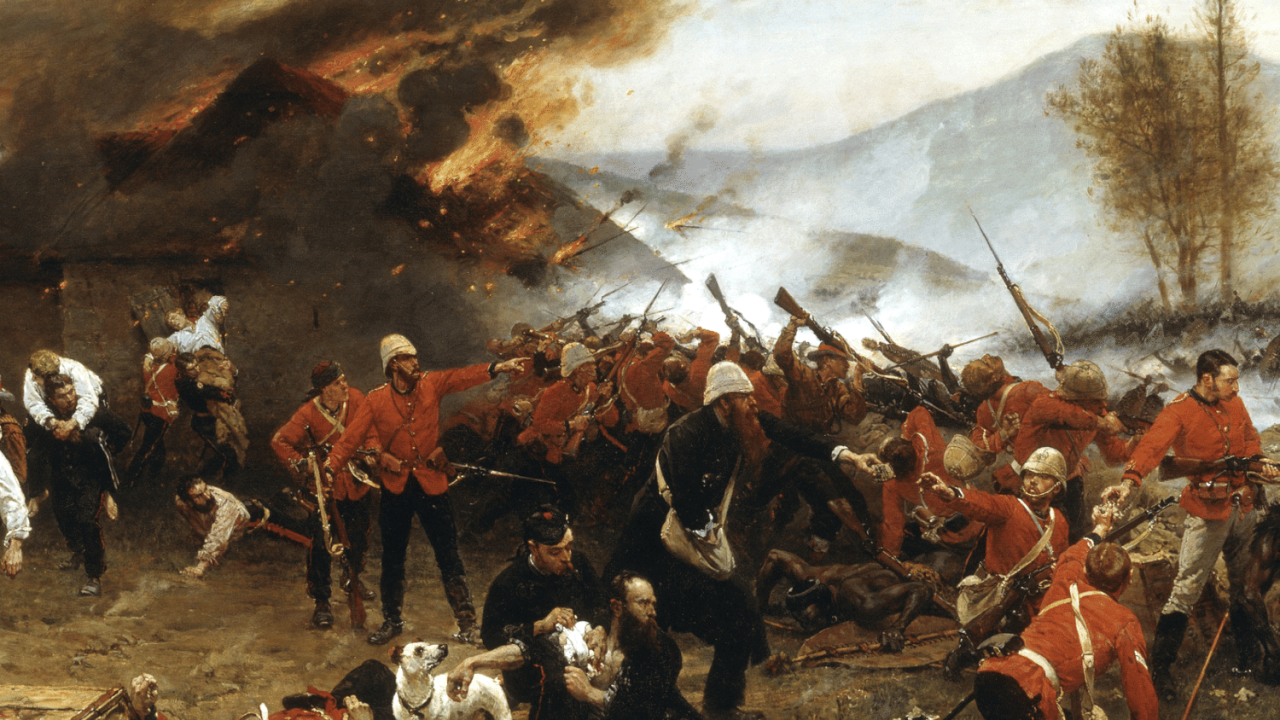
Lieutenant Gonville Bromhead wiped sweat from his brow as he watched the horizon shimmer in the scorching South African sun. It was January 22, 1879, and something felt terribly wrong. The usual sounds of the nearby Zulu settlements had gone eerily quiet, replaced by an unsettling silence that made his stomach churn.
“Sir, there’s movement on the hills,” called out a nervous voice from the ramparts of Rorke’s Drift mission station.
What happened next would become one of the most extraordinary displays of courage and determination in military history. In just 12 hours, 140 British soldiers would face an overwhelming force of 4,000 Zulu warriors in a battle that defied every reasonable expectation of survival.
When the Impossible Became Reality
The Battle of Rorke’s Drift wasn’t supposed to happen. This small mission station, serving as a supply depot and hospital, was meant to be a quiet backwater during the Anglo-Zulu War. But when news arrived that the main British force had been catastrophically defeated at Isandlwana, everything changed in an instant.
The Zulu impi (warrior regiment) that had helped crush the British at Isandlwana was now heading straight for Rorke’s Drift. These weren’t just any warriors – they were battle-hardened veterans riding high on their stunning victory, eager to continue their momentum against the British invaders.
The men knew they were facing impossible odds, but there was nowhere to run. They had wounded soldiers to protect and a mission to defend.
— Military historian Dr. James Patterson
Lieutenant John Chard of the Royal Engineers quickly took command alongside Bromhead. With barely 140 able-bodied men, including patients from the hospital who could still fight, they faced a terrifying reality: thousands of Zulu warriors were approaching, and retreat wasn’t an option.
The Defense That Shouldn’t Have Worked
What made this defense so remarkable wasn’t just the numbers – it was how quickly these men transformed a simple mission station into an impregnable fortress. Using mealie bags (corn sacks), biscuit boxes, and anything else they could find, they built defensive walls in a matter of hours.
The battle began around 4:30 PM and raged until dawn the next day. Here’s how the impossible defense unfolded:
| Time | Key Events | Critical Moments |
|---|---|---|
| 4:30 PM | First Zulu attack begins | Hospital comes under heavy assault |
| 6:00 PM | Hospital evacuated and set ablaze | Defenders retreat to inner perimeter |
| 8:00 PM | Multiple coordinated attacks | Hand-to-hand combat at the walls |
| 2:00 AM | Final major assault | Ammunition running critically low |
| 4:00 AM | Zulu forces begin withdrawing | British maintain defensive positions |
| 7:00 AM | Relief column arrives | 140 defenders still holding the station |
The Zulu warriors attacked with incredible bravery, charging directly into rifle fire and climbing over the makeshift barricades. Some battles are won by superior tactics or technology, but Rorke’s Drift was won by pure determination and desperate courage on both sides.
These weren’t professional soldiers cowering behind walls. Many were sick men who crawled from their hospital beds to fight. Some had never seen combat before that day.
— Colonel Michael Thompson, Military Academy
Heroes Forged in Fire
Individual acts of heroism emerged throughout the night that seem almost too incredible to believe. Private Henry Hook, initially assigned as a hospital orderly, single-handedly helped evacuate patients while the building burned around him. He used a pickaxe to smash through walls, creating escape routes as Zulu warriors poured through the front entrance.
Corporal William Allen and Private Frederick Hitch maintained ammunition supplies throughout the battle despite being wounded. They crawled through gunfire to distribute cartridges to defenders whose positions were running dangerously low.
The most remarkable aspect wasn’t just individual courage – it was how these men worked together. When sections of the perimeter were overrun, they fell back in good order. When ammunition ran low in one area, they redistributed supplies. When the hospital became indefensible, they evacuated the patients without abandoning anyone.
Why This Battle Changed Everything
The successful defense of Rorke’s Drift had consequences far beyond that single night. After the devastating defeat at Isandlwana, British morale was shattered. The news that a tiny garrison had held off thousands of Zulu warriors provided a crucial psychological victory.
Eleven Victoria Crosses were awarded for the action – the most ever given for a single engagement. This wasn’t just about recognizing bravery; it was about sending a message that British forces could still achieve the impossible against overwhelming odds.
The Zulu warriors showed incredible respect for the defenders afterward. They recognized courage when they saw it, regardless of which side it came from.
— Dr. Sarah Mitchell, African Military History
But the battle also highlighted the brutal reality of colonial warfare. The Zulu forces were fighting to defend their homeland against foreign invasion. Their tactical skill and fearless attacks demonstrated why they had become such a formidable military power in southern Africa.
The casualties tell the story of just how fierce this fight became:
- British losses: 17 killed, 15 wounded
- Estimated Zulu losses: 350-500 killed, many more wounded
- Duration: Nearly 12 hours of continuous combat
- Ammunition expended: Over 20,000 rounds
Modern military analysts still study Rorke’s Drift as an example of how small, well-disciplined forces can defeat much larger armies through superior defensive positioning and coordinated fire. The battle demonstrated that courage, preparation, and teamwork could overcome seemingly impossible odds.
What happened at Rorke’s Drift wasn’t just about superior weapons. The Zulus had proven at Isandlwana they could defeat British forces. This was about men who simply refused to give up.
— General Robert Hayes, Defense Studies Institute
The story of Rorke’s Drift continues to inspire military units around the world. It represents the idea that ordinary people can achieve extraordinary things when they stand together against overwhelming challenges. Whether you view it as a tale of imperial warfare or simply human courage under extreme pressure, the basic lesson remains the same: sometimes the impossible becomes possible when people refuse to surrender.
FAQs
Why didn’t the British retreat when they saw how outnumbered they were?
They had wounded soldiers in the hospital who couldn’t be moved, and retreat across open ground would have meant certain death for everyone.
How did such a small force hold off 4,000 warriors?
They used superior firepower, defensive positions, and coordinated tactics, while the Zulu forces had to attack across open ground against entrenched defenders.
Were the Zulu warriors poorly equipped?
No, they were experienced fighters with traditional weapons like spears and shields, plus some captured rifles, but they faced disciplined rifle fire from defensive positions.
How many Victoria Crosses were awarded?
Eleven Victoria Crosses were given for the Battle of Rorke’s Drift, the most ever awarded for a single engagement.
What happened to Rorke’s Drift after the battle?
The mission station was rebuilt and continued operating, eventually becoming a museum and monument to the battle.
Did this battle end the Anglo-Zulu War?
No, the war continued for several more months, but Rorke’s Drift provided a crucial morale boost for British forces after their defeat at Isandlwana.

Leave a Reply