
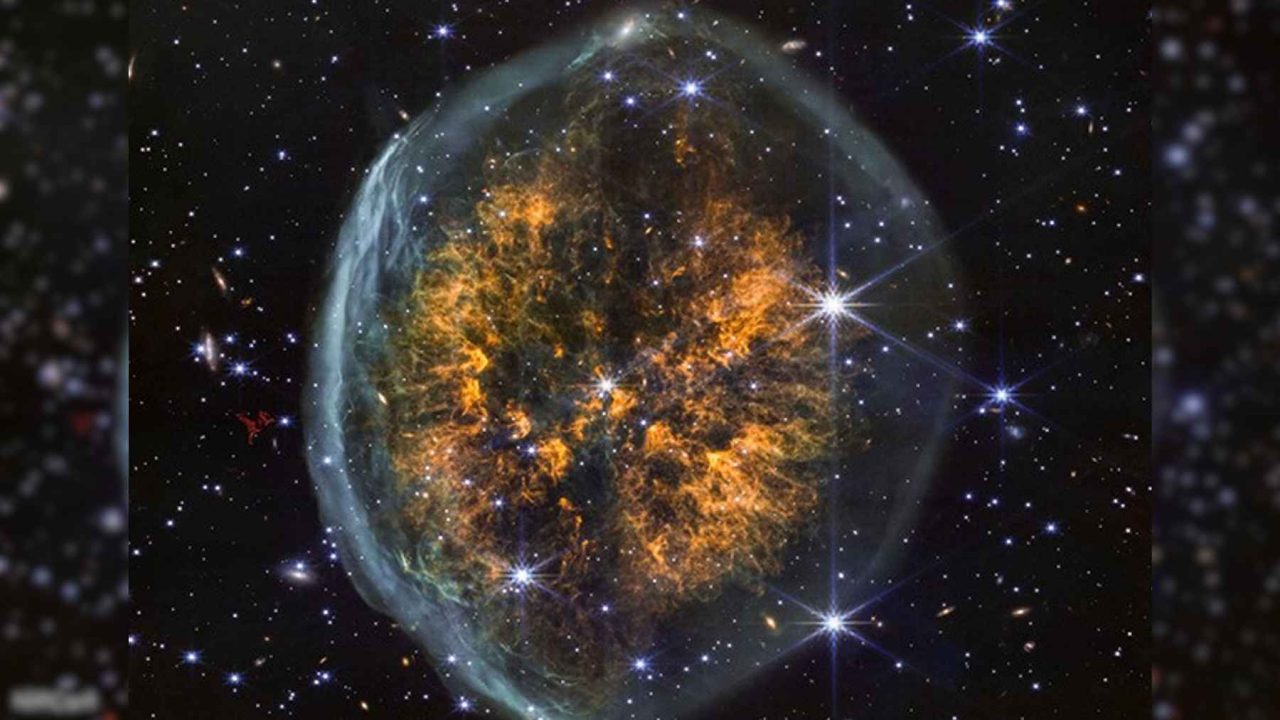
About 5,000 light-years from Earth, a dying star has been slowly tearing itself apart for thousands of years — and NASA’s James Webb Space Telescope has now captured that process in extraordinary detail. The result is one of the most haunting images the telescope has produced: a glowing, skull-shaped structure drifting through deep space in the constellation Vela.
The object is called PMR 1, and it carries a nickname that fits perfectly — the “Exposed Cranium” nebula. At first glance, the new Webb images look like something out of a science fiction film. Look closer, and what you’re actually seeing is the slow, spectacular death of a star playing out across millennia.
NASA released these new side-by-side views on February 25, 2026, drawing on observations Webb collected on March 30 and 31, 2025. The images have since captured widespread attention — and for good reason. This is stellar death rendered visible in a way we’ve never quite seen before.
What PMR 1 Actually Is — And Why It Looks Like a Skull
PMR 1 is a planetary nebula, a term that can be a little misleading. It has nothing to do with planets. A planetary nebula forms when a star similar to our Sun exhausts its nuclear fuel and begins shedding its outer layers into surrounding space. What remains is an expanding shell of glowing gas and dust — often shaped by the complex forces the dying star unleashes as it collapses.
In PMR 1’s case, those forces have produced something with an almost unsettling bilateral symmetry. The structure has a vertical arrangement and a strange, hollow appearance that genuinely resembles an exposed skull — complete with dark eye sockets and a rounded cranial shape. It’s not a trick of the imagination. The symmetry is real, and Webb’s sharper resolution makes it harder to ignore than ever before.
The nebula sits roughly 5,000 light-years away in the constellation Vela, and the image itself covers approximately 3.2 light-years across. By nebula standards, that’s not enormous. But what PMR 1 lacks in size, it more than makes up for in visual complexity and scientific interest.
How Webb Sees What Other Telescopes Couldn’t
PMR 1 is not a new discovery. NASA’s Spitzer Space Telescope first revealed it in infrared light more than a decade ago, giving astronomers an early look at its unusual form. But Spitzer’s view was blurry compared to what Webb can now deliver.
The new images combine two distinct observing modes to create something closer to a full cosmic scan of the object:
- NIRCam (Near-Infrared Camera): Captures near-infrared light, allowing background stars and distant galaxies to shine through the nebula’s structure.
- MIRI (Mid-Infrared Instrument): Detects mid-infrared wavelengths, where cosmic dust glows more strongly and the nebula’s internal structure becomes clearer.
By placing these two views side by side, astronomers can essentially separate what is glowing gas and dust from what is background starlight passing through the nebula. The effect is described as being almost like a cosmic scan — a layered look at a star coming apart piece by piece.
That combination of instruments is one of Webb’s most powerful capabilities, and PMR 1 is a strong example of why it matters. Details that were previously blurred or invisible are now rendered with striking precision.
Key Facts About the “Exposed Cranium” Nebula at a Glance
| Detail | Information |
|---|---|
| Object Name | PMR 1 |
| Nickname | “Exposed Cranium” nebula |
| Object Type | Planetary nebula |
| Location | Constellation Vela |
| Distance from Earth | ~5,000 light-years |
| Image Coverage | ~3.2 light-years across |
| Webb Instruments Used | NIRCam and MIRI |
| Observations Taken | March 30–31, 2025 |
| Images Released | February 25, 2026 |
| Previously Imaged By | NASA’s Spitzer Space Telescope |
Why a Dying Star Thousands of Light-Years Away Actually Matters Here
It’s easy to look at an image like this and treat it as pure spectacle — a beautiful, eerie picture from the far reaches of space. But PMR 1 is also a window into our own future.
Our Sun is a star of similar type to the one that formed PMR 1. In roughly five billion years, it will go through the same process: exhausting its fuel, expanding, and eventually shedding its outer layers into space. What Webb is showing us with PMR 1 is essentially a preview — a detailed look at the kind of structure our solar system may one day leave behind.
For astronomers, the finer detail Webb provides is also scientifically valuable in a more immediate sense. Understanding how stars shed mass at the end of their lives helps researchers model how elements are recycled through galaxies — contributing to the raw material from which new stars and planets eventually form. Every dying star, in a very real sense, seeds the next generation.
What Comes Next for PMR 1 Research
The release of these images in February 2026 marks the beginning of a new phase of study for PMR 1, not the end of one. Webb’s combined NIRCam and MIRI observations give researchers a dataset far richer than anything Spitzer could provide, and astronomers are expected to continue analyzing the structure’s symmetry, dust distribution, and the behavior of the central dying star.
The fact that Webb captured these observations in March 2025 and released them nearly a year later reflects the depth of analysis typically involved — processing and interpreting Webb data takes time, and the scientific community tends to study these images carefully before publication.
More planetary nebulae are likely to receive similar treatment as Webb’s observing schedule continues. PMR 1 may be one of the most visually striking, but it is far from the only dying star Webb has on its list.
Frequently Asked Questions
What is PMR 1?
PMR 1 is a planetary nebula located approximately 5,000 light-years from Earth in the constellation Vela. It is nicknamed the “Exposed Cranium” nebula because of its striking skull-like appearance.
Why does PMR 1 look like a skull?
The nebula has an unusual bilateral symmetry and hollow structure that closely resembles an exposed skull. Webb’s sharper resolution has made this symmetry significantly more visible than in previous telescope images.
When did NASA release the new Webb images of PMR 1?
NASA released the new side-by-side Webb images on February 25, 2026, based on observations taken by the James Webb Space Telescope on March 30 and 31, 2025.
What instruments did Webb use to image PMR 1?
Webb used two instruments: NIRCam, which captures near-infrared light, and MIRI, which detects mid-infrared wavelengths where cosmic dust glows more strongly.
Has PMR 1 been photographed before?
Yes. NASA’s Spitzer Space Telescope first imaged PMR 1 in infrared light more than a decade ago, but Webb’s resolution reveals far finer detail than Spitzer was capable of providing.
How large is PMR 1?
The Webb image of PMR 1 covers approximately 3.2 light-years across, which is relatively modest by nebula standards, though its visual complexity makes it a significant object of study.



Leave a Reply