
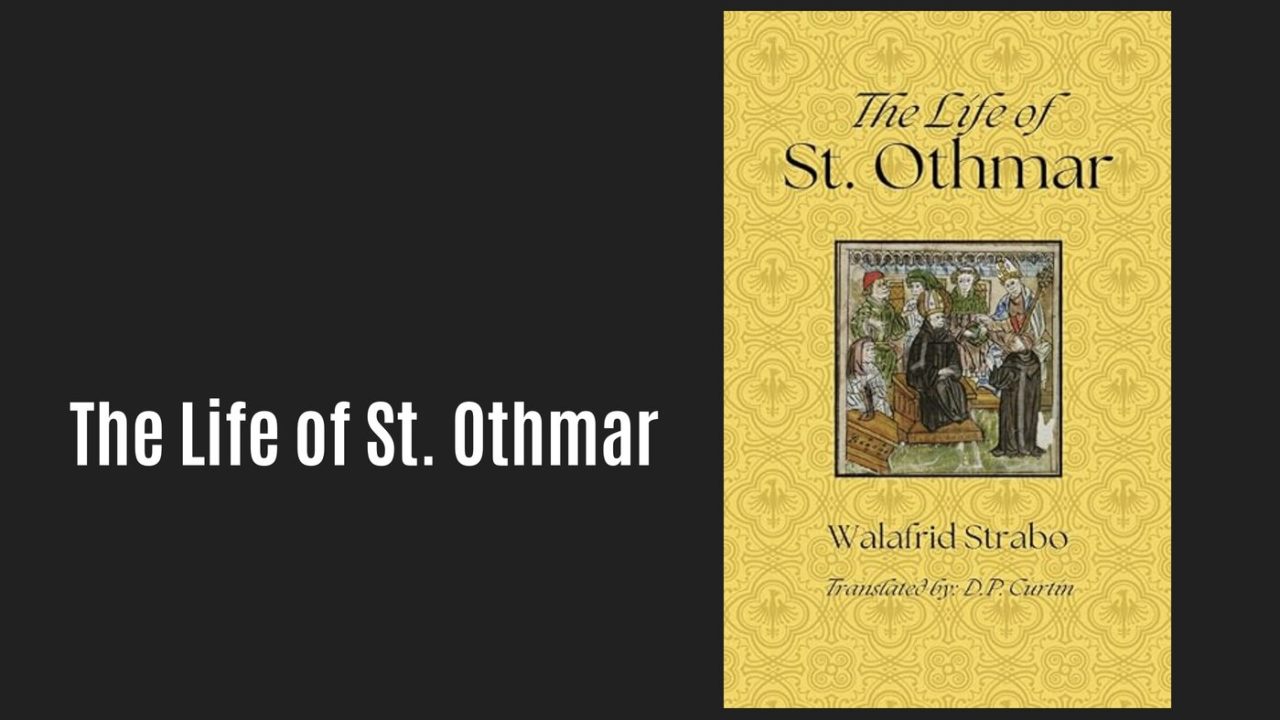
A saint’s life that fits in your pocket — just 12 pages in English translation — tells one of the more quietly dramatic stories of early medieval Christianity. It involves a devoted abbot, a corrupt local power structure, an unjust imprisonment, and a death in captivity. And then, according to the text, the miracles began.
That is the shape of The Life of St. Othmar, a hagiographical work originally written by the Carolingian scholar Walafrid Strabo and now newly available in English translation by D.P. Curtin through Dalcassian Press. For anyone with an interest in medieval monasticism, early Swiss church history, or the literary tradition of saints’ lives, it is a compact but genuinely rewarding read.
Othmar himself is not a household name outside specialist circles, but his story sits at the foundation of one of the most important monasteries in medieval Europe — the Abbey of St. Gall, which he led as its first abbot.
Who Was Othmar, and Why Does His Story Still Matter?
Othmar lived from approximately 689 to approximately 759 in what is now Switzerland. He became the first abbot of the Abbey of St. Gall, a monastery that would grow into one of the most significant centers of learning, manuscript production, and religious life in the medieval world.
The text portrays him as a pious and compassionate leader, particularly devoted to helping the poor. That portrait of humble service makes what follows all the more striking: Othmar became the target of local rulers, was imprisoned despite his innocence, and ultimately died in captivity.
His story fits a recognizable pattern in medieval hagiography — the holy man persecuted by earthly power — but that pattern resonated deeply with medieval audiences precisely because it reflected real tensions between religious communities and secular authority. For Othmar, those tensions were not abstract. They cost him his freedom and his life.
What the Text Actually Contains
Walafrid Strabo structured the work in two distinct movements. The first covers Othmar’s life, character, leadership of the Abbey of St. Gall, his persecution at the hands of local rulers, his imprisonment, and his death. The second shifts into miracle narrative territory.
After Othmar’s death, the text records ten miracle stories attributed to him. One of the most striking, noted in These post-mortem miracles are not incidental — they are central to the hagiographical purpose of the text, establishing Othmar’s sanctity and making the case for his veneration.
| Element | Detail |
|---|---|
| Subject | Othmar, first abbot of the Abbey of St. Gall |
| Dates | Approximately 689–759 |
| Location | What is now Switzerland |
| Original author | Walafrid Strabo |
| Translator | D.P. Curtin |
| Publisher | Dalcassian Press |
| Length in translation | Approximately 12 pages |
| Miracle stories included | Ten |
| ISBN | 979-8-3482-6637-0 |
The Translator Behind the Project
D.P. Curtin is the driving force behind The Scriptorium Project, an ongoing effort to translate shorter medieval texts into English — most of them dealing with Christianity and largely overlooked by mainstream academic publishing. The project has produced dozens of translations, filling a real gap for readers who want access to primary sources without needing fluency in Latin or Old High German.
This translation of The Life of St. Othmar fits squarely within that mission. Short medieval texts like this one often go untranslated for decades simply because they are not long enough to justify a standalone academic edition. The Scriptorium Project’s approach of making them available as accessible, affordable standalone translations changes that equation.
Why the Abbey of St. Gall Makes This Text Especially Valuable
The Abbey of St. Gall is not just any medieval monastery. It became one of the great intellectual centers of the Carolingian world, famous for its scriptorium, its library, and its role in preserving and transmitting classical and early Christian texts. Its manuscript collection, much of which survives, remains a major resource for medieval scholars today.
Othmar’s life predates much of that later glory — he was laying the institutional foundations during a period when the abbey’s future was far from certain. Reading his story means reading about the very beginning of that history, including the vulnerabilities and conflicts that shaped it.
For anyone researching the Abbey of St. Gall specifically, this text is essentially required reading. But it also works as a standalone example of early medieval hagiography — the kind of text that shaped how ordinary people in the Middle Ages understood sanctity, suffering, and divine power.
Who Should Read This Book
Given its length, The Life of St. Othmar is not a major time commitment. It is the kind of primary source that works well as supplementary reading for a course, as background for a research project, or simply as a window into a corner of medieval religious culture that rarely gets attention in popular history.
- Readers interested in the history of the Abbey of St. Gall
- Students and scholars of medieval hagiography
- Anyone exploring early Swiss religious and monastic history
- Readers curious about Walafrid Strabo, one of the notable Carolingian scholars
- Those building a broader familiarity with medieval primary sources in translation
The brevity is not a drawback. If anything, it makes the text more approachable. A 12-page saint’s life is a genuine artifact of how medieval communities told stories about their holy figures — compressed, purposeful, and structured around specific theological and communal goals. Reading it takes less than an hour, but the context it opens up can sustain interest for much longer.
Frequently Asked Questions
Who was St. Othmar?
Othmar was the first abbot of the Abbey of St. Gall, living from approximately 689 to 759 in what is now Switzerland. He was known for his piety and care for the poor, and he died in captivity after being unjustly imprisoned by local rulers.
Who wrote The Life of St. Othmar?
The original hagiographical text was written by Walafrid Strabo, a Carolingian scholar. The current English translation was produced by D.P. Curtin and published by Dalcassian Press.
How long is this book?
The English translation is approximately 12 pages long, making it a very short but self-contained primary
What miracles are described in the text?
The text includes ten miracle stories attributed to Othmar after his death. One described in
Who is D.P. Curtin?
D.P. Curtin is the primary figure behind The Scriptorium Project, which has translated dozens of shorter medieval texts — most focused on Christianity — into English.
Where can I buy this book?
According to the listing on Medievalists.net, the book is available through Amazon.com, Amazon.ca, and Amazon.co.uk, and more information can be found on The Scriptorium Project website.

Leave a Reply