
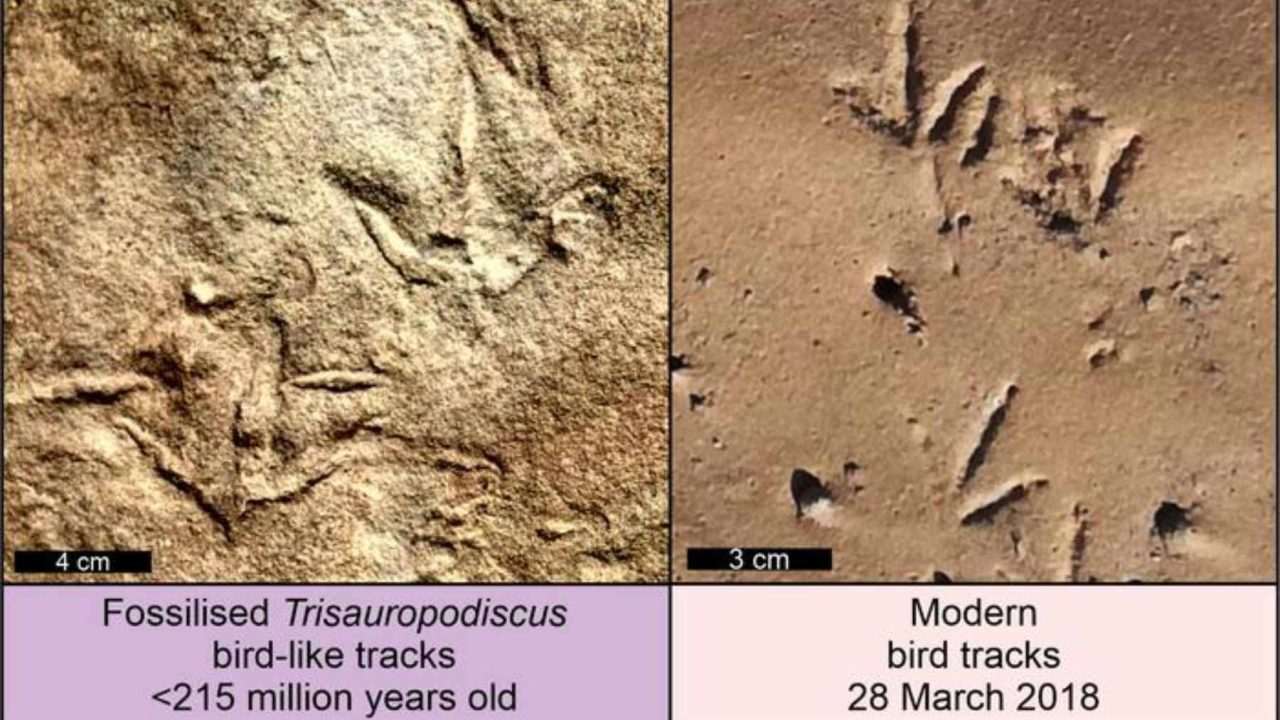
An AI tool can now identify dinosaur footprints with 90% accuracy — and in doing so, it may have quietly rewritten one of paleontology’s most fundamental timelines. Researchers believe the system could push the origin of birds back by tens of millions of years, far earlier than the scientific community has long assumed.
The tool is called DinoTracker, and it does something deceptively simple: a user uploads a photo or a basic outline of a fossil footprint, and within seconds, the app suggests which type of dinosaur most likely left it. The results rival the accuracy of expert paleontologists in most tests.
Behind that simplicity, though, is something far more powerful — a neural network trained on nearly 2,000 fossil footprints spanning more than 200 million years of evolutionary history. And what it found in that data may change what we think we know about when birds first appeared on Earth.
How DinoTracker Actually Works
DinoTracker was developed by researchers at Helmholtz-Zentrum Berlin and the University of Edinburgh. At its core is an unsupervised neural network — a type of AI that isn’t given labeled answers in advance. Instead, it was left to sort through fossil footprint shapes on its own, finding the patterns that naturally separate different groups.
That training dataset included 1,974 dinosaur and bird footprints, covering more than two centuries of geological time. By working without human guidance on classification, the network avoided some of the biases that can creep in when researchers manually sort specimens into categories.
The result is a system that can look at a three-toed print pressed into ancient stone and suggest, with remarkable confidence, what kind of animal left it there. The app is designed to be accessible — not just for researchers with lab access, but for anyone who can take a photograph.
What DinoTracker Is Analyzing When It Studies a Fossil Print
Dinosaur footprints have always been difficult to work with. Unlike bones, tracks are highly variable — they shift depending on the animal’s speed, the softness of the ground, and how the sediment dried over millions of years. Human experts spend careers learning to read those variations.
DinoTracker approaches the problem differently. Rather than relying on a single feature, the neural network weighs the overall shape and geometry of a print, identifying patterns across thousands of examples that no individual researcher could process alone.
The system looks at three-toed prints — common among theropod dinosaurs, the group that eventually gave rise to modern birds — and compares them against its trained library of footprint shapes. The comparison happens in seconds, and the app returns a suggested classification along with its confidence level.
The Bird Origin Finding That Changes Everything
This is where the story gets genuinely surprising. Among the footprints DinoTracker analyzed, the system may have identified tracks belonging to the planet’s first birds — dating back approximately 200 million years.
That would be a significant shift. The current scientific consensus places the origin of birds at roughly 150 million years ago, anchored largely by the famous Archaeopteryx fossils found in Germany. If DinoTracker’s analysis holds up under further scrutiny, it would mean birds appeared on Earth some 50 million years earlier than previously understood.
Researchers note that footprints can preserve evidence of animals that left no skeletal remains — making tracks a potentially critical source of data for understanding evolutionary timelines that bones alone cannot fill in.
| Detail | Information |
|---|---|
| Tool name | DinoTracker |
| Developed by | Helmholtz-Zentrum Berlin & University of Edinburgh |
| Identification accuracy | ~90% |
| Training dataset size | 1,974 dinosaur and bird footprints |
| Timespan covered | More than 200 million years of evolution |
| Potential bird origin finding | Approximately 200 million years ago |
| AI method used | Unsupervised neural network |
Why This Matters Beyond the Lab
The immediate impact of DinoTracker is felt most directly in paleontology — a field where access to expertise has always been unevenly distributed. Not every fossil site is located near a university with specialists on staff. Not every museum can afford the consultants needed to classify a newly discovered print.
A tool that delivers expert-level accuracy from a smartphone photograph changes that equation entirely. Amateur fossil hunters, field researchers in remote locations, and small natural history museums could all use DinoTracker to get a rapid, reliable first assessment of what they’ve found.
More broadly, the system demonstrates something important about what AI can do for historical sciences. Fossil footprints are among the most abundant physical records of prehistoric life — far more common than skeletal remains — yet they’ve historically been harder to classify and study systematically. DinoTracker offers a way to process that data at scale.
If the bird origin finding is confirmed, it would also have ripple effects across evolutionary biology, reshaping our understanding of how and when the lineage that produced every living bird on Earth first emerged.
What Researchers Are Watching For Next
The potential identification of 200-million-year-old bird tracks is currently a finding that warrants further investigation, not a settled conclusion. Paleontological discoveries of this magnitude require peer review, independent verification, and — ideally — corroborating evidence from other fossil sources.
The broader question researchers will be asking is whether DinoTracker’s classifications hold up when tested against footprints the system has never encountered before. A 90% accuracy rate is impressive, but the remaining 10% matters when the stakes involve rewriting evolutionary history.
What’s clear is that the tool already represents a meaningful advance in how scientists can approach fossil track analysis — and that its training dataset, built across more than 200 million years of footprint history, gives it a foundation broad enough to keep producing unexpected findings.
Frequently Asked Questions
What is DinoTracker?
DinoTracker is an AI application developed by researchers at Helmholtz-Zentrum Berlin and the University of Edinburgh that identifies dinosaur footprints from photos or outlines with approximately 90% accuracy.
How was DinoTracker trained?
The system uses an unsupervised neural network trained on 1,974 dinosaur and bird footprints spanning more than 200 million years of evolutionary history, without being given pre-labeled classifications in advance.
What is the significance of the bird footprint finding?
DinoTracker may have identified fossil tracks belonging to the planet’s first birds, dating back approximately 200 million years — which would push the known origin of birds significantly earlier than the current scientific consensus.
How accurate is DinoTracker compared to human experts?
According to
Can anyone use DinoTracker?
The app is designed to be accessible to non-specialists — users simply upload a photo or outline of a fossil footprint, and the system returns a suggested classification within seconds.
Is the 200-million-year bird origin finding confirmed?
This has not yet been confirmed as settled science. It is a potential finding from DinoTracker’s analysis that would require further peer review and independent verification before being accepted by the broader scientific community.


Leave a Reply