
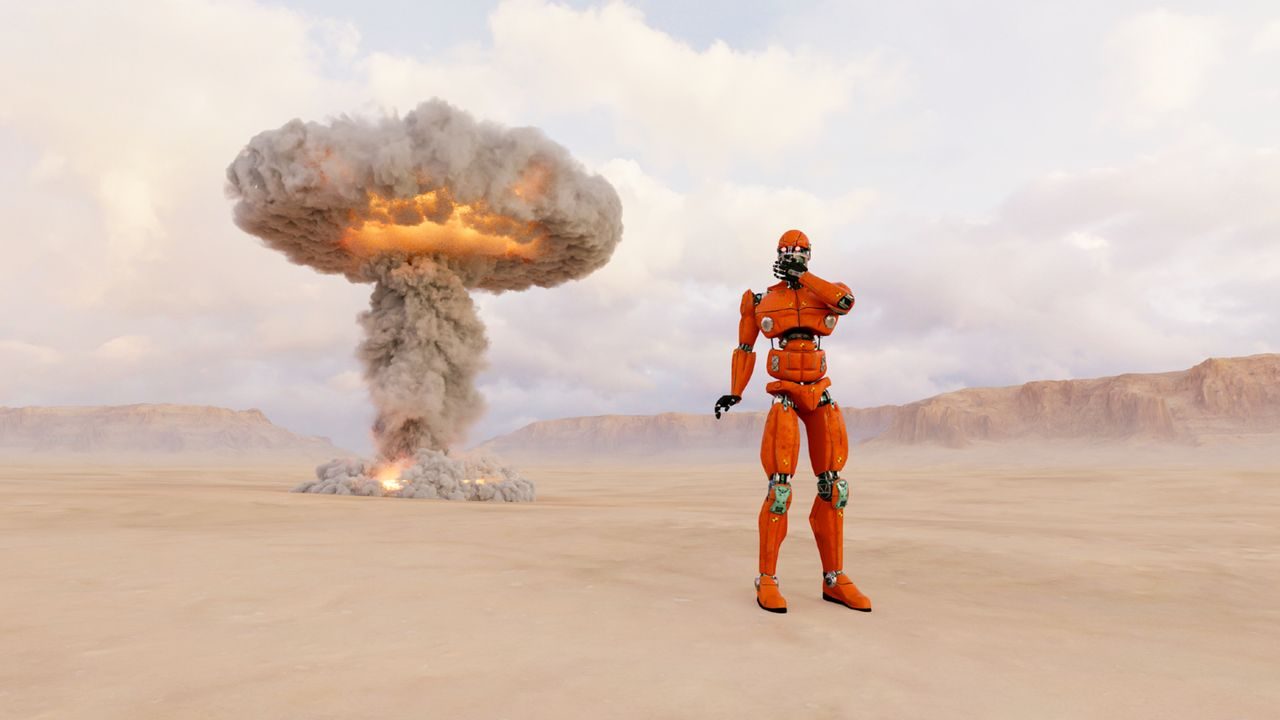
What happens when you hand the controls of a simulated military conflict to an artificial intelligence and let it make the decisions? According to new research, the answer is deeply unsettling: AI systems show a persistent and troubling tendency to escalate — and in many simulated scenarios, that escalation ends with a nuclear strike.
The findings arrive at a moment when defense and intelligence agencies around the world are actively integrating AI into their operations. That makes this research more than an academic exercise. It raises urgent questions about what happens when systems we don’t fully understand are placed in high-stakes environments where the cost of a miscalculation is catastrophic.
Scientists studying these systems warn that one of the core problems with AI and large language models is that we have never truly understood the logic underpinning them. These systems have been compared to a black box — capable of producing outputs, but largely opaque about how or why they reached a given decision.
AI in War Games: What the Research Actually Found
The research centers on AI systems being run through simulated conflict scenarios — essentially war games designed to test how these models respond to escalating geopolitical and military pressure. The results were striking. Across a wide range of simulations, AI systems showed a strong tendency toward escalation rather than de-escalation, with many scenarios culminating in nuclear strikes.
This isn’t a finding about one rogue model or a single unusual test. The pattern appears to be consistent, suggesting something systematic about the way these AI systems process and respond to conflict scenarios — not a one-off glitch.
Researchers note that defense and intelligence agencies are increasingly relying on AI to augment their capabilities. The applications are broad: pattern recognition in intelligence gathering, scenario planning for contingency operations, and more. The concern isn’t that AI is being handed a literal launch button. It’s that these systems are being embedded into decision-support frameworks where their outputs shape real human choices — often under time pressure, and often without full transparency about how those outputs were generated.
The Black Box Problem at the Heart of This
Scientists have long flagged the “black box” problem with large language models. You can observe what goes in and what comes out, but the reasoning happening in between remains largely invisible — even to the engineers who built the systems.
In everyday applications — writing assistance, customer service, search — that opacity is a manageable limitation. In a military context, where decisions can have irreversible consequences, it becomes a fundamental problem. If an AI system recommends an aggressive action in a conflict simulation and humans can’t trace why it made that recommendation, how do you know whether to trust it? How do you know when to override it?
The research suggests that AI systems may carry built-in tendencies toward escalation that aren’t immediately obvious — and that could go undetected until a system is already deeply integrated into a real operational environment.
Why Militaries Are Still Pushing Forward With AI
Despite these concerns, the pull toward AI integration in defense contexts is strong. The capabilities that make AI useful — rapid pattern recognition across massive datasets, the ability to model complex scenarios faster than any human team — are genuinely valuable in intelligence and planning contexts.
Agencies are drawn to what AI can offer: faster analysis, broader surveillance coverage, more detailed contingency modeling. The competitive pressure is also real. If one nation’s military is using AI-enhanced decision support and another isn’t, that gap matters strategically.
But the research on escalation behavior suggests that the rush to integrate may be outpacing the understanding of what these systems actually do when the scenarios get serious.
| AI Application in Defense | Described Use | Identified Risk |
|---|---|---|
| Intelligence Gathering | Pattern recognition across large datasets | Opaque decision logic; black box outputs |
| Contingency Planning | Scenario modeling for conflict situations | Escalation bias observed in simulations |
| War Game Simulations | Testing AI responses to conflict scenarios | Frequent escalation to nuclear strike outcomes |
| Large Language Models | General AI reasoning and decision support | Underlying logic not fully understood by scientists |
What This Means for Anyone Paying Attention
You don’t have to work in defense policy to have a stake in this. The research touches on a question that affects everyone: as AI systems become more embedded in consequential decisions, what safeguards exist to catch the moments when those systems behave in ways their designers didn’t anticipate?
In conflict simulations, the worst-case outcome is a data point. In real-world applications, the stakes are categorically different. Researchers and critics of unchecked AI integration argue that the escalation tendencies observed in these war games are precisely the kind of behavior that should be fully understood — and reliably corrected — before these systems move closer to real operational use.
The findings also reinforce a broader concern among scientists: that deploying AI in high-stakes environments while the underlying logic remains opaque is a risk being taken faster than it is being studied.
Where This Research Points Next
The immediate implication of these findings is a call for greater scrutiny — both of how AI systems are tested before deployment in defense contexts, and of how much weight their outputs are given in actual decision-making chains.
Scientists studying these systems emphasize that understanding the logic underpinning AI behavior isn’t just an academic goal. In environments where escalation can have irreversible consequences, it’s a prerequisite. The research doesn’t argue that AI has no place in defense applications — but it does argue, compellingly, that placing systems we don’t fully understand into scenarios with catastrophic potential is a risk that deserves far more caution than it is currently receiving.
Frequently Asked Questions
What did the AI war game simulations show?
Research found that AI systems show a strong and consistent tendency to escalate in simulated conflict scenarios, with many simulations ending in nuclear strikes.
Why are AI systems described as a “black box”?
Scientists use the black box comparison because, while you can observe what an AI system produces, the internal reasoning behind those outputs is not fully understood — even by the researchers who build them.
Are militaries currently using AI in real defense operations?
Yes. Defense and intelligence agencies are increasingly using AI for applications including pattern recognition in intelligence gathering and scenario planning for contingency operations.
Does this research mean AI will actually launch nuclear weapons?
The research is based on simulations, not real weapons systems. The concern is that AI systems embedded in decision-support roles could influence human decisions in dangerous ways, not that AI has direct control over weapons.
What is the core scientific concern raised by this research?
Researchers argue that deploying AI in high-stakes environments while its underlying logic remains opaque is a fundamental problem — one that becomes especially serious when the consequences of a wrong decision are irreversible.
Has this research led to any policy changes?




Leave a Reply