
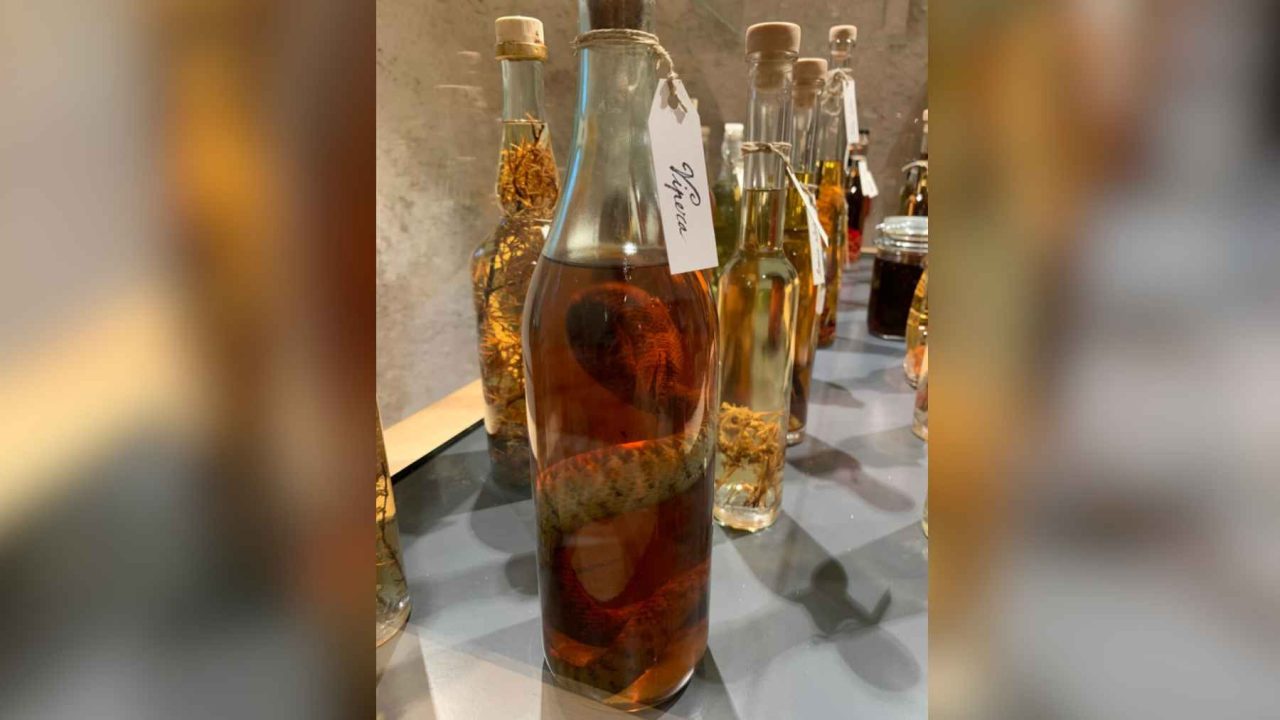
A single pharmacy in Padua or Venice could burn through 600 to 800 live vipers in a single year during the early 1700s. Not as a curiosity. Not as a spectacle. As medicine. That number, cited in recent research, tells you everything about how seriously people once took the idea that a coiled snake inside a bottle of strong spirits could heal the body.
The tradition behind that figure is older than most people realize, and traces of it are still visible today — tucked onto the shelves of Alpine mountain huts and old-style Italian taverns, where a bottle of clear grappa with a snake inside sometimes sits between the herbal liqueurs, waiting for someone to notice it.
This is the strange, long history of viper grappa: a drink that was once a remedy, once required hundreds of snakes a year to produce, and now exists somewhere between folk tradition and legal grey area.
What Viper Grappa Actually Is
The drink is exactly what it sounds like. Grappa — a strong Italian spirit distilled from grape pomace — is used as the base, and a whole viper is placed inside the bottle. The snake is typically coiled, preserved by the alcohol, and visible through the glass.
Journalist Samuele Doria, writing about northern Italian traditions, noted that regulars at Alpine huts and old-style taverns sometimes still encounter these bottles. They tend to attract attention. Hikers photograph them. Visitors ask questions. The bottle itself has become a kind of artifact — something that carries the weight of a much older story.
That older story is rooted not in novelty, but in medicine. For centuries, the viper wasn’t just a dramatic garnish. It was the point.
How a Snake Became a Remedy
The logic behind viper-based remedies was not random. For a long time, across many cultures, there was a belief that the dangerous properties of a venomous animal could be transformed — through preparation, through infusion, through the right process — into something that protected or healed the body that consumed it. The viper, being one of the most feared animals in the Alpine region, was a natural candidate.
Luca Faoro, a curator at METS, the ethnographic museum in San Michele all’Adige, traced the tradition through historical recipes and documents. His research connects the bottles still seen in mountain huts today to a practice that was once taken seriously enough to drive significant commercial demand.
The scale of that demand is what makes the early 18th-century pharmacy figures so striking. One establishment — in Padua or Venice — reportedly needed between 600 and 800 vipers annually. That is not a hobby. That is a supply chain.
The Numbers Behind the Tradition
The viper grappa tradition left behind more than bottles. It left behind a paper trail that researchers have been able to follow through pharmacy records, recipes, and ethnographic sources.
| Detail | What the Record Shows |
|---|---|
| Time period | Early 1700s (early 18th century) |
| Location of pharmacy | Padua or Venice, northern Italy |
| Annual viper consumption (single pharmacy) | 600 to 800 snakes per year |
| Base spirit used | Grappa (Italian grape spirit) |
| Where bottles are still found | Alpine mountain huts and old-style taverns, northern Italy |
| Research source | Luca Faoro, curator at METS, San Michele all’Adige |
Those numbers put the tradition in a different light. Hundreds of wild vipers, caught in the Alpine environment, processed and sold through a single commercial outlet every twelve months. Multiply that across multiple pharmacies and regions, and the ecological and logistical scale becomes considerable.
Why This Matters Beyond the Curiosity Factor
It would be easy to file viper grappa under “weird historical oddity” and move on. But the tradition raises real questions that are still relevant.
- Wildlife and the law: Catching wild vipers for use in alcohol is now illegal in many parts of the Alps. What was once an accepted commercial practice is today a conservation concern.
- Folk medicine and pharmacology: The viper remedy existed within a broader system of belief about how dangerous substances could be repurposed as cures — a logic that shaped centuries of European medicine.
- Living traditions: The fact that these bottles still appear in mountain huts means the tradition hasn’t fully disappeared. It has shifted from remedy to relic, but it persists in physical form.
- Ethnographic record: Museums like METS in San Michele all’Adige are actively working to document these practices before the knowledge and the objects disappear entirely.
The bottle on the shelf isn’t just a conversation piece. It’s a window into how people once understood danger, healing, and the natural world around them.
Where the Tradition Stands Today
Viper grappa occupies an unusual position in the present. In many Alpine regions, capturing a wild viper is now restricted or outright prohibited, which means the practice that once supported hundreds of snakes a year through a single pharmacy is no longer legally replicable at scale.
What remains is largely what has already been made — old bottles passed down, displayed, or occasionally still encountered in the kinds of places Samuele Doria described: the back shelves of huts at altitude, where the décor tends toward the traditional and the stories tend toward the old.
Researchers and museum curators are now the ones keeping the fuller history alive, tracing the recipes and records that show just how seriously this remedy was once taken — and just how many snakes it took to sustain that belief.
Frequently Asked Questions
What is viper grappa?
Viper grappa is a drink made by placing a whole viper inside a bottle of grappa, a strong Italian spirit distilled from grapes. It was historically sold and used as a medicinal remedy.
How many vipers were used to make this drink?
According to historical estimates cited in recent research, a single pharmacy in Padua or Venice could require between 600 and 800 vipers in a single year during the early 1700s.
Is viper grappa still made today?
Bottles are still occasionally found in Alpine mountain huts and old-style taverns in northern Italy, but catching wild vipers for this purpose is now illegal in many parts of the Alps.
Who has researched this tradition?
Luca Faoro, a curator at METS — the ethnographic museum in San Michele all’Adige — has traced the tradition through historical recipes and documents. Journalist Samuele Doria has also written about its presence in Alpine culture.
Why did people believe a snake in a bottle was medicinal?
The belief was rooted in the idea that the dangerous properties of a venomous animal could be transformed through infusion into something healing. This logic was common in European folk medicine for centuries, though
Where can this tradition be seen today?
Bottles of viper grappa are still occasionally spotted on the shelves of Alpine mountain huts and old taverns in northern Italy, and the ethnographic museum METS in San Michele all’Adige documents related traditions.




Leave a Reply