
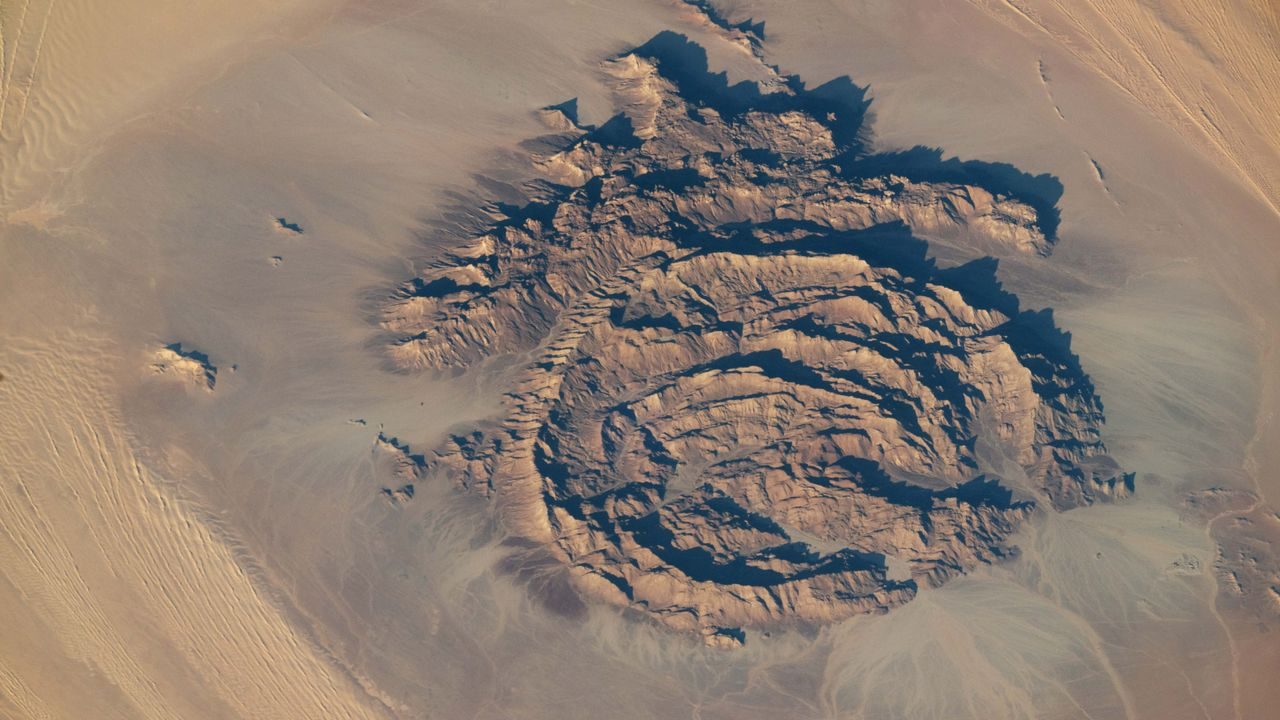
Somewhere in the heart of the Sahara Desert, far from any road or settlement, a geological structure sits in almost perfect silence — a series of concentric rocky rings so striking that astronauts on the International Space Station have been photographing it from orbit. And the image captured on September 13, 2025 is one of the most arresting Earth-from-space photographs in recent memory.
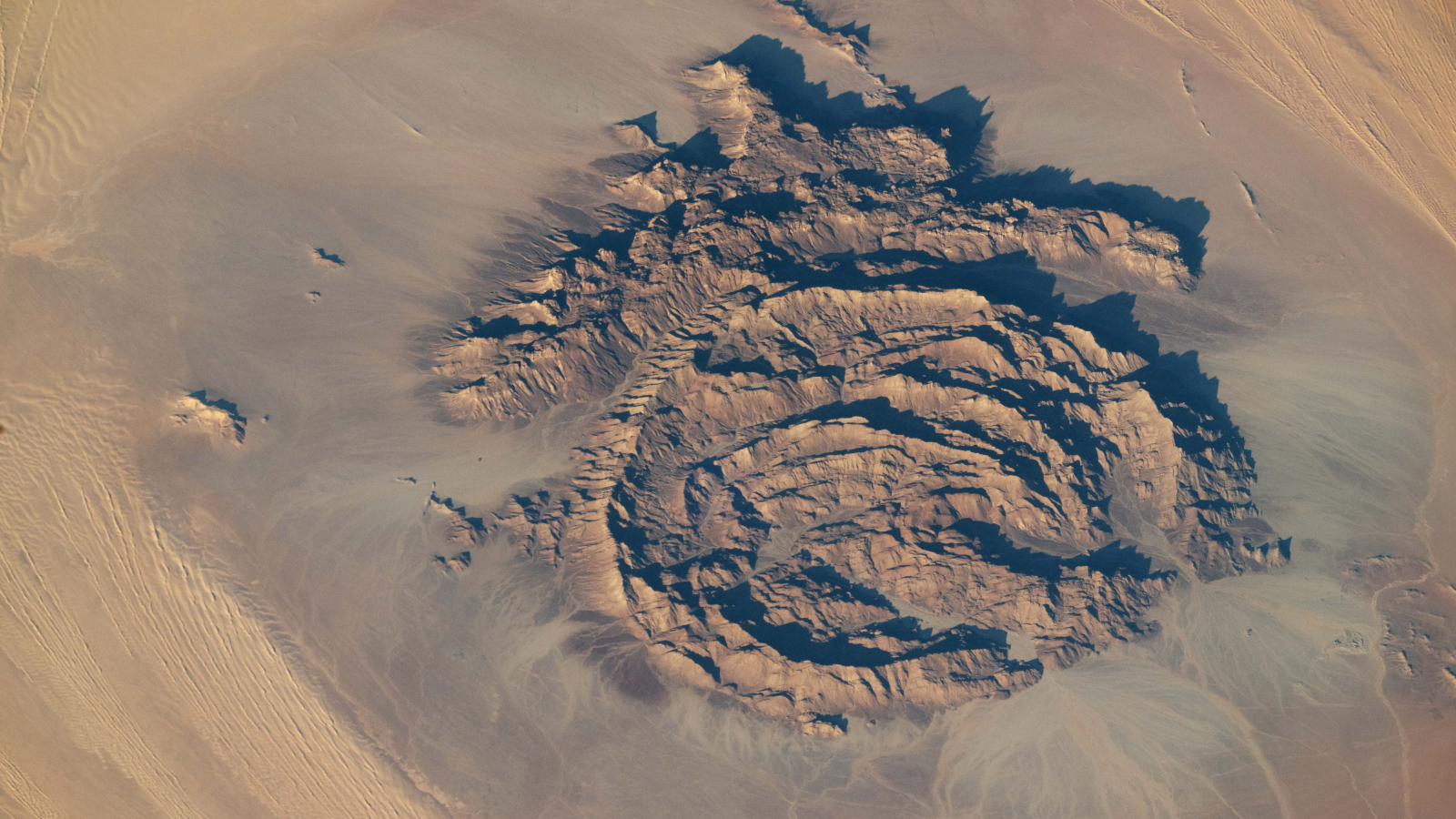
The structure is called Mount Arkanu, and it sits in Libya at coordinates 22.267325754°N, 24.7226055004°E — deep in the Sahara, in one of the most remote and inhospitable regions on the planet. The entire formation stretches more than 15 miles wide, making it visible from low Earth orbit with remarkable clarity.
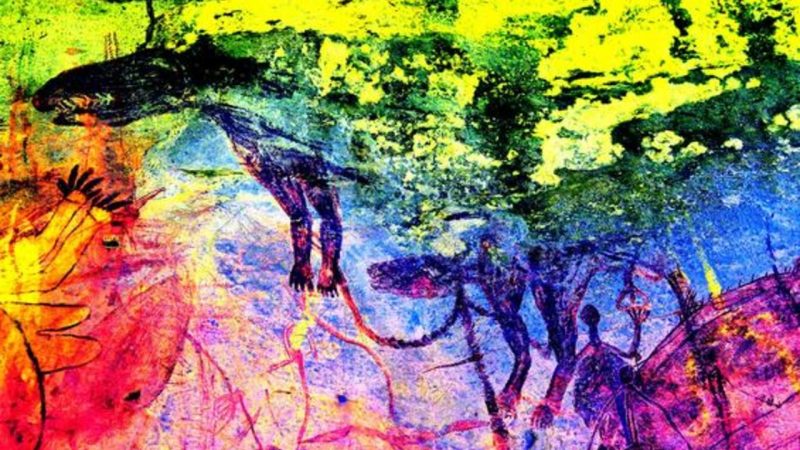
What makes it so visually extraordinary isn’t just its scale. It’s the shape: a series of concentric rings of rock, layered like the cross-section of a tree trunk, topped with what researchers describe as a large, hat-like magma formation sitting above the rest of the structure. Ancient artwork has also been found adorning the rocks — meaning this place has captured human imagination for thousands of years, long before anyone could see it from space.
What Mount Arkanu Actually Is
Mount Arkanu is classified as a massif — a large, compact section of the Earth’s crust that has been shaped by geological forces over millions of years. The concentric ring pattern visible in the astronaut photograph is the result of deeply ancient geological processes, where different layers of rock have been exposed by erosion over time, creating the distinctive bull’s-eye appearance from above.
The “hat” formation at the top of the structure is particularly notable. This elevated, dome-like feature sits above the concentric rings and is believed to be the remnant of magmatic activity — essentially, solidified material from deep within the Earth that pushed upward and hardened in place, resisting erosion while the surrounding rock wore away over geological time.
Structures like this are sometimes compared to the famous Richat Structure in Mauritania — another circular geological formation in the Sahara that has long fascinated scientists and space observers alike. Both are products of the same fundamental geological drama: the slow, relentless contest between the forces that build the Earth’s surface and the forces that wear it down.
The Ancient Artwork Hidden in the Rings
What sets Mount Arkanu apart from being simply a geological curiosity is the presence of ancient artwork found on its rocky surfaces. The Sahara was not always the barren desert it is today. Thousands of years ago, the region supported grasslands, lakes, and human populations who left behind a significant artistic record carved and painted onto rock surfaces across the landscape.
The fact that Mount Arkanu’s striking ring formations served as a canvas — or at least a gathering place — for ancient peoples adds a deeply human dimension to what might otherwise be a purely geological story. These rocks have been meaningful to human beings across enormous stretches of time, from prehistoric communities navigating a greener Sahara to astronauts photographing the structure from 250 miles above the Earth.
The combination of geological rarity and ancient human presence makes this one of the more quietly remarkable sites in North Africa — and one that remains largely unknown outside specialist circles.
Key Facts About the Mount Arkanu Formation
| Detail | Information |
|---|---|
| Location | Libya, Sahara Desert |
| Coordinates | 22.267325754°N, 24.7226055004°E |
| Total width | Over 15 miles |
| Structure type | Massif with concentric rocky rings |
| Distinctive feature | Large hat-like magma formation at the top |
| Photo taken by | Unnamed astronaut aboard the ISS |
| Photo date | September 13, 2025 |
| Photo credit | NASA / ISS program |
- The structure is located in one of the most remote parts of the Sahara Desert
- Ancient rock artwork has been documented on the formation’s surfaces
- The concentric ring pattern is clearly visible from low Earth orbit
- The elevated “hat” feature is associated with ancient magmatic activity
Why the View From Space Tells the Whole Story
There are some geological features that simply cannot be appreciated from ground level. Mount Arkanu is one of them. Standing at the base of the structure, a person would see rock walls and desert — impressive, perhaps, but without the full picture. From the ISS, the geometry becomes undeniable: perfect rings, a defined center, and that unmistakable elevated cap sitting above everything else like a crown.
The ISS Earth observation program has been capturing images like this for decades, and they consistently reveal a planet full of structures that challenge our intuitions about what’s possible through natural processes alone. Mount Arkanu is a reminder that some of the most extraordinary places on Earth are the ones nobody talks about — sitting quietly in the desert, largely unvisited, waiting to be noticed from 250 miles up.
The photograph taken on September 13, 2025 is the latest in a long tradition of astronaut imagery that reframes how we see our own planet. For a formation that has existed for millions of years and been visited by humans for thousands, the attention is well deserved.
What We Still Don’t Fully Know
Despite its visual drama, Mount Arkanu remains relatively understudied compared to more accessible geological formations. Its remote location in the Libyan Sahara makes field research logistically difficult, and the ancient artwork found there has not been as widely documented or analyzed as rock art at more accessible Saharan sites.
The precise age of the formation, the full extent of the ancient artwork, and the complete geological history of the magma hat structure have not been confirmed in publicly available detail. What is clear is that this is a site of both geological and archaeological significance — and one that deserves considerably more scientific attention than it currently receives.
Frequently Asked Questions
Where exactly is Mount Arkanu located?
Mount Arkanu is located in Libya, in the Sahara Desert, at coordinates 22.267325754°N, 24.7226055004°E.
How big is the Mount Arkanu formation?
The entire structure is over 15 miles wide, making it large enough to be clearly photographed from the International Space Station.
What is the “hat” formation at the top of Mount Arkanu?
The hat-like feature is a large elevated formation associated with ancient magmatic activity — solidified material that pushed upward and resisted erosion while surrounding rock wore away.
Who took the photograph of Mount Arkanu from space?
The photograph was taken by an unnamed astronaut aboard the International Space Station on September 13, 2025, as part of the NASA ISS program.
What ancient artwork has been found at Mount Arkanu?
Ancient artwork has been documented on the rocky surfaces of the formation, though the full extent and details of this artwork have not been confirmed in the available source material.
Is Mount Arkanu similar to the Richat Structure?
Both are large circular geological formations in the Sahara with concentric features visible from space, though they have distinct geological histories. The comparison is a general observational one and not a confirmed scientific classification.


Leave a Reply