
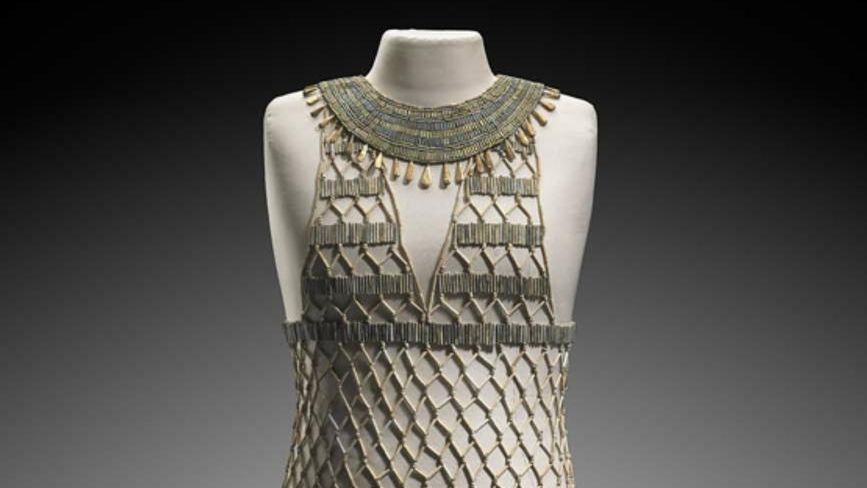
Seven thousand beads. That’s what it took to dress a woman for eternity in ancient Egypt — and remarkably, nearly all of them survived more than 4,500 years underground.
The beadnet dress, discovered in 1927 at a tomb in Giza, is one of the most striking artifacts to emerge from the Old Kingdom period of ancient Egypt. It dates to roughly 2551 to 2528 B.C. — the same era in which the Great Pyramid of Khufu was being built — and it offers a rare, intimate glimpse into how elite Egyptian women were prepared for the afterlife.
@houstonmuseumns Beadnet Dress ~ On display in the Hall of Ancient Egypt, presented by Egyptologist Tom Hardwick. This beadnet dress was worn over a linen backing, with flower pendants at the hemline, and blue-green beads that would rustle as the wearer moved. Faience Old Kingdom, Dynasty 6 2345 – 2181 BC From Giza, Tomb G 5520 D #ancienthistory #ancientegypt #dress #ancientfashion #museumtok
What makes this artifact especially remarkable is not just its age, but its survival. The linen thread that once held those thousands of beads together had long since crumbled to dust. Yet the beads themselves remained, scattered in a pattern that allowed archaeologists to reconstruct the garment with considerable confidence.
What the Beadnet Dress Actually Is
The beadnet dress is exactly what its name suggests: a dress constructed from a net of beads. It was a funeral garment — designed not for daily life, but specifically to clothe the deceased for burial and, by ancient Egyptian belief, for the journey into the afterlife.
The dress was found in the Old Kingdom tomb of a woman who was a contemporary of King Khufu, the pharaoh credited with commissioning the Great Pyramid at Giza. That association places the garment at the very height of Egypt’s pyramid-building age, a period of extraordinary cultural and artistic achievement.
When archaeologists uncovered the tomb in 1927, they found the beads arranged in a way that preserved the outline and structure of the original garment. Though the linen string binding them had completely disintegrated over the millennia, the position of the beads on the tomb floor allowed researchers to piece together how the dress had once looked and how it was worn.
Today, the reconstructed beadnet dress is held at the Museum of Fine Arts in Boston.
The Craftsmanship Behind 7,000 Beads
The scale of this garment is hard to fully absorb at first. Seven thousand individual beads, each one placed deliberately, each one part of a larger decorative and symbolic whole. This was not casual craftsmanship — it was a labor-intensive act of devotion, likely reserved for women of significant social standing.
The fact that this type of dress has been documented well enough to allow reconstruction suggests the beadnet style was not unique to this one burial. It appears to have been a recognizable fashion of the Old Kingdom period — a funerary tradition with enough consistency that scholars could work backward from the scattered beads to recreate the original form.
| Detail | Information |
|---|---|
| Name | Beadnet dress |
| Type of object | Beaded funeral dress |
| Origin | Giza, Egypt |
| Date of creation | Circa 2551 to 2528 B.C. |
| Number of beads | Approximately 7,000 |
| Original binding material | Linen string (disintegrated) |
| Year of discovery | 1927 |
| Associated ruler | King Khufu (contemporary) |
| Current location | Museum of Fine Arts, Boston |
Why This Discovery Matters Beyond the Object Itself
Artifacts like the beadnet dress do something that monumental architecture simply cannot — they bring us face to face with individual human lives. The pyramids at Giza tell us about power and engineering on an almost incomprehensible scale. A burial dress tells us about a specific woman, her status, her culture’s beliefs about death, and the people who cared enough to send her into the afterlife clothed in thousands of carefully strung beads.
The Old Kingdom, which spanned roughly from 2686 to 2181 B.C., is often called the Age of the Pyramids. It was a period of centralized royal power, ambitious construction projects, and sophisticated artistic traditions. Funerary culture was central to Egyptian life during this era — not as a morbid preoccupation, but as a deeply held belief system around preservation, identity, and eternal existence.
Burial goods like this dress were not merely decorative. They were functional, in the spiritual sense — objects intended to serve the deceased in the next world. For an elite woman buried at Giza during the reign of Khufu, appearing properly dressed for eternity was a serious matter.
What Survival Looks Like After 4,500 Years
The condition of the beadnet dress raises its own fascinating questions about preservation and archaeology. The beads themselves — likely made from materials more durable than organic thread — outlasted the very structure that held them together. The linen string is gone. The dress as a wearable object ceased to exist long before anyone found it.
What the 1927 excavation team encountered was essentially a puzzle: thousands of beads lying in the dust of a sealed tomb, their positions still echoing the shape of the garment they once formed. The reconstruction that followed was an act of informed archaeological interpretation, drawing on knowledge of how this style of dress was typically constructed during the Old Kingdom period.
That the dress could be reconstructed at all speaks to the consistency of the beadnet tradition — and to the careful, methodical work of the archaeologists who documented exactly where each bead lay before disturbing the scene.
Where the Dress Lives Now
The reconstructed beadnet dress has been part of the collection at the Museum of Fine Arts in Boston since its discovery and subsequent conservation. It stands as one of the museum’s connections to the ancient Egyptian world — a tangible link to a woman who lived and died at the same time the most famous structures in human history were rising from the desert sand.
For anyone interested in ancient Egypt beyond the pharaohs and the monuments, objects like this are where the real story lives — in the details, the materials, the extraordinary care taken to honor an individual life.
Frequently Asked Questions
What is the beadnet dress?
The beadnet dress is an ancient Egyptian funeral garment made from approximately 7,000 beads, originally strung together on linen thread and designed to clothe a woman for burial.
How old is the beadnet dress?
It dates to approximately 2551 to 2528 B.C., placing it at roughly 4,500 years old and contemporaneous with the reign of King Khufu.
Where was the beadnet dress found?
It was discovered in 1927 in an Old Kingdom tomb at Giza, Egypt, belonging to a woman who was a contemporary of King Khufu.
How was the dress reconstructed if the thread had disintegrated?
Archaeologists used the positions of the beads as they were found in the tomb, combined with knowledge of how this style of dress was typically constructed during the Old Kingdom period, to reconstruct the garment.
Where can the beadnet dress be seen today?
The reconstructed beadnet dress is currently held at the Museum of Fine Arts in Boston.</p




Leave a Reply