
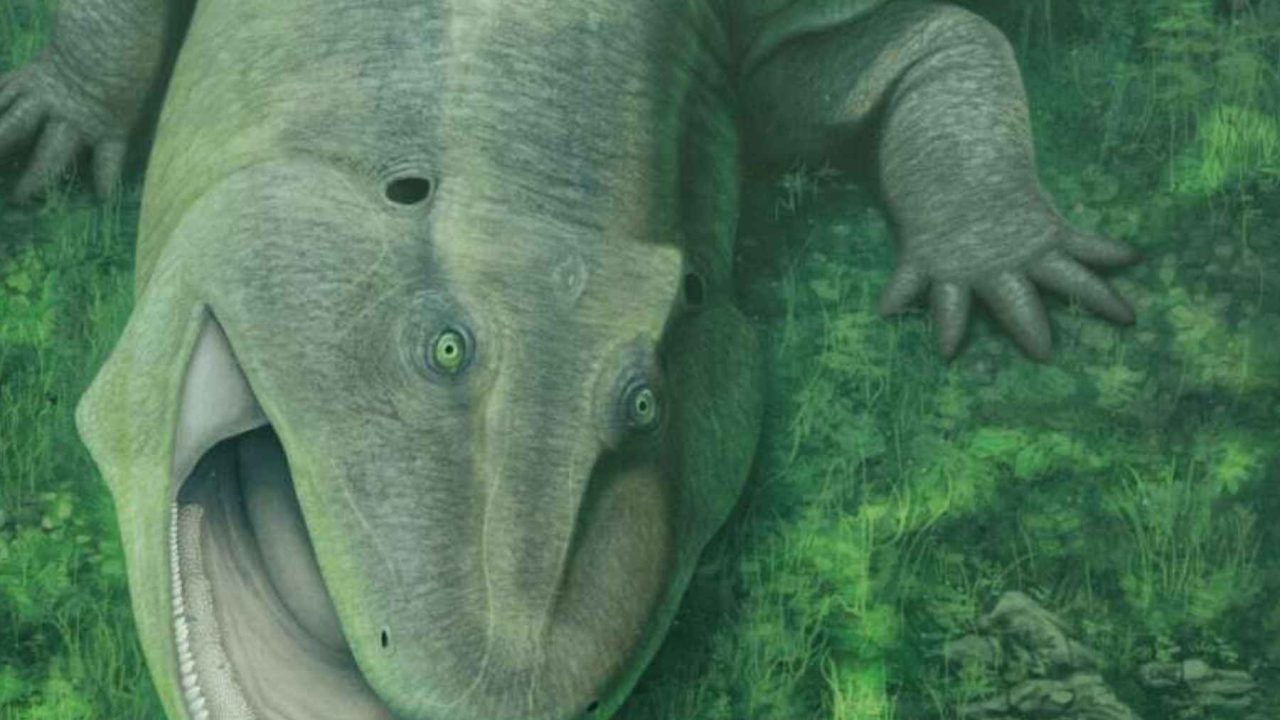
Some fossil discoveries rewrite the timeline of life on Earth — and a set of nine jaw specimens pulled from northeastern Brazil has done exactly that. Meet Tanyka amnicola, a 275-million-year-old herbivore with one of the strangest mouths in the prehistoric record: a crooked lower jaw with teeth that pointed sideways rather than upward.
The find, described in a paper published on March 4, 2026, has given paleontologists a rare window into a branch of the tetrapod family tree that most scientists assumed had already faded from the picture. Instead, it was still here — still evolving, still adapting — in what is now South America, hundreds of millions of years before humans arrived to dig it up.
The discovery comes from the Pedra de Fogo Formation in northeastern Brazil, a geological site that continues to yield surprises from the deep Permian period. What makes Tanyka particularly striking is not just its age, but what its survival implies about the complexity of ancient ecosystems in the supercontinent Gondwana.
What Made Tanyka amnicola So Unusual
Nine jaw specimens. That is all researchers had to work with — and yet it was enough to stop the scientific community in its tracks.
The lower jaw of Tanyka amnicola was so structurally unusual that some of its teeth did not point upward the way you would expect in most animals. They pointed sideways. Combined with the crooked shape of the jaw itself, this gave the animal a bite unlike anything else from its era. Researchers believe this anatomy was likely connected to its diet as a herbivore, though the precise feeding mechanics are still being studied.
The animal is estimated to have grown to around three feet long, and based on the rock formations where its fossils were found, it likely lived in or near lakes and wetland environments. It was not a large creature by any measure, but in terms of what it represents on the evolutionary tree, it looms much larger.
A Living Fossil From the Age Before Dinosaurs
Researchers place Tanyka on the stem of the tetrapod family tree — meaning it belonged to an ancient branch that sits outside the lineages that eventually gave rise to reptiles, birds, mammals, and modern amphibians. In other words, it was not an ancestor of any of those groups. It was a survivor from an older world, still living alongside more evolutionarily advanced animals.
That is what earns it the label “living fossil” in a paleontological sense. By 275 million years ago, the world already contained tetrapods that looked far more familiar. Yet Tanyka’s lineage — one of the oldest branches on the tetrapod tree — had not disappeared. It was still there, still changing, still occupying ecological space in Gondwana’s wetlands.
This kind of discovery matters because it challenges assumptions about extinction timing. Scientists do not always know when ancient lineages truly vanished. Tanyka suggests some of them held on much longer than the fossil record had previously indicated.
Key Facts About the Tanyka amnicola Discovery
- Fossil specimens: Nine jaw specimens recovered from the Pedra de Fogo Formation, northeastern Brazil
- Age of the animal: Approximately 275 million years old (Permian period)
- Estimated body length: Around three feet long
- Diet: Herbivore
- Habitat: Likely lakes or wetland environments
- Defining feature: Crooked lower jaw with teeth oriented sideways
- Evolutionary position: Stem tetrapod — outside the lineages leading to reptiles, birds, mammals, and modern amphibians
- Paper published: March 4, 2026
| Feature | Detail |
|---|---|
| Species name | Tanyka amnicola |
| Age | ~275 million years old |
| Location found | Pedra de Fogo Formation, northeastern Brazil |
| Number of specimens | 9 jaw specimens |
| Estimated size | ~3 feet long |
| Diet | Herbivore |
| Jaw characteristic | Crooked jaw with sideways-pointing teeth |
| Classification | Stem tetrapod |
| Research published | March 4, 2026 |
Why This Find Matters Beyond the Fossil Itself
Discoveries like Tanyka amnicola do something important: they force a reassessment of what was actually alive at a given point in Earth’s history. The Permian period — which ended roughly 252 million years ago in the largest mass extinction the planet has ever seen — is often treated as a prelude to the age of dinosaurs. But it was a world of tremendous biological diversity in its own right.
The fact that a very ancient tetrapod lineage was still present and still evolving in Gondwana 275 million years ago tells researchers that these older branches of the tree of life were not simply fading out. They were competing, adapting, and finding ecological niches alongside more derived animals. That picture of ancient biodiversity is far richer and more complicated than a simple ladder from “primitive” to “advanced.”
For Brazil specifically, the Pedra de Fogo Formation continues to prove its scientific value. The region has now yielded evidence of an archaic survivor that adds a new data point to our understanding of Permian-era Gondwana — and raises the question of what else might still be waiting in those rocks.
What Researchers Are Still Working to Understand
Because Tanyka amnicola is known almost entirely from jaw specimens, many questions remain open. The full body shape of the animal has not been reconstructed. Its precise relationship to other stem tetrapods is still being analyzed. And the exact mechanics of how those sideways teeth functioned — what the animal was eating and how — has not been fully explained by the available evidence.
Researchers note that while the jaw specimens alone were enough to identify a genuinely new and significant animal, a more complete picture will depend on future fieldwork at the Pedra de Fogo Formation and potentially at other Permian sites across South America.
For now, nine crooked jaws have told scientists something they did not know before: an ancient line of tetrapods, thought to belong to a much earlier chapter of life’s story, was still writing new pages 275 million years ago.
Frequently Asked Questions
What is Tanyka amnicola?
Tanyka amnicola is a newly described 275-million-year-old herbivore from Brazil, known for its unusual crooked jaw with sideways-pointing teeth and its classification as a stem tetrapod.
Where was Tanyka amnicola found?
The fossils — nine jaw specimens — were recovered from the Pedra de Fogo Formation in northeastern Brazil.
Why is Tanyka called a living fossil?
Because it belonged to a very ancient branch of the tetrapod family tree that predates the lineages leading to reptiles, birds, mammals, and modern amphibians, yet was still alive and evolving 275 million years ago.
How big was Tanyka amnicola?
Researchers estimate it grew to around three feet long and likely lived in lakes or wetland environments.
When was the research on Tanyka amnicola published?
The paper describing the animal was published on March 4, 2026.
Do scientists have a complete skeleton of Tanyka amnicola?
No — the animal is currently known almost entirely from jaw specimens, and a full body reconstruction has not yet been confirmed by the available evidence.




Leave a Reply