
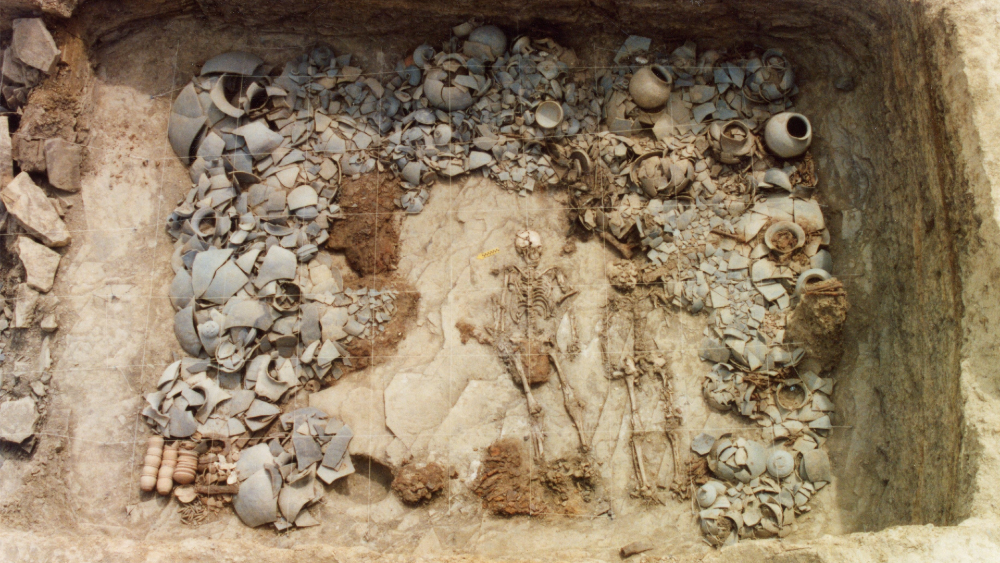
About 1,500 years ago, in what is now the southeastern region of South Korea, entire families were put to death — not as punishment, not as war, but as ritual offerings to honor the dead royalty buried beside them. A sweeping new genetic study has confirmed what archaeologists long suspected: ancient Korean society at this site practiced human sacrifice on a significant scale, and the social structure binding those communities together was far more tightly — and deliberately — interwoven than anyone had previously understood.
The findings, published on April 8 in the peer-reviewed journal Science Advances, are based on the analysis of 78 skeletons recovered from the Imdang-Joyeong burial complex in Gyeongsan, a city in South Korea’s North Gyeongsang Province. The research was conducted by an international team of scientists whose genetic analysis is now reshaping what we know about power, kinship, and death in ancient Korea.
This is not a story about a distant or abstract past. It is a story about how societies organize themselves around power — and what they were once willing to do to preserve it.
What Researchers Found Inside the Burial Complex
The Imdang-Joyeong burial complex is not a small site. It contains multiple tombs, and the 78 individuals whose remains were analyzed represent a cross-section of the people interred there across generations. What the genetic analysis revealed was striking on two fronts: evidence of ritual human sacrifice and an unusually high degree of inbreeding within the community.
Researchers found that whole families appear to have been sacrificed together to accompany local rulers into death — a practice that places this ancient Korean society alongside other ancient cultures around the world where human sacrifice served as a demonstration of royal power and religious devotion. The scale of this, involving family groups rather than isolated individuals, suggests it was not an improvised or rare act but a structured, socially recognized ritual.
The genetic data also revealed a kinship system that was notably dense and matrilineal in orientation — meaning it was organized around women and their descendants. This focus on female lineage as the core of family and social identity is a significant finding, offering a window into how gender shaped power and belonging in this ancient community.
The Science Behind the Discovery — Ancient Korean Human Sacrifice Confirmed
Genetic archaeology — the use of ancient DNA extracted from skeletal remains — has transformed what researchers can learn from burial sites. Rather than relying solely on the position of bones, grave goods, or tomb architecture, scientists can now read the biological relationships between individuals with a high degree of precision.
In this study, the team analyzed 78 skeletons and used that genetic data to reconstruct family trees, identify patterns of relatedness, and detect signs of consanguinity — the technical term for reproduction between close relatives, which is what produces inbreeding. The high level of inbreeding detected suggests this was not accidental but reflected deliberate social and possibly political choices about who could marry whom.
Here is a summary of the key confirmed details from the study:
| Detail | Finding |
|---|---|
| Publication date | April 8, in Science Advances |
| Site location | Imdang-Joyeong burial complex, Gyeongsan, South Korea |
| Number of skeletons analyzed | 78 |
| Estimated time period | Approximately 1,500 years ago |
| Key findings | Human sacrifice of entire families; high inbreeding; matrilineal kinship system |
| Research team | International team of researchers |
Why the Inbreeding Finding Matters as Much as the Sacrifice
Human sacrifice tends to dominate headlines — and understandably so. But the inbreeding finding is equally significant from a historical and anthropological standpoint.
High levels of inbreeding within elite or ruling groups are not unique to ancient Korea. Across history, from ancient Egypt’s pharaonic dynasties to European royal families, close-relative marriage was often used as a tool to consolidate wealth, maintain bloodline purity as a cultural concept, and keep political power within a tightly controlled group. Finding evidence of this practice at the Imdang-Joyeong complex suggests the community buried there — or at least the elite segments of it — operated under similar social logic.
The matrilineal structure adds another layer. In many ancient societies, descent and inheritance were tracked through the male line. A system centered on women and their descendants points to a distinct cultural framework — one where female ancestry carried particular weight in defining who belonged to which family and, by extension, who held social standing.
- The kinship system was organized around women and their descendants
- Inbreeding levels were notably high, suggesting deliberate social practices around marriage
- Entire family groups, not just individuals, appear to have been sacrificed
- The sacrifices were connected to honoring local royalty at the time of burial
- The site is located in the southeastern region of modern South Korea
What This Tells Us About Ancient Korean Society
The picture emerging from Gyeongsan is of a hierarchical society where the boundary between the living and the dead — and between the powerful and the powerless — was enforced in the most absolute way imaginable. Sacrificing an entire family to accompany a ruler into the afterlife was not an act of grief. It was a demonstration of dominion.
The dense kinship networks revealed by the DNA suggest that the people buried at this complex were not random subjects. They were bound together by blood, by lineage, and by a social system that defined their roles — including, for some, the role of dying alongside their ruler.
This research also contributes to a growing body of genetic archaeology work across Asia that is fundamentally revising our understanding of ancient social structures. Sites like Imdang-Joyeong are no longer just collections of bones and artifacts. With modern DNA analysis, they become readable records of how people lived, who they were related to, and what their society demanded of them.
What Comes Next for This Research
The study published in Science Advances represents a significant step, but researchers working in ancient Korean archaeology and genetic history are likely to build on these findings. The Imdang-Joyeong complex and similar sites across the Korean peninsula hold the potential for further excavation and analysis that could clarify the timeline of these practices, the specific ruling lineages involved, and how widespread human sacrifice was across different regions and periods of ancient Korea.
For now, the 78 individuals whose DNA was analyzed have provided a rare and detailed look at a society that existed 1,500 years ago — one that was deeply organized around family, power, and ritual in ways that continue to surprise even the researchers studying them.
Frequently Asked Questions
Where was the burial complex discovered?
The Imdang-Joyeong burial complex is located in Gyeongsan, in the southeastern region of South Korea.
How many skeletons were analyzed in the study?
Researchers analyzed 78 skeletons from the burial complex as part of the genetic study.
When was this ancient society believed to have practiced human sacrifice?
The practices identified in the study date back approximately 1,500 years.
Where were the study’s findings published?
The research was published on April 8 in the peer-reviewed journal Science Advances.
What kind of kinship system did this ancient society use?
The genetic analysis revealed a dense kinship system centered on women and their descendants, described as matrilineal in orientation.
Was the inbreeding accidental or deliberate?



Leave a Reply