
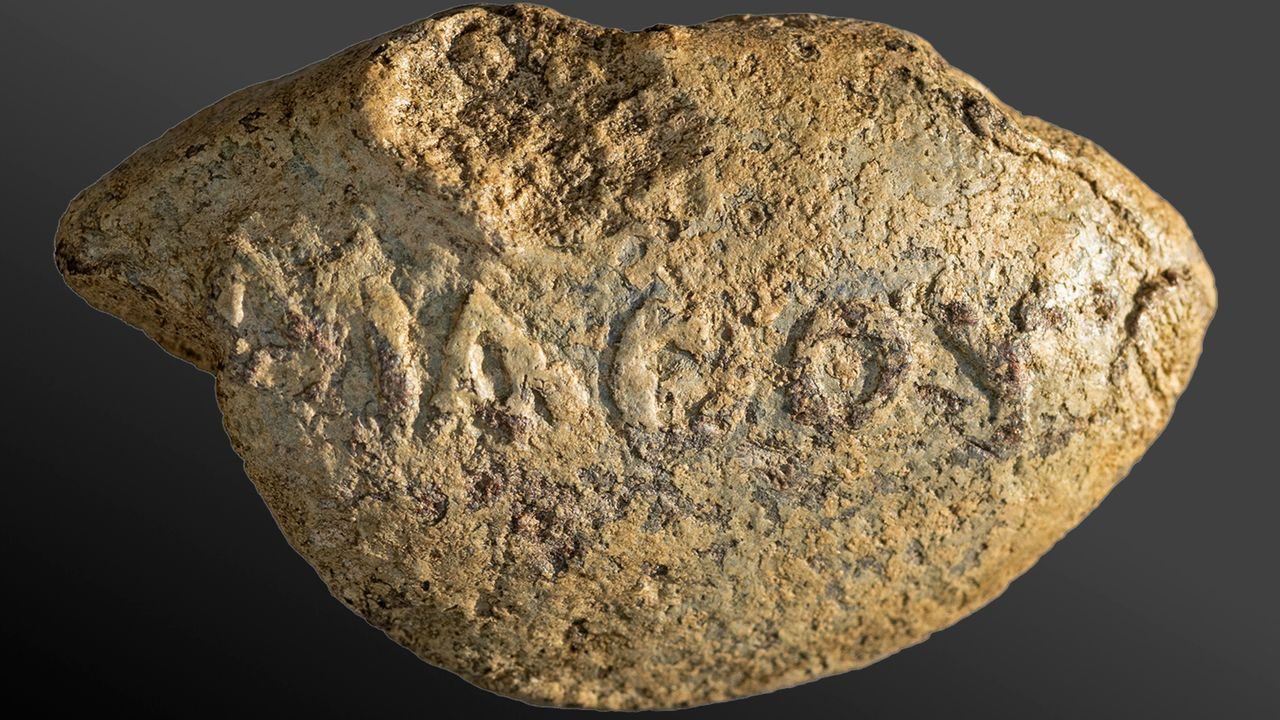
A small lead projectile, no larger than a walnut, has survived two millennia buried in the soil of the ancient Holy Land — and it carries one of the most chilling battlefield messages ever recovered by archaeologists. Inscribed in Greek, the word translates to a blunt, contemptuous command: “Learn your lesson.”
Israeli archaeologists recently unearthed the 2,000-year-old sling bullet at the site of the ancient city of Hippos, also known as Sussita, located in what is now modern Israel. It is a find that offers a rare, unfiltered glimpse into the psychology of ancient warfare — not just the weapons used, but the mindset of the people who wielded them.
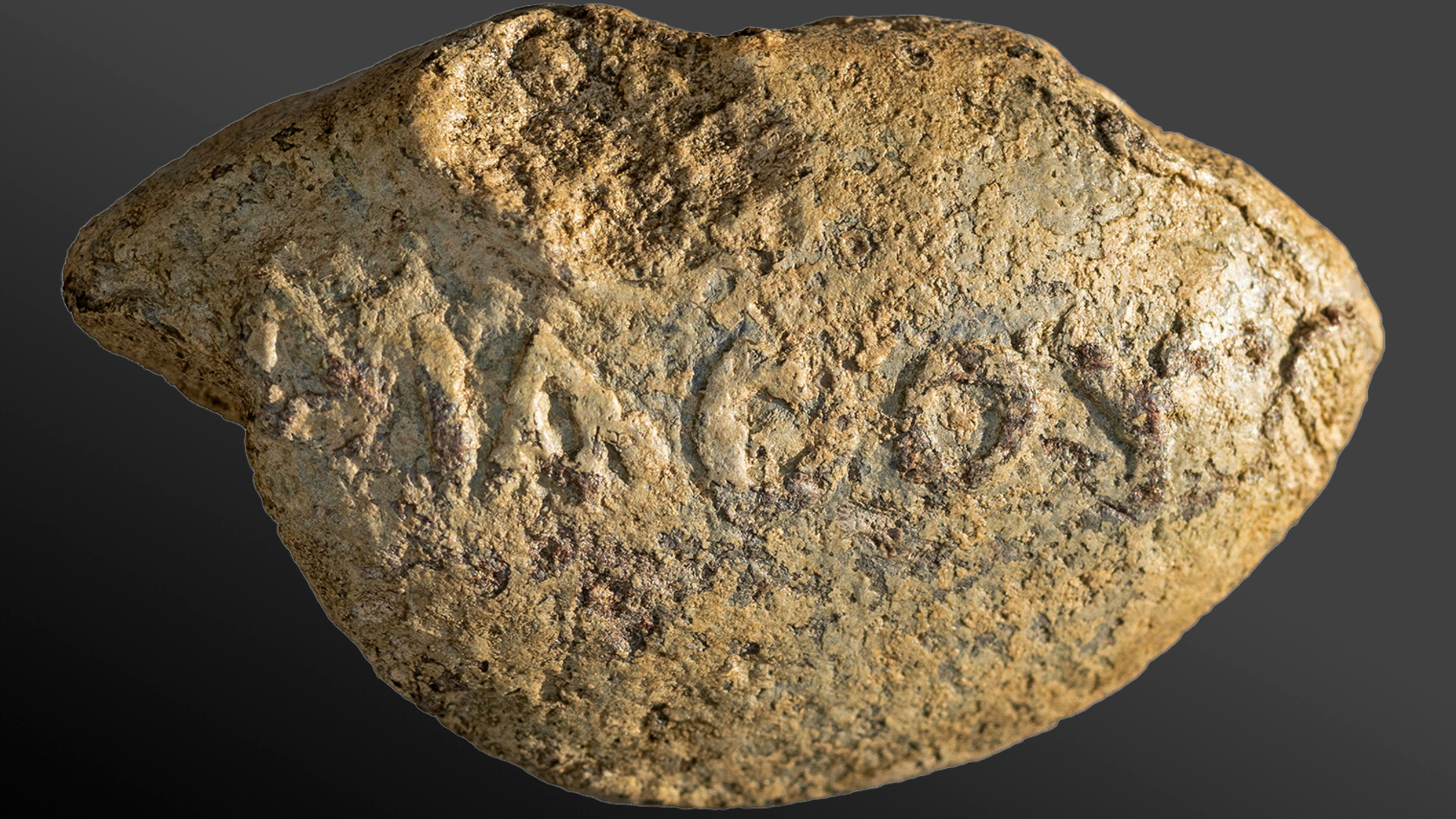
This wasn’t simply a weapon. It was a message, cast in molten lead, meant to humiliate as much as to harm.
What Was Found — and Where
The sling bullet was discovered in the ruins of Hippos, an ancient Greco-Roman city perched on a hilltop overlooking the Sea of Galilee. The city, known by its Semitic name Sussita — meaning “horse” — was one of the cities of the Decapolis, a league of ten prominent Hellenistic urban centers in the eastern Roman Empire.
The bullet itself is made of lead, which was the standard material for sling ammunition in the ancient world. What makes this one extraordinary is what was done before it was ever fired. The molten lead was poured into a mold that had been deliberately engraved with Greek letters: ΜΑΘΟΥ.
Researchers from the University of Haifa, including archaeologist Michael Eisenberg, identified the inscription. The word is understood to be an ancient Greek command form — an imperative — meaning “learn” or, in fuller context, “learn your lesson.” Every bullet cast from that mold would have carried the same taunting message into battle.
The Ancient Art of the Sling Bullet — and Its Hidden Messages
Slings were among the most effective ranged weapons of the ancient world. Skilled slingers could hurl lead bullets at speeds comparable to early firearms, with enough force to fracture bone and penetrate light armor. Armies across the Greek, Roman, and Near Eastern worlds relied on them heavily.
What is less commonly known is that inscribed sling bullets — sometimes called glandes in Latin — were not unusual in the ancient Mediterranean. Archaeologists have recovered bullets from various conflict sites bearing short inscriptions, including names of commanders, unit markings, and occasionally crude insults directed at enemies.
But the Hippos bullet stands out. Rather than a simple name or symbol, it delivers a full moral rebuke — a command to the enemy to reflect on their defeat. It speaks to a level of psychological warfare that feels startlingly modern.
| Detail | Information |
|---|---|
| Object | Lead sling bullet |
| Age | Approximately 2,000 years old |
| Discovery site | Hippos (Sussita), ancient Holy Land |
| Inscription language | Ancient Greek |
| Inscription (Greek) | ΜΑΘΟΥ |
| Translation | “Learn” / “Learn your lesson” |
| Research institution | University of Haifa |
| Named researcher | Michael Eisenberg |
Why This Discovery Matters Beyond the Battlefield
Finds like this one do more than satisfy curiosity about ancient weapons. They force us to reconsider how sophisticated — and how deliberately cruel — ancient psychological warfare could be.
The act of engraving a mold, rather than scratching letters into individual bullets after casting, tells researchers something important: this was not an impulsive act. Someone planned it. They wanted every single bullet produced from that mold to carry the same contemptuous message. It was a deliberate manufacturing choice, made before the battle even began.
That level of premeditation suggests the inscription was intended as much for morale as for injury. Whether the enemy soldiers who were struck by these bullets ever read the words is unknowable. But the intent — to demean, to warn, to psychologically dominate — is unmistakable across two thousand years.
Hippos itself was a culturally layered city, sitting at the intersection of Greek, Roman, and Jewish worlds during one of the most turbulent periods in the region’s history. The use of Greek for the inscription reflects the dominant administrative and cultural language of the Hellenistic and early Roman periods in that part of the ancient Near East.
What This Tells Us About Ancient Conflict in the Holy Land
The Holy Land during this period was no stranger to violence. The region saw repeated military conflicts — between local Jewish populations and Hellenistic rulers, between competing Roman factions, and during the great Jewish revolts against Rome. Hippos, as a Hellenistic city in a contested region, would have been both a target and a participant in many of these struggles.
Sling bullets have been recovered from conflict sites across the ancient world, but inscribed examples from this specific region remain rare and significant. Each one functions like a frozen moment of human aggression — a physical artifact of someone’s anger, fear, or contempt, preserved in metal long after the battle ended and everyone involved turned to dust.
The Hippos bullet joins a small but remarkable collection of ancient weapons that double as written communication. It is, in a very real sense, a letter — just one that was meant to arrive at lethal velocity.
What Comes Next for the Research
The discovery was made by researchers affiliated with the University of Haifa, with Michael Eisenberg credited in connection with the find. Further analysis of the bullet and the broader archaeological context of Hippos is expected to continue, as the site has yielded significant finds over years of excavation.
Scholars will likely focus on dating the bullet more precisely and connecting it to specific known conflicts in the region during the Hellenistic or early Roman periods. Understanding who fired it — and at whom — remains an open question that future excavation layers may help answer.
For now, the bullet sits as one of the more arresting objects to emerge from the ancient Holy Land in recent memory: a weapon, a warning, and a window into a world where even ammunition could carry a grudge.
Frequently Asked Questions
Where was the 2,000-year-old sling bullet found?
It was discovered at the site of the ancient city of Hippos, also known as Sussita, located in the ancient Holy Land in what is now modern Israel.
What does the inscription on the sling bullet say?
The bullet is inscribed with the Greek letters ΜΑΘΟΥ, which researchers interpret as a command meaning “learn” or “learn your lesson.”
What language is the inscription written in?
The inscription is written in ancient Greek, which was the dominant cultural and administrative language of the Hellenistic and early Roman periods in that region.
Who discovered and researched the sling bullet?
The find is associated with researcher Michael Eisenberg and the University of Haifa, who are conducting archaeological work at the Hippos site.
How was the message put on the bullet?
The Greek letters were engraved into the mold used to cast the bullet, meaning the inscription was baked into the manufacturing process — every bullet from that mold would have carried the same message.
Were inscribed sling bullets common in the ancient world?
Inscribed sling bullets have been found at various ancient Mediterranean conflict sites, sometimes bearing names or short messages, but a full command like this one is considered a particularly striking example.




Leave a Reply