
Somewhere beneath the sun-bleached ruins of an ancient Mediterranean city, workers uncovered a floor that hadn’t been walked on in roughly 1,500 years — and what it had to say turned out to be surprisingly relatable.
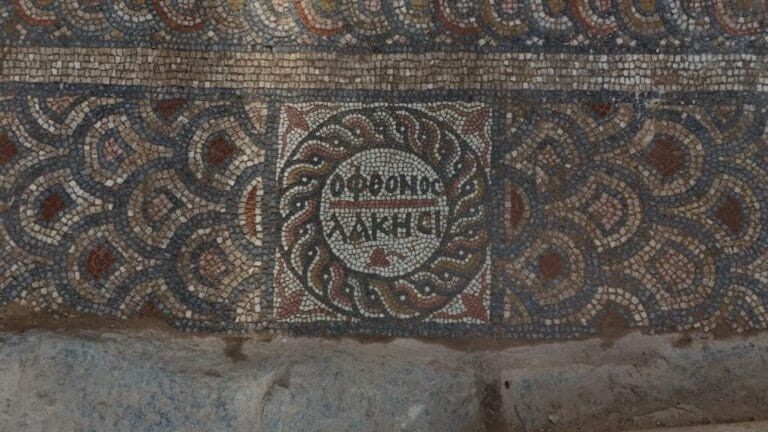
Archaeologists excavating the ancient city of Syedra, near modern-day Alanya on Turkey’s southern Mediterranean coast, have unearthed a strikingly well-preserved mosaic floor dating to approximately the 5th or 6th century AD. The mosaic itself is beautiful — but it’s the words embedded within it that have genuinely caught people off guard. One of its inscriptions is essentially the ancient world’s version of telling your haters to deal with it.
https://www.instagram.com/p/DV3AY24iKQH/
https://www.instagram.com/reel/DV02tRkjLYC/
The discovery is offering historians and the public alike a rare, unfiltered window into the personality of late Roman and early Byzantine daily life — and proof that human nature hasn’t changed quite as much as we might assume.
What Was Found Beneath the Ancient City of Syedra
The mosaic measures approximately 4.5 by 4.5 metres — a substantial floor covering that would have dominated the room it belonged to. Archaeologists believe it was part of one of Syedra’s important residential buildings, likely the entrance area of a significant private home or civic structure.
The design is intricate, featuring geometric and floral patterns characteristic of the late antique decorative tradition. Mosaics of this kind were status symbols — expensive, time-consuming to produce, and intended to impress anyone who crossed the threshold. The owner of this building clearly had resources and wasn’t shy about showing it.
But the real surprise wasn’t the craftsmanship. It was the text.
Two Greek inscriptions were found worked into the mosaic’s design. The first, positioned at the centre of the floor, carries a welcoming message translated variously as “Use it with joy” or simply “Enjoy it” — a warm invitation to whoever entered the space.
The second inscription, placed near the entrance within a circular border, takes a sharper tone entirely.
The Inscription That Stopped Archaeologists in Their Tracks
The entrance inscription has been translated as “May the envious burst with jealousy” — a phrase that excavation director Ertuğ Ergürer, a professor at Alanya Alaaddin Keykubat University, describes as expressing something that “corresponds to the phrase ‘let the jealous one burst’ that we still use today.”
“Encountering such an expression at the entrance of a structure built approximately 1500 years ago was a great surprise for us.” — Ertuğ Ergürer, excavation director
It’s a sentiment that reads less like a formal dedication and more like something a proud homeowner might mutter under their breath — or, in this case, commission a craftsman to immortalise permanently in stone and tile at the front door.
The placement matters. Positioning a message at the entrance of a building was deliberate. Visitors would see it the moment they arrived. Whether it was meant as a boast, a joke, a ward against the evil eye, or simply a statement of pride, it communicated something personal and immediate about the person who lived there.
Key Facts About the Mosaic Discovery
| Detail | Information |
|---|---|
| Location | Ancient city of Syedra, near Alanya, southern Turkey |
| Estimated date | Approximately 5th or 6th century AD |
| Dimensions | Approximately 4.5 by 4.5 metres |
| Design features | Geometric and floral patterns, two Greek inscriptions |
| Inscription 1 (centre) | “Use it with joy” / “Enjoy it” |
| Inscription 2 (entrance) | “May the envious burst with jealousy” |
| Excavation director | Prof. Ertuğ Ergürer, Alanya Alaaddin Keykubat University |
| Building type | Believed to be an important residential structure |
Why This Find Matters Beyond the Humour
It’s easy to focus on the wit of the inscription — and understandably so. There’s something genuinely delightful about a 1,500-year-old floor telling envious neighbours to mind their business. But the discovery carries real historical weight beyond the punchline.
Mosaics from this period are relatively well-documented in religious and public settings — churches, bathhouses, civic buildings. Finding one of this quality in what appears to be a private residential context adds to the picture of how wealthy individuals in late antique cities lived, decorated their homes, and projected their status.
The inscriptions also speak to the continuity of human emotion. Envy, pride, the desire to show off and simultaneously dare others to resent you for it — these aren’t modern inventions. The person who commissioned this floor was navigating social dynamics that would feel immediately familiar today.
Syedra itself is a site with significant archaeological potential. Located on the Mediterranean coast near Alanya, it was an active city during the Roman and early Byzantine periods. Finds like this mosaic help fill in the texture of daily life in cities that history often records only through official documents, wars, and religious controversies.
What Comes Next for the Site
Given the find’s condition — described as remarkably well-preserved — it is reasonable to expect that ongoing work at Syedra will continue to attract academic and public interest.
Professor Ergürer and the team at Alanya Alaaddin Keykubat University are leading the excavation, and the discovery has already drawn attention from the broader archaeological community. Whether additional rooms or structures connected to the mosaic building remain to be uncovered has not yet been confirmed in available reporting.
What is clear is that Syedra has more to say — and if this floor is any indication, it may say it with considerable personality.
Frequently Asked Questions
Where exactly was the mosaic discovered?
The mosaic was found at the ancient city of Syedra, located near modern-day Alanya on Turkey’s southern Mediterranean coast.
How old is the mosaic?
Archaeologists date the mosaic to approximately the 5th or 6th century AD, placing it in the late Roman and early Byzantine period.
What do the inscriptions on the mosaic say?
One inscription reads “Use it with joy” or “Enjoy it,” while the entrance inscription translates roughly as “May the envious burst with jealousy.”
Who is leading the excavation?
The excavation is directed by Professor Ertuğ Ergürer of Alanya Alaaddin Keykubat University.
What kind of building did the mosaic belong to?
Archaeologists believe it was part of one of Syedra’s important residential buildings, based on its location and design.
Will the mosaic be put on public display?
This has not yet been confirmed in available reporting on the discovery.

Leave a Reply