
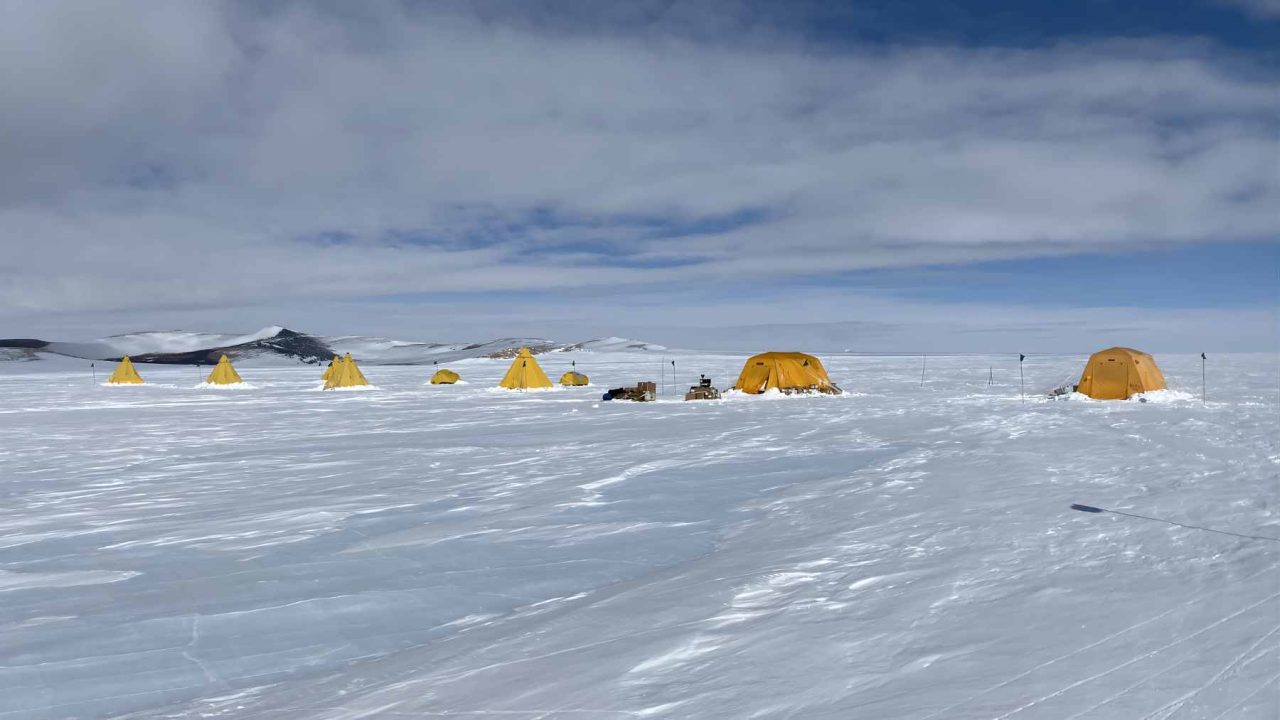
Nine meters beneath the surface of Antarctica, at a temperature of minus 52 degrees Celsius, scientists have built something that may outlast every climate policy, international agreement, and government currently in existence — a frozen library of Earth’s past, preserved without a single watt of electricity.
The Ice Memory Foundation officially opened the world’s first global sanctuary for mountain ice cores in mid-January, carved into the compacted snow of the Antarctic plateau near the Franco-Italian Concordia Station. The cave stretches 35 meters long and stays cold enough on its own to preserve samples that took thousands of years to form — and that are now disappearing from the world’s glaciers faster than anyone anticipated.
It is one of the most quietly ambitious scientific projects on the planet, and most people have never heard of it.
What Is Actually Stored Inside This Antarctic Cave
Ice cores are cylindrical samples drilled from glaciers and ice sheets. Locked inside them are air bubbles, dust particles, and chemical signatures that record centuries of atmospheric conditions — volcanic eruptions, ancient temperatures, the composition of air before industrialization, and the slow fingerprint of human activity on the climate.
Think of them as nature’s own hard drive. Once a glacier melts, that data is gone permanently. There is no recovery, no backup, no second chance.
The sanctuary near Concordia Station was designed specifically to solve that problem. By housing ice cores in a naturally stable sub-zero environment, the Ice Memory Foundation can preserve samples from glaciers that are actively retreating or may disappear entirely within decades. The cave requires no mechanical cooling system and no continuous power supply — the Antarctic plateau’s own climate does the work.
The project was launched in 2015 as an international collaboration between France’s CNRS research agency and partner institutes in Italy and Switzerland. Nearly a decade of planning, drilling, and international coordination preceded the January inauguration.
Why the Timing Could Not Be More Urgent
The opening of this sanctuary comes against a backdrop of accelerating loss. According to available climate data, 2025 ranked among the three warmest years ever recorded, with global temperatures running approximately 1.4 degrees Celsius above 19th-century averages.
Mountain glaciers — the very sources of many of these ice cores — are shrinking at rates that vary dramatically by region but are almost universally heading in one direction. The World Meteorological Organization has flagged the pace of glacier loss as a growing concern for water supplies, sea level rise, and the scientific record itself.
Once those glaciers are gone, the climate history they contain goes with them. The ice cores stored in Antarctica may eventually be the only physical evidence we have of what Earth’s atmosphere looked like before human industry reshaped it.
The Numbers Behind the Frozen Archive
| Detail | Specification |
|---|---|
| Cave length | 35 meters |
| Depth below surface | Approximately 9 meters |
| Natural storage temperature | Approximately minus 52°C |
| Power required for cooling | None — naturally maintained |
| Location | Antarctic plateau, near Concordia Station |
| Project launched | 2015 |
| Founding organizations | CNRS (France), partner institutes in Italy and Switzerland |
| Sanctuary inaugurated | Mid-January 2026 |
| Global temperature rise (2025) | Approximately 1.4°C above 19th-century average |
| Glacier ice loss since 2000 | Between approximately 2% and 39% depending on region |
What This Means for the Future of Climate Science
The practical value of this archive is hard to overstate. Climate scientists rely on ice cores to understand how the atmosphere behaved long before modern instruments existed. They reveal how quickly temperatures shifted during past warming events, how greenhouse gas concentrations changed over millennia, and what natural climate variability actually looks like at scale.
That context is essential for modeling future climate scenarios accurately. Without preserved samples from glaciers that no longer exist, future researchers would be working with an incomplete picture — trying to understand a story with critical chapters torn out.
Supporters of the project argue that centralizing these samples in one of the most stable cold environments on Earth — rather than leaving them distributed across mountain research stations that depend on refrigeration equipment and funding continuity — dramatically improves the chances that this scientific record survives the coming centuries intact.
The fact that the cave maintains its temperature entirely through natural conditions also means the archive is not vulnerable to power failures, budget cuts, or equipment breakdowns. In a world where institutions rise and fall, that kind of passive resilience carries real weight.
The Scale of What Is Already Lost
The urgency behind this project becomes clearer when you look at what glacier retreat has already cost the scientific community. Since 2000, mountain glaciers across different regions have lost anywhere from roughly 2% to 39% of their ice volume, according to available data.
In practical terms, that means ice cores that could have been collected from those glaciers twenty years ago simply cannot be collected today. The samples that researchers managed to extract and preserve before that loss occurred are now irreplaceable.
The Ice Memory Foundation’s sanctuary is, in part, a direct response to that lesson — an acknowledgment that waiting is not a neutral choice when
What Comes Next for the Ice Memory Project
With the sanctuary now formally open, the next phase involves expanding the collection of ice cores stored within it. The project has always been conceived as a global effort, drawing on drilling expeditions from glaciers on multiple continents before those sites deteriorate further.
Researchers involved in the broader initiative have described the sanctuary as a long-term investment in scientific continuity — not just for the current generation of climate scientists, but for researchers who will be working decades or centuries from now, asking questions we cannot yet fully anticipate.
The cave beneath the Antarctic snow is not dramatic in the way that space telescopes or particle accelerators are dramatic. But what it holds — the frozen breath of a planet across thousands of years — may prove just as consequential to our understanding of where Earth has been, and where it is heading.
Frequently Asked Questions
Where exactly is the ice core sanctuary located?
It is situated on the Antarctic plateau, near the Franco-Italian Concordia Station, approximately 9 meters below the snow surface.
How cold does the cave get, and does it need electricity to stay that temperature?
The cave maintains a natural temperature of approximately minus 52 degrees Celsius with no electricity or mechanical cooling required.
Who is behind the Ice Memory Foundation project?
The project was launched in 2015 by the French research agency CNRS, along with partner institutes in Italy and Switzerland.
Why are ice cores so important to climate science?
Ice cores preserve ancient atmospheric data — including air bubbles, temperature signatures, and chemical records — that cannot be obtained any other way once a glacier melts.
How much glacier ice has the world already lost?
Since 2000, mountain glaciers have lost between approximately 2% and 39% of their ice depending on the region, according to available data cited in connection with the project.
When was the sanctuary officially opened?
The Ice Memory Foundation inaugurated the sanctuary in mid-January 2026.




Leave a Reply