
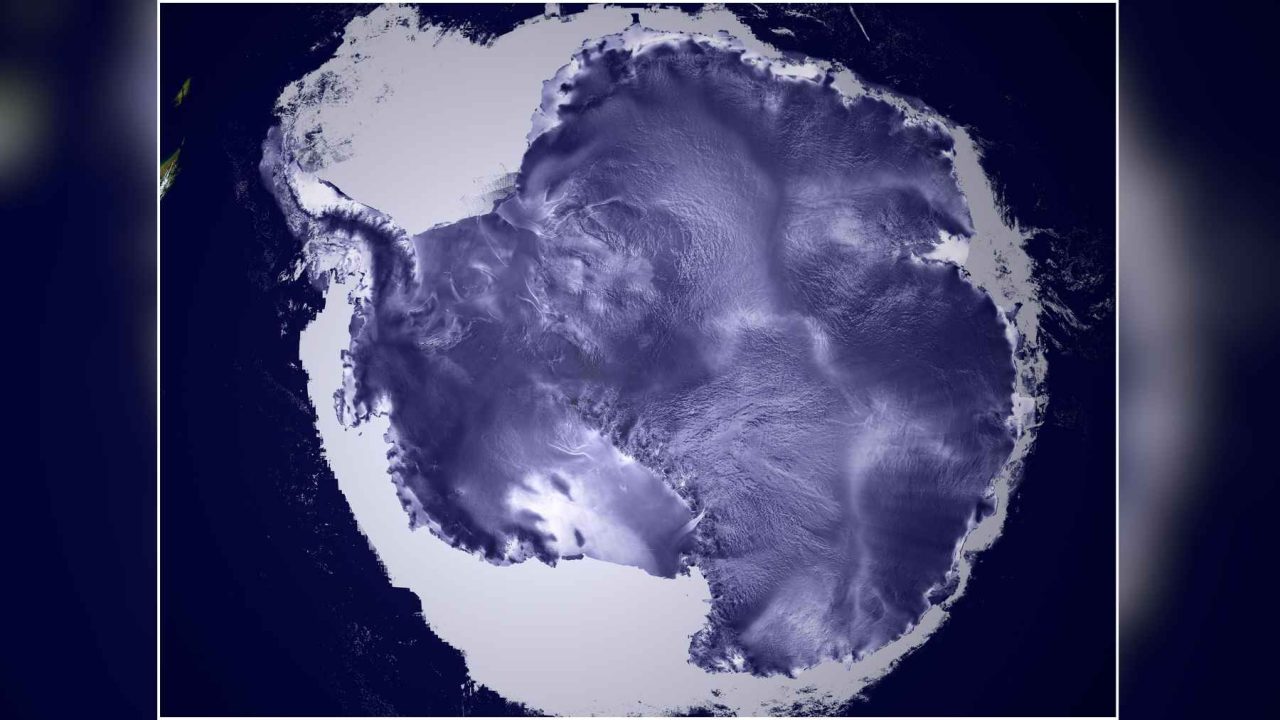
Beneath the frozen expanse of Antarctica lies a scientific puzzle that has quietly puzzled researchers for decades — a region where gravity itself is measurably weaker than it should be. Now, a new study suggests this strange phenomenon, known as the Antarctic Geoid Low, took shape over at least 70 million years through extraordinarily slow movements of rock deep inside Earth’s mantle.
This isn’t a crater or a physical void. There’s no actual hole in the ice. But the gravitational signal is real, and what it tells us about the planet’s hidden interior is only now coming into focus.
To understand why this matters, you have to think about what gravity actually does at a planetary scale — and why a slight dip in its strength beneath one of Earth’s most remote continents could have consequences that stretch far beyond the South Pole.
What the Antarctic Geoid Low Actually Is
The term “gravitational hole” is a shorthand that sounds dramatic but describes something genuinely unusual. The Antarctic Geoid Low is a vast region where gravity is slightly weaker than average, once Earth’s rotation is factored out of the equation.
The reason it forms comes down to mass distribution. Earth is not a perfectly uniform sphere. Its interior is made up of layers of rock and molten material with varying densities, and those differences create subtle but measurable variations in the gravitational pull across the planet’s surface.
Where mass is lower — because the rock beneath is less dense, or because material has shifted away over geological time — gravity weakens slightly. That’s exactly what appears to be happening beneath Antarctica, and the new research points to slow-moving rock in the mantle as the culprit behind it.
In practical terms, weaker gravity in this region means the ocean surface around Antarctica can sit slightly lower relative to Earth’s center. Water naturally migrates toward areas where gravitational pull is stronger, so a gravity low can subtly reshape the sea surface over time. That connection between gravity, ocean levels, and ice sheet behavior is part of why scientists find this anomaly so scientifically significant.
How the Research Was Done
To trace how this anomaly developed over tens of millions of years, geophysicists Petar Glišović and Alessandro Forte combined seismic tomography with physics-based modeling. Seismic tomography works similarly to a medical CT scan — it uses the way seismic waves travel through Earth’s interior to build a picture of what lies beneath the surface, revealing variations in density and temperature deep within the mantle.
By layering that imaging data with physical models of how mantle rock flows over geological timescales, the researchers were able to reconstruct the anomaly’s history and estimate how long it has been building.
Their conclusion: the Antarctic Geoid Low has been shaped over at least 70 million years by extremely slow rock movements deep inside the mantle. That’s a timescale that dwarfs human civilization — and even predates the extinction of the dinosaurs.
Key Facts About the Antarctic Gravitational Anomaly
| Feature | Detail |
|---|---|
| Scientific name | Antarctic Geoid Low |
| Nature of the anomaly | Region of slightly weaker gravitational pull |
| Cause identified by new research | Slow rock movements deep in Earth’s mantle |
| Estimated formation period | At least 70 million years |
| Research method used | Seismic tomography combined with physics-based modeling |
| Lead researchers | Petar Glišović and Alessandro Forte |
| Practical effect | Ocean surface around Antarctica sits slightly lower |
- The anomaly is not a physical hole — it is a gravitational signal caused by uneven mass distribution below the surface
- Earth’s rotation must be accounted for before the weaker gravity becomes measurable
- Water moves toward areas of stronger gravitational pull, meaning the anomaly affects local ocean surface levels
- The mantle movements responsible are extraordinarily slow, unfolding across geological rather than human timescales
Why This Could Matter Beyond Antarctica
At first glance, a gravitational quirk beneath a frozen, mostly uninhabited continent might seem like a curiosity for specialists. But the implications reach further than the ice shelf.
The link between gravity, ocean surface levels, and ice sheet behavior is a critical one for climate science. Understanding how these forces interacted over tens of millions of years could help researchers build more accurate models of how ice sheets grow and retreat — and how sea levels respond.
Researchers have noted that better mapping of gravitational anomalies like this one could improve our understanding of how sea level and ice sheet growth connect over geologic time. That kind of deep-time context is increasingly valuable as scientists try to understand the long-term dynamics of Antarctic ice in a warming world.
There’s also a broader scientific value here. The mantle is largely inaccessible to direct observation — no drill has ever come close to reaching it. Studies like this one, which use seismic data to peer into Earth’s interior and reconstruct its history, expand what we know about the planet’s hidden engine. The slow churning of rock miles below the surface turns out to shape the world above in ways that are still being mapped.
What Comes Next in This Research
The identification of mantle movement as the driving force behind the Antarctic Geoid Low opens new questions rather than closing old ones. Researchers will likely look more closely at the specific dynamics of how that rock moved, which regions of the mantle were most involved, and whether similar processes are responsible for gravitational anomalies elsewhere on Earth.
The method used — combining seismic tomography with physics-based modeling — also represents a template that could be applied to other geological mysteries. If deep mantle flow can be reconstructed across 70 million years beneath Antarctica, similar techniques might illuminate other long-standing puzzles about how Earth’s interior shapes its surface.
For now, the Antarctic Geoid Low remains one of the more striking reminders that the planet we think we know is still full of surprises — including some that have been quietly building since before the age of mammals.
Frequently Asked Questions
What is the Antarctic Geoid Low?
It is a large region beneath Antarctica where gravity is slightly weaker than average, once Earth’s rotation is factored in. It is not a physical hole but a signal of uneven mass distribution deep below the surface.
What causes the gravitational anomaly in Antarctica?
According to the new research, it was caused by extremely slow movements of rock deep inside Earth’s mantle, a process that has been building for at least 70 million years.
Who conducted this research?
The study was carried out by geophysicists Petar Glišović and Alessandro Forte, who used seismic tomography combined with physics-based modeling to reconstruct the anomaly’s history.
Does this gravitational anomaly affect sea levels?
Yes, in a subtle way. Weaker gravity can cause the ocean surface around Antarctica to sit slightly lower, because water migrates toward areas where gravitational pull is stronger.
Is Antarctica sinking or physically different because of this?
No. The anomaly is a gravitational signal, not a physical depression or structural change in the continent itself.
Why did it take so long to explain this phenomenon?


Leave a Reply