
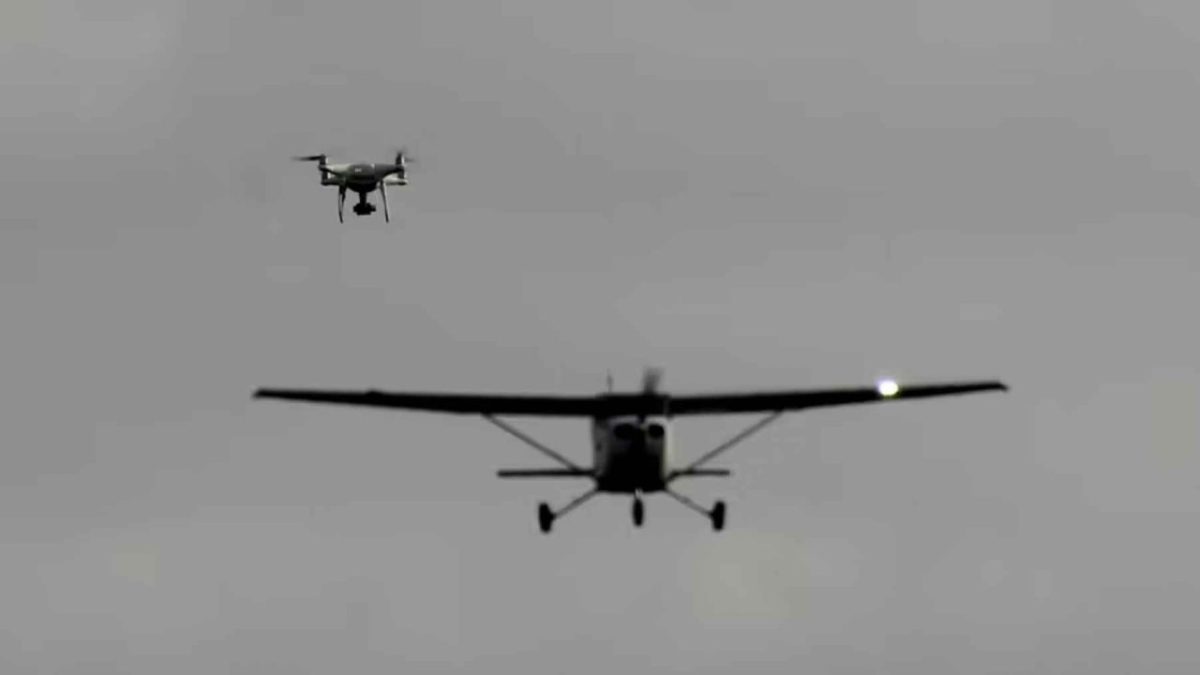
A military laser fired at a suspected cartel drone near El Paso International Airport brought air traffic to a standstill in early February — not because the weapon missed, but because it hit a party balloon. For a few tense hours, flights in and out of one of the busiest border airports in the American Southwest were grounded while officials determined whether the laser itself posed a danger to passenger aircraft overhead.
That single incident captures something essential about where anti-drone defense stands right now. The technology is advancing fast, and some of it genuinely looks like science fiction. But the harder truth, the one that keeps security planners up at night, is that no system works perfectly — and every new drone threat has a way of exposing whatever gap you thought you had covered.
The arms race between drones and the systems designed to stop them is accelerating. Understanding where it stands, and why experts warn that a single solution is never enough, matters for anyone living near critical infrastructure, an airport, a military base, or a national border.
What Actually Happened at El Paso — and Why It Matters
According to reports, personnel from U.S. Customs and Border Protection used a Pentagon-supplied high-energy laser during what was described as a test near El Paso. The weapon was directed at an object officials believed to be a cartel drone operating along the border — a real and documented threat in that region.
The object turned out to be a party balloon. The Federal Aviation Administration responded by temporarily closing the airspace around El Paso International Airport while officials assessed whether the laser itself could endanger commercial aircraft in the area.
It is a story with layers. Cartel drones are a genuine operational problem for border authorities. High-energy lasers are a legitimate and increasingly deployed counter-drone tool. The decision to fire was not irrational. And yet the outcome — a closed airport, a mistaken target, a weapon pointed skyward near commercial flight paths — illustrates exactly why experts consistently warn that no anti-drone technology, however advanced, operates without risk or error.
The Anti-Drone Arsenal: What’s Actually Being Used
The range of technologies now deployed or under active development to counter hostile drones is broad, and parts of it do read like a science fiction inventory. Here is what the current landscape includes:
- High-energy lasers: Directed-energy weapons capable of disabling or destroying a drone by focusing intense heat on its components. The El Paso incident involved one of these Pentagon-supplied systems.
- RF jammers and signal inhibitors: Devices that disrupt the radio frequency link between a drone and its operator, causing the drone to lose control, hover in place, or return to its launch point.
- GPS spoofing systems: Technology that feeds false location data to a drone’s navigation system, redirecting it away from a protected area.
- Net-firing systems: Ground-based or airborne systems that physically capture a drone by launching a net around it — effective at close range without the risks associated with kinetic or energy weapons.
- Counter-drone drones: Autonomous or remotely piloted aircraft designed specifically to intercept and disable hostile drones in the air.
- Radar and sensor detection arrays: Systems that identify and track drones before any countermeasure is deployed, providing the targeting data every other system depends on.
| Technology | Primary Method | Key Limitation |
|---|---|---|
| High-energy laser | Destroys drone with focused heat | Risk to nearby aircraft; misidentification possible |
| RF jammer / inhibitor | Disrupts drone-operator signal | Can interfere with legitimate communications |
| GPS spoofing | Redirects drone via false location data | May affect other GPS-dependent systems nearby |
| Net-firing system | Physically captures drone | Limited effective range |
| Counter-drone aircraft | Intercepts drone in flight | Response time and cost constraints |
| Radar and sensor arrays | Detection and tracking only | Must be paired with an active countermeasure |
The Warning No One Wants to Hear: There Is No Foolproof System
Here is the uncomfortable reality that security analysts and defense officials have been frank about: every one of these technologies has a weakness, and every new drone threat tends to find it.
Jammers can disrupt friendly communications. Lasers require a clear line of sight and carry their own collateral risks, as El Paso demonstrated. Net systems work at close range but struggle with fast or small targets. Radar arrays can detect drones but cannot stop them on their own. And autonomous counter-drone aircraft, for all their promise, introduce their own set of failure modes and legal complications over populated areas.
The expert consensus — and it is consistent across defense research and security planning — is that real protection requires layering multiple systems together. Detection feeds targeting data to a jammer; the jammer forces the drone into a predictable flight path; a net or laser handles the final intercept. Each layer compensates for the weakness of the one before it.
The problem is that layered systems are expensive, complex to coordinate, and still not immune to a threat that evolves faster than the defenses designed to stop it. Every new drone design, every new attack tactic, stress-tests the plan in ways that are difficult to predict in advance.
Who Is Most Exposed Right Now
The El Paso incident focused attention on border security, but the drone threat is not confined to any single context. Airports, power infrastructure, military installations, large public events, and even private industrial facilities have all faced documented drone incursions in recent years.
For ordinary people, the practical consequence is less about personal danger and more about disruption — grounded flights, closed airspace, delayed emergency responses — caused by the countermeasures themselves as much as by the drones they are meant to stop. A weapon powerful enough to destroy a drone is powerful enough to cause problems if it is pointed in the wrong direction.
That tension — between the need to act and the risk of acting wrongly — is at the center of every anti-drone deployment decision. Officials have to move fast, often with incomplete information, against targets that can be as small and unremarkable as a party balloon drifting on the wind.
What the Next Phase of This Looks Like
The development of anti-drone technology is not slowing down. Investment from both government and private defense contractors is pushing new systems toward deployment, with artificial intelligence increasingly being used to improve detection accuracy and reduce the risk of misidentification — the exact failure that occurred at El Paso.
But the fundamental challenge will remain. Drones are cheap, accessible, and adaptable. The systems designed to stop them are expensive, specialized, and constrained by rules about where and how they can be used near civilian populations. Until that asymmetry narrows, the honest answer from anyone working in this field is the same: no single layer of defense is enough, and the next threat will always be testing the edges of whatever is currently in place.
Frequently Asked Questions
What happened at El Paso International Airport with the anti-drone laser?
U.S. Customs and Border Protection personnel fired a Pentagon-supplied high-energy laser at an object believed to be a cartel drone. The object turned out to be a party balloon, and the FAA temporarily closed airspace around the airport as a precaution.
What types of anti-drone technologies are currently in use?
Deployed and developing systems include high-energy lasers, RF jammers, GPS spoofing devices, net-firing systems, counter-drone aircraft, and radar detection arrays, each with distinct strengths and limitations.
Is there a single anti-drone system that can stop all threats?
No. Security experts consistently warn that no single system is foolproof, and that effective defense requires combining multiple layers of technology, because each method has weaknesses that a new drone or attack tactic can exploit.
Why did the FAA close airspace during the El Paso laser incident?
Officials needed to assess whether the high-energy laser itself posed a risk to commercial passenger aircraft operating in the area, not just the object it had been fired at.
Who is most at risk from hostile drone activity?
Based on documented incidents, airports, border zones, military installations, power infrastructure, and large public events face the highest exposure, though the threat is not limited to any single sector.
Can anti-drone systems accidentally interfere with civilian technology?
Yes. RF jammers can disrupt legitimate communications, GPS spoofing can affect other navigation systems in the area, and directed-energy weapons carry risks for aircraft and other objects in their path — all documented concerns with current countermeasure technologies.




Leave a Reply