
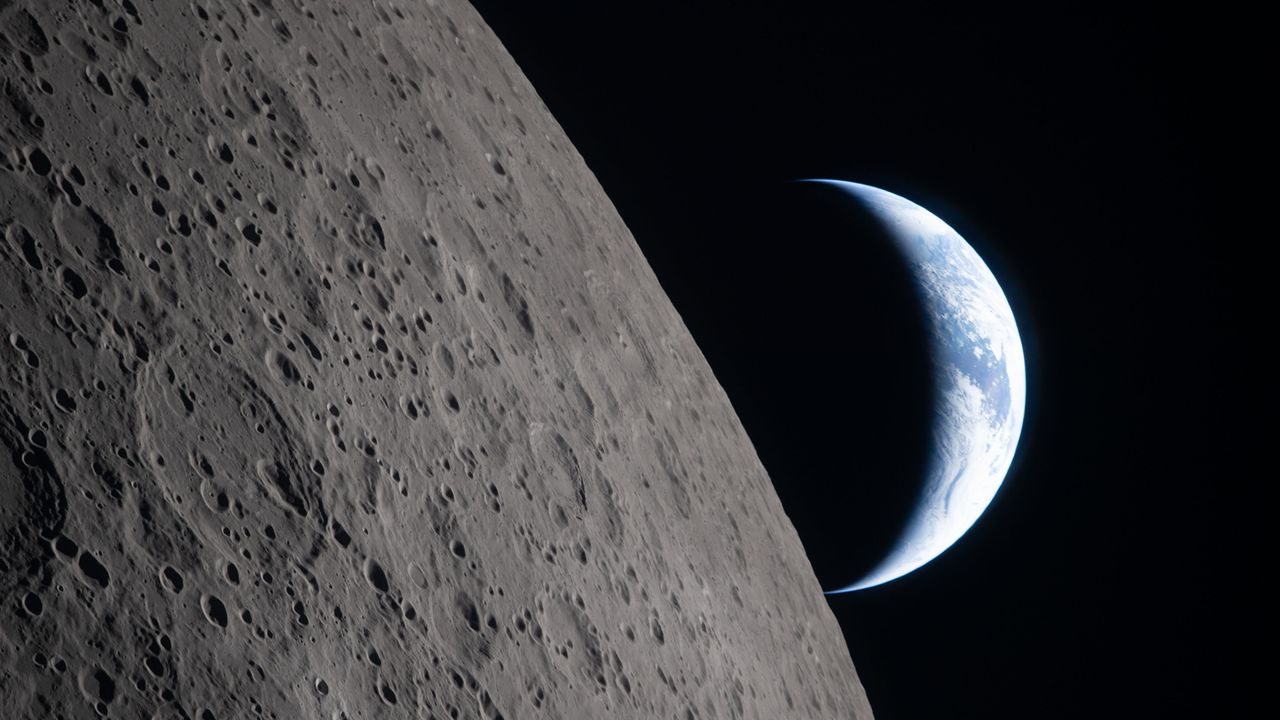
Imagine watching Earth — the only home humanity has ever known — slowly slip behind the edge of the moon and vanish from sight entirely. No ground beneath your feet. No atmosphere between you and the void. Just silence, and then nothing where your entire world used to be.
That is exactly what the crew of NASA’s Artemis II mission experienced, and a photograph they captured in that extraordinary moment has now been shared with the world. Taken on April 6, 2026, the image shows a crescent Earth setting on the moon’s rugged limb — a phenomenon being called an “Earthset” — and it may be the most quietly devastating space photograph taken in a generation.
The crew described the experience as something human minds were never built to process. And looking at the image, it is not hard to understand why.
What the Artemis II Mission Actually Did
Artemis II is NASA’s first crewed mission to travel around the moon in more than half a century. Unlike the Apollo missions that landed on the lunar surface, Artemis II was a flyby — a journey designed to carry astronauts around the moon and back, testing systems and pushing human spaceflight back into deep space for the first time since the Apollo era ended.
The mission represents a critical step in NASA’s broader Artemis program, which aims to eventually return humans to the lunar surface. Before anyone sets foot on the moon again, NASA needed to prove that its new systems — the Orion capsule, the Space Launch System rocket, and the life support infrastructure — could carry a human crew safely around the moon and bring them home.
Artemis II did exactly that, and along the way, its crew captured something that no camera had framed in quite this way before.
The Moment Earth Disappeared Behind the Moon
The photograph was taken just before the Artemis II crew passed behind the moon — a moment when Earth itself would become completely invisible to them, blocked by 2,000 miles of ancient lunar rock.
The image was captured from approximately 4,070 miles (6,550 kilometers) above the lunar surface. From that altitude, Earth appears as a thin crescent, its familiar blue-and-white shape reduced to a delicate sliver of light resting on the moon’s uneven horizon.
There is something deeply disorienting about the image. On Earth, we watch the sun and moon rise and set. Here, it is Earth itself that is setting — becoming the small thing, the fragile thing, the thing that disappears. The crew reportedly described the experience as something human minds simply should not have to process. That reaction makes sense. Every instinct, every piece of evolutionary wiring a human being carries, is built around Earth being the fixed point. Watching it vanish is a direct confrontation with that assumption.
The term “Earthset” mirrors the familiar concept of a sunset — except instead of our star dipping below the horizon as seen from Earth, it is our entire planet dipping below the lunar horizon as seen from space.
Key Facts About the Artemis II Earthset Image
| Detail | Information |
|---|---|
| What it shows | A crescent Earth setting behind the moon’s limb (“Earthset”) |
| Who captured it | The crew of NASA’s Artemis II mission |
| Altitude above lunar surface | 4,070 miles (6,550 kilometers) |
| Date shared publicly | April 6, 2026 |
| Mission context | First crewed mission around the moon in the Artemis program |
| Described as | Arguably the highlight of the first Artemis crewed mission |
- The image was taken just before the crew passed behind the moon, cutting off all line-of-sight contact with Earth
- Earth appears as a crescent in the photo due to the angle of sunlight at the time of capture
- The moon’s limb — its visible outer edge — appears rough and irregular against the blackness of space
- The moment has been described as the emotional and visual highlight of the entire Artemis II mission
Why This Image Hits Differently Than Other Space Photos
Space photography has given us iconic images before. Earthrise, taken by Apollo 8 astronaut William Anders in 1968, showed Earth floating above the lunar surface and became one of the most reproduced photographs in history. The “Blue Marble” image from Apollo 17 in 1972 shaped how an entire generation thought about the planet.
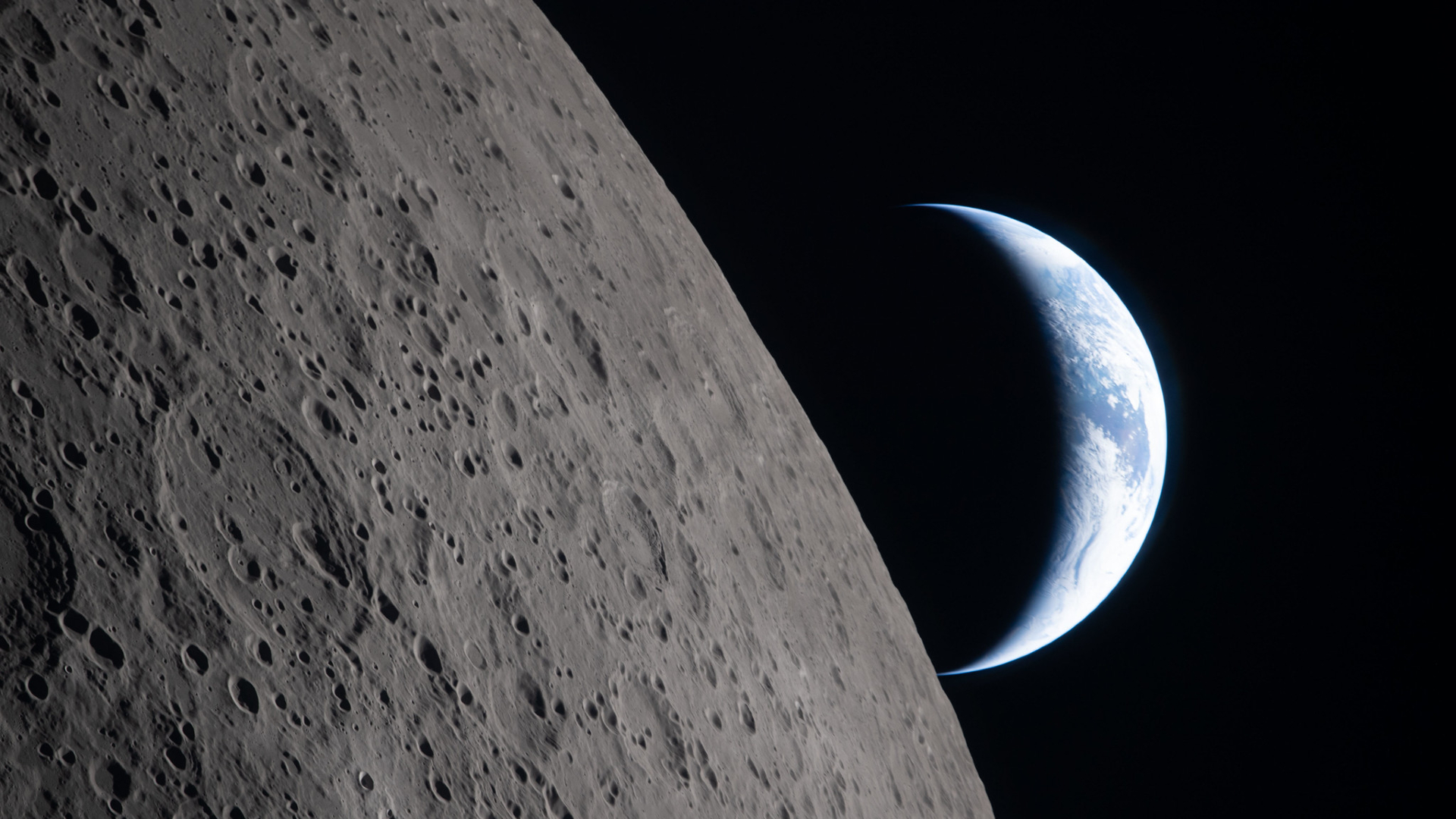
The Artemis II Earthset image belongs in that conversation — but it carries a different emotional weight. Where Earthrise showed our planet as something beautiful and present, this new image shows it in the act of disappearing. It captures a moment of absence rather than arrival.
For the crew aboard Orion, that disappearance was not metaphorical. Earth genuinely vanished. No radio contact. No visible home. Just the crew, the capsule, and the far side of the moon.
That kind of psychological isolation is something NASA has studied carefully as it prepares for longer missions — eventually to Mars, where the communication delay alone will stretch to 20 minutes each way. The Artemis II crew’s experience of watching Earth set behind the moon is, in some ways, a preview of what deep space truly feels like from the inside.
What Comes Next for the Artemis Program
Artemis II was always intended as a stepping stone, not a destination. With the crewed lunar flyby now accomplished, NASA’s attention turns to Artemis III — the mission currently planned to actually land astronauts on the lunar surface, targeting the moon’s south pole, a region believed to contain water ice deposits that could support long-term exploration.
The images and data gathered during Artemis II will inform how future crews are prepared — not just technically, but psychologically. Knowing what it feels like to watch Earth disappear is now part of the mission record.
That crescent Earth, slipping silently behind 4,070 miles of moon, is no longer just a photograph. It is a document of what human beings are willing to face in order to go further.
Frequently Asked Questions
What is the Artemis II mission?
Artemis II is NASA’s first crewed mission to travel around the moon as part of the broader Artemis program, which aims to eventually return humans to the lunar surface.
What is an “Earthset”?
An Earthset occurs when Earth is observed setting below the lunar horizon, mirroring the concept of a sunset but seen from the moon or lunar orbit rather than from Earth.
How far above the moon was the crew when the photo was taken?
The image was captured from approximately 4,070 miles (6,550 kilometers) above the lunar surface.
When was the Earthset image shared publicly?
The image was shared on April 6, 2026.
Why did Earth appear as a crescent in the photo?
Earth appears as a crescent due to the angle of sunlight relative to the crew’s position near the moon at the time the photograph was taken.</p



Leave a Reply