
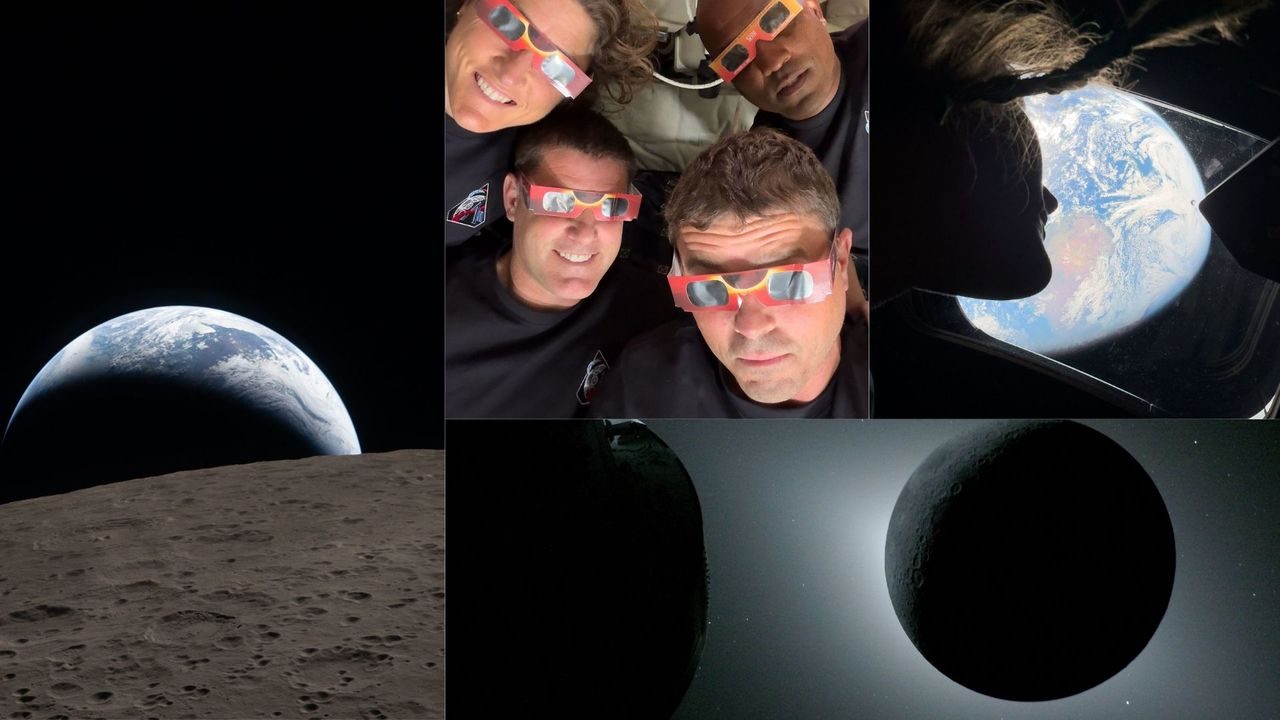
When NASA’s Artemis II crew ventured beyond Earth orbit, they carried cameras — and what they captured has stopped people cold. These aren’t polished studio renders or CGI composites. They are real photographs taken by real astronauts during one of the most significant human spaceflight missions since the Apollo era, and they document moments that no camera had ever been positioned to catch quite like this before.
The images span the full arc of the mission: from the thunderous launch off the pad to the quiet, almost meditative sight of Earth hanging in the black beyond the lunar horizon. Together, they form a visual record that belongs not just to NASA or the crew, but to everyone on the planet looking up.
Here is what makes each of these Artemis II photos so remarkable — and why they matter beyond the mission itself.
What the Artemis II Mission Actually Was
Artemis II is NASA’s crewed lunar flyby mission, the first time astronauts have traveled to the vicinity of the moon since Apollo 17 in 1972. The crew flew aboard the Orion capsule, and among the astronauts was Christina Koch, who was photographed viewing Earth from inside the capsule — a striking image that became one of the defining portraits of the mission.
The mission was not a lunar landing, but a deep-space journey designed to test systems, prove out the Orion spacecraft with a crew aboard, and lay the groundwork for future Artemis missions that will return humans to the lunar surface. What no one fully anticipated was just how powerful the photographic record of that journey would become.
Since its historic launch, the images released from the mission have circulated widely — capturing not just scientific milestones, but genuinely human moments that connect viewers to the experience of being in deep space.
The Ten Artemis II Photos That Define the Mission
NASA and the crew documented the mission across ten standout images, each capturing a distinct moment or perspective. Taken together, they tell the story of the journey from Earth to the moon and back.
| Photo Title | What It Shows |
|---|---|
| Artemis II Launch | The moment of liftoff, marking humanity’s return to deep space travel |
| Spaceship Earth | Earth seen from deep space, small and singular against the void |
| Earth’s Dark Side | The unlit face of Earth, rarely photographed from this vantage point |
| Hello, World | An intimate crew moment connecting the astronauts to the planet below |
| The Terminator | The boundary line between light and shadow on Earth’s surface |
| A Moment with the Moon | The lunar surface seen from the Orion capsule during closest approach |
| Shadows at the Edge of a Lunar Day | Long dramatic shadows cast at the moon’s terminator line |
| Total Solar Eclipse | A rare total solar eclipse viewed from behind the moon — a perspective never photographed before |
| Eclipse Safety First | The astronauts wearing solar eclipse glasses, a candid and human moment |
| Integrity Comes Home | The Orion capsule returning to Earth, completing the mission |
The Image That Has Never Been Seen Before
Among all ten, one photograph stands entirely apart from anything in the history of space exploration: a total solar eclipse viewed from behind the moon. This is a perspective that no human eye — and no camera — had ever captured from that precise vantage point before Artemis II.
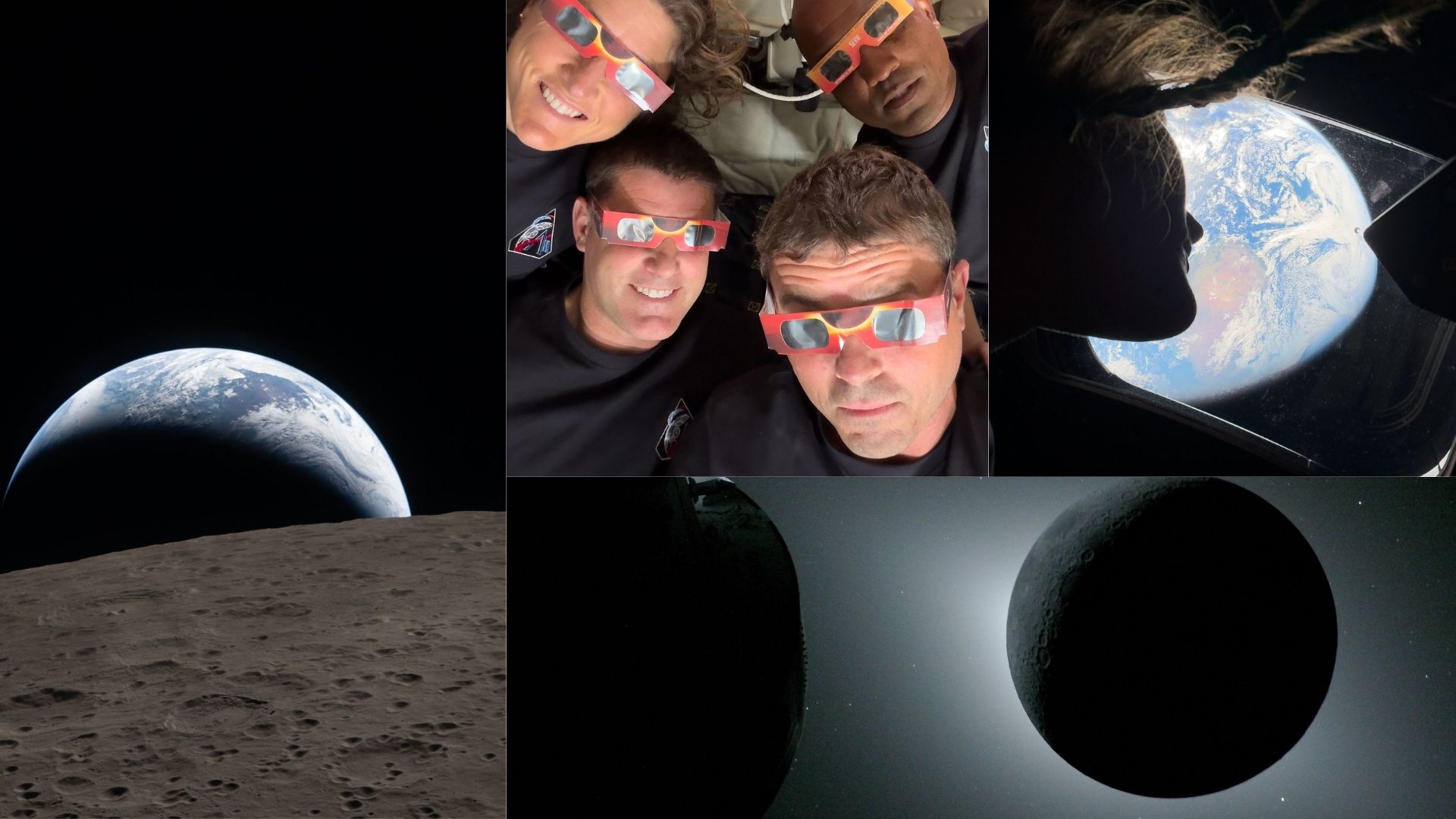
From behind the moon, with the sun perfectly aligned, the Orion capsule was positioned to witness something extraordinary. The result is an image that reframes how we understand the relationship between Earth, moon, and sun — three bodies we think we know well, seen in an arrangement that looks almost impossible.
Paired with that image is a companion shot: Earth setting behind the moon, sometimes called an “Earthset” — the lunar equivalent of a sunset, but where it is our own planet that disappears below the lunar horizon. These two photographs alone represent a new chapter in humanity’s visual record of the solar system.
Why These Photos Hit Differently Than Mission Data
Space missions generate enormous amounts of scientific data — telemetry, measurements, instrument readings — but photographs do something data cannot. They create emotional connection. They make abstract distances and engineering achievements feel real to people who will never leave Earth’s atmosphere.
The image of Christina Koch looking out at Earth from inside the Orion capsule is a perfect example. It is not just a portrait of an astronaut. It is a window into what it actually feels like to be that far from home, looking back at a planet that contains everyone and everything you have ever known.
Similarly, the photo of the crew wearing solar eclipse glasses — ordinary protective eyewear worn for an extraordinary event — is a reminder that these are people, not just mission assets. That kind of candid humanity is what makes space exploration resonate far beyond the scientific community.
What These Images Mean for What Comes Next
Artemis II is, by design, a precursor. The mission’s purpose is to validate the systems and procedures that will eventually carry astronauts back to the lunar surface. The photographs it has produced serve a similar function culturally — they are the images that will define public understanding of this new era of exploration before the landings actually happen.
In the same way that Apollo-era photography shaped a generation’s sense of humanity’s place in the universe, the Artemis II photo record is already beginning to do the same work for a new generation. The total solar eclipse viewed from behind the moon, Earth’s dark side, the long shadows at the lunar terminator — these are not just mission souvenirs. They are the images that will appear in textbooks, documentaries, and museum exhibitions for decades to come.
The mission has returned. The photographs remain.
Frequently Asked Questions
Who took the photos during the Artemis II mission?
The photographs were taken by the Artemis II astronauts themselves aboard the Orion capsule during the mission.
Which astronaut is shown looking at Earth from inside the Orion capsule?
Christina Koch is the astronaut photographed viewing Earth from inside the Orion capsule — one of the ten defining images from the mission.
Has a total solar eclipse ever been photographed from behind the moon before?
Based on
What spacecraft did the Artemis II crew use?
The Artemis II crew traveled aboard NASA’s Orion capsule.
What is the “terminator” in the context of these photos?
The terminator refers to the boundary line between the sunlit and shadowed sides of a planetary body — in these images, it appears on both Earth and the moon.
Was Artemis II a lunar landing mission?
No. Artemis II was a crewed lunar flyby mission, not a landing. It was designed to test the Orion spacecraft with astronauts aboard in preparation for future missions.



Leave a Reply