
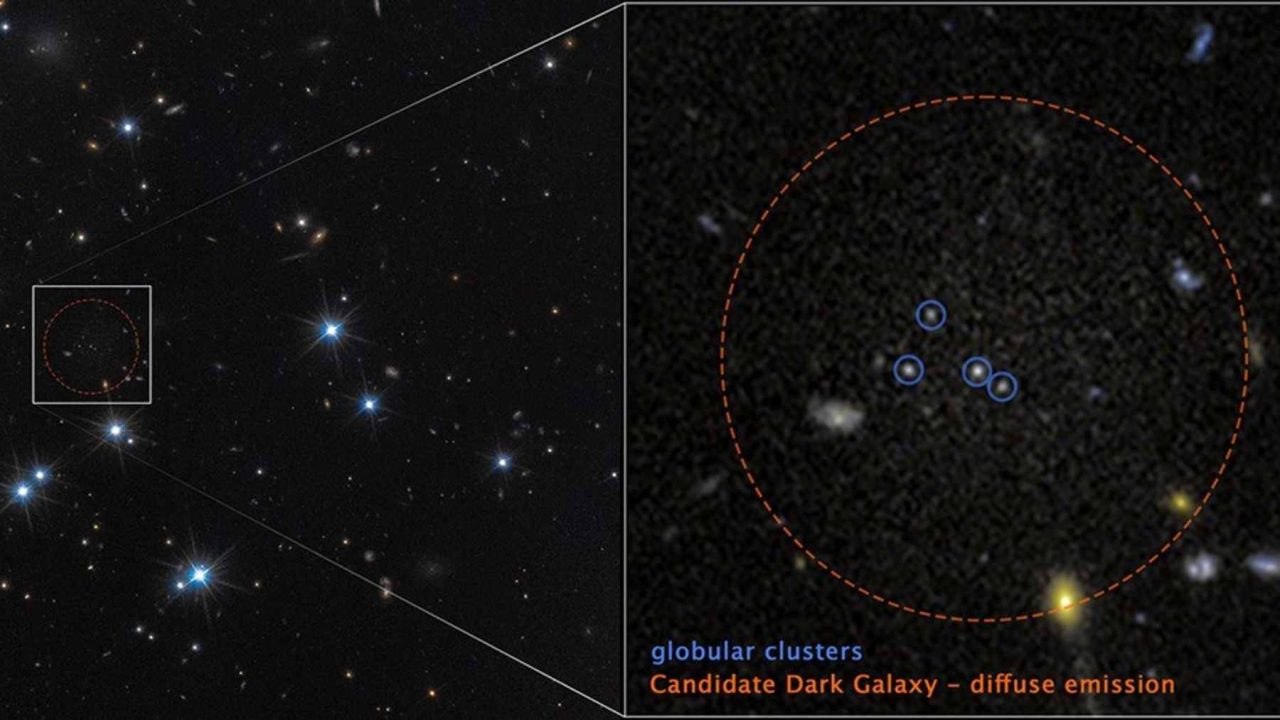
A galaxy made almost entirely of invisible matter — with only four clusters of stars holding any visible light at all — has been confirmed for the first time, and it is reshaping what astronomers thought was possible in the universe.
The object, known as Candidate Dark Galaxy 2, or CDG-2, sits roughly 300 million light years from Earth inside the Perseus galaxy cluster. It is so faint that for years, scientists had no idea they were looking at a galaxy at all. What they saw instead were four compact swarms of stars floating in what appeared to be empty space — isolated, unexplained, and puzzling.
New research has now revealed those four star clusters are not random. They are the visible fingerprints of something far larger and almost entirely dark.
What CDG-2 Actually Is — and Why It Matters
CDG-2 is being described as one of the most extreme objects of its kind ever observed. According to the new findings, the galaxy is composed of approximately 99.9% dark matter — the invisible substance that scientists believe makes up most of the matter in the entire universe, yet has never been directly detected or observed.
Dark matter does not emit, absorb, or reflect light. It cannot be seen through any telescope. Its existence is inferred entirely from the gravitational effects it has on visible matter around it. That makes CDG-2 a remarkable natural laboratory: a galaxy held together almost entirely by something we cannot see, detected only because of how it pulls on the few stars it actually contains.
The research was led by Dayi (David) Li, a statistician at the University of Toronto. His team took a different approach from previous observers. Rather than treating the four globular clusters inside CDG-2 as isolated objects, they used them as clues — measuring their positions and motions to determine whether something larger was holding them together. The answer, it turns out, was yes.
How Scientists Found a Galaxy That Cannot Be Seen
The Perseus galaxy cluster, where CDG-2 resides, is one of the most studied regions of the nearby universe. It is crowded, massive, and filled with galaxies of every shape and size. For years, those four globular clusters inside what we now call CDG-2 simply blended into the background — easy to overlook, easy to misclassify.
What made the new detection possible was treating the star clusters as a system rather than as individual objects. By analyzing how they move relative to one another, researchers could calculate the gravitational mass needed to keep them bound together. That mass turned out to be vastly greater than the visible stars could account for on their own.
The implication is striking: nearly all of the galaxy’s mass is dark matter. The stars are essentially passengers, held in place by an enormous invisible structure surrounding them.
Key Facts About the Dark Galaxy CDG-2
| Detail | Confirmed Information |
|---|---|
| Object name | Candidate Dark Galaxy 2 (CDG-2) |
| Distance from Earth | Approximately 300 million light years |
| Location | Inside the Perseus galaxy cluster |
| Visible components | Four globular clusters (compact star swarms) |
| Dark matter composition | Approximately 99.9% of total mass |
| Lead researcher | Dayi (David) Li, University of Toronto |
| Research approach | Statistical analysis of globular cluster positions and motions |
- CDG-2 contains only four globular clusters — compact groups of stars — as its only visible material
- The galaxy is so faint it blends into the background glow of the universe
- Dark matter, which makes up the vast majority of CDG-2, has never been directly detected anywhere in the universe
- The Perseus galaxy cluster, where CDG-2 sits, is considered one of the richest and most studied galaxy clusters near Earth
Why This Discovery Changes the Picture of How Galaxies Form
Most galaxies we know of contain a mix of visible stars, gas, dust, and dark matter. CDG-2 throws that balance almost entirely out the window. A galaxy that is 99.9% dark matter challenges basic assumptions about what conditions are needed for a galaxy to form and survive.
Researchers have long theorized that dark matter halos — invisible clouds of the substance — could exist without ever forming many stars at all. CDG-2 appears to be exactly that kind of object: a dark matter structure that gathered only the thinnest dusting of visible matter over its lifetime.
That makes it scientifically precious. Because CDG-2 contains so little starlight to complicate observations, it offers a rare opportunity to study how dark matter behaves in something close to isolation. The Perseus galaxy cluster, already a prime target for astronomers, just became even more interesting.
Astronomers note that objects like CDG-2 may be far more common than previously thought — simply too faint and too dark to have been identified before now. If similar galaxies exist throughout the universe, the total inventory of dark matter structures could be significantly larger than current models suggest.
What Comes Next for Dark Galaxy Research
The confirmation of CDG-2 is a starting point, not an endpoint. Researchers will likely turn more powerful instruments toward the Perseus cluster to learn more about how the four globular clusters are distributed and how they move over time.
The broader scientific community is also watching to see whether other candidate dark galaxies — objects like CDG-2 that have been flagged but not yet confirmed — will hold up under similar statistical scrutiny. The method used by Li’s team, treating star clusters as gravitational tracers rather than isolated objects, could become a template for finding more of these ghostly systems elsewhere in the sky.
For now, CDG-2 stands as the clearest evidence yet that galaxies can exist almost entirely beyond the reach of ordinary light — held together by something the universe has kept hidden since the very beginning.
Frequently Asked Questions
What is CDG-2?
CDG-2, or Candidate Dark Galaxy 2, is a galaxy located approximately 300 million light years away inside the Perseus galaxy cluster. It is composed of approximately 99.9% dark matter, making it one of the most extreme objects of its kind ever confirmed.
How was an invisible galaxy detected if it emits no light?
Researchers led by Dayi (David) Li at the University of Toronto analyzed the positions and motions of four globular clusters inside CDG-2, using them as gravitational tracers to infer the enormous invisible mass holding the system together.
What is dark matter?
Dark matter is an invisible substance that does not emit, absorb, or reflect light. It is believed to make up most of the matter in the universe and is detected only through its gravitational effects on visible objects.
Where is CDG-2 located?
CDG-2 sits inside the Perseus galaxy cluster, roughly 300 million light years from Earth — a region already considered one of the most studied galaxy clusters in the nearby universe.
How much visible matter does CDG-2 actually contain?
The galaxy contains only four globular clusters — compact swarms of stars — as its visible material. Everything else that holds the system together appears to be dark matter.
Could there be more dark galaxies like CDG-2?
This has not yet been fully confirmed through additional discoveries.



Leave a Reply