
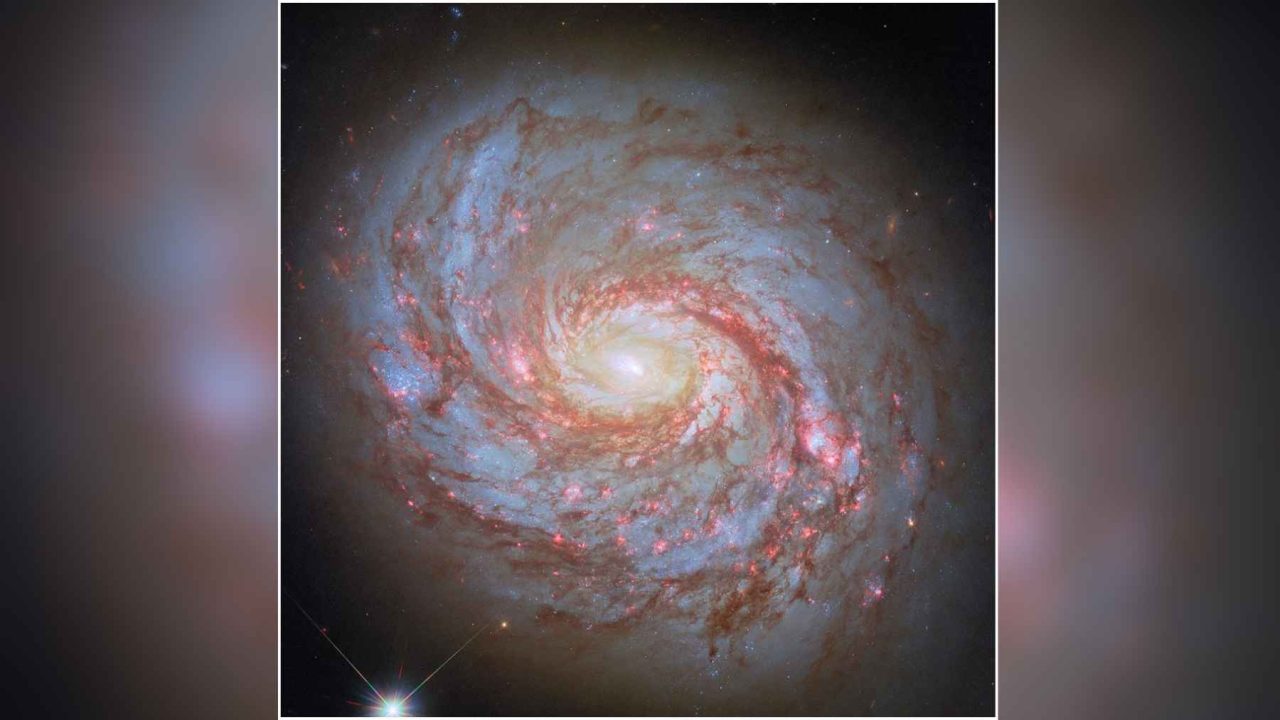
Fourteen million light-years from Earth, sitting quietly on the edge of a spiral galaxy, is an object that may have no business existing — and yet there it is. Astronomers have confirmed the discovery of a compact cloud of gas and dark matter called Cloud 9, and it could help unlock one of the deepest mysteries in all of science: what dark matter actually is, and how it shaped everything we see in the universe.
What makes Cloud 9 so extraordinary isn’t just what it contains. It’s what it doesn’t contain. Despite holding roughly one million solar masses of hydrogen gas and an estimated five billion solar masses of dark matter, this object has no stars at all. None. It’s an enormous concentration of mass that somehow never lit up.
That combination — a dark matter-dominated system with zero stars — is exactly the kind of natural laboratory astronomers have been searching for. It gives researchers a rare, clean window into the invisible material that makes up roughly 85% of all matter in the universe.
What Is Cloud 9, and Where Did It Come From?
Cloud 9 was identified using the Hubble Space Telescope and sits on the outskirts of the spiral galaxy Messier 94, located about 14 million light-years from Earth. Researchers classify it as a Reionization Limited HI Cloud, or RELHIC — a dark matter halo filled with neutral hydrogen gas that never managed to trigger star formation.
The lead researcher on the project, Alejandro Benítez Llambay, has described it as a tale of a failed galaxy — a structure that had all the ingredients to become something like the Milky Way, but was frozen before it ever got started.
The leading theory is that a process called cosmic reionization is responsible. In the early universe, a flood of ultraviolet radiation from the first stars and quasars heated the surrounding gas so intensely that many small halos of dark matter simply couldn’t cool their gas enough to collapse and form stars. Cloud 9 may be one of those halos — a relic from the universe’s earliest chapter, preserved in a kind of suspended animation for billions of years.
Why Dark Matter Makes This Discovery So Significant
Dark matter is one of the most studied and least understood phenomena in modern physics. Astronomers know it exists because of the gravitational effects it produces — galaxies spin in ways that only make sense if there’s far more mass present than the stars and gas we can see. It bends light, shapes cosmic structure, and accounts for an estimated 85% of all matter in the universe.
But because dark matter doesn’t emit or reflect light, scientists can’t observe it directly. They infer it from its effects on visible matter — galaxy rotation curves, gravitational lensing, and the large-scale structure of the cosmos.
That’s exactly why Cloud 9 is so valuable. In most galaxies, the dark matter signal is tangled up with the behavior of stars, gas, and other ordinary matter. Cloud 9 is different. With no stars present, the dark matter signature is essentially uncontaminated, giving researchers an unusually pure environment to test their models.
Key Facts About Cloud 9 at a Glance
| Property | Detail |
|---|---|
| Object name | Cloud 9 |
| Object type | Reionization Limited HI Cloud (RELHIC) |
| Host galaxy | Messier 94 |
| Distance from Earth | Approximately 14 million light-years |
| Hydrogen gas mass | ~1 million solar masses |
| Estimated dark matter mass | ~5 billion solar masses |
| Stars present | None confirmed |
| Telescope used | Hubble Space Telescope |
| Principal investigator | Alejandro Benítez Llambay |
- Cloud 9 is classified as a dark matter-dominated system, with dark matter outweighing its hydrogen gas by thousands to one.
- Its starless nature makes it a near-ideal testing ground for cosmological theories about structure formation.
- It is believed to be a fossil from the early universe, its evolution halted by reionization.
- The discovery was made using the Hubble Space Telescope, one of the most powerful observational tools available to astronomers.
What This Means for Our Understanding of the Universe
For decades, cosmologists have predicted that the universe should be filled with small dark matter halos that never formed stars — ghost structures left over from the era of reionization. Finding them has proven incredibly difficult, precisely because they produce no light to detect.
Cloud 9 appears to be one of these predicted objects, caught in the act of simply existing. If confirmed as a true RELHIC, it would represent direct observational evidence for a class of objects that until now existed mostly in theoretical models and computer simulations.
The implications stretch beyond just one strange cloud. If astronomers can study Cloud 9 in detail — measuring how its gas moves, how its dark matter is distributed — they gain a direct probe into the fundamental properties of dark matter itself. That could help distinguish between competing theories about what dark matter actually is at the particle level, a question that remains completely open.
Researchers also note that finding Cloud 9 near Messier 94 raises the possibility that similar objects could be lurking near other galaxies, previously overlooked because no one knew exactly what to look for.
What Comes Next for Cloud 9 Research
The confirmation of Cloud 9’s existence is a beginning, not an endpoint. Astronomers will want to study it with additional instruments to better characterize its dark matter distribution and confirm that it is truly starless rather than simply hosting stars too faint to detect with current technology.
Future observations could also help determine whether Cloud 9 is gravitationally stable or slowly being disrupted by the gravitational pull of Messier 94. Its long-term fate — and what that tells us about the life cycle of these failed galaxies — is an open question that researchers are eager to pursue.
The broader goal is to use objects like Cloud 9 to test the standard cosmological model in ways that galaxy-scale observations simply cannot. A starless, dark matter-dominated cloud sitting 14 million light-years away might just be the cleanest dark matter experiment nature has ever offered us.
Frequently Asked Questions
What is Cloud 9 in astronomy?
Cloud 9 is a compact cloud of hydrogen gas and dark matter located on the outskirts of the galaxy Messier 94, about 14 million light-years from Earth. It contains no stars and is classified as a Reionization Limited HI Cloud, or RELHIC.
How much dark matter does Cloud 9 contain?
Researchers estimate Cloud 9 holds approximately five billion solar masses of dark matter, alongside roughly one million solar masses of hydrogen gas.
Why does Cloud 9 have no stars?
The leading explanation is that cosmic reionization in the early universe heated the cloud’s gas so intensely that it could never cool enough to collapse and form stars, leaving it frozen in an early evolutionary state.
How was Cloud 9 discovered?
It was identified using the Hubble Space Telescope by a research team led by principal investigator Alejandro Benítez Llambay.
Why is a starless dark matter cloud scientifically valuable?
Because there are no stars to complicate the signal, Cloud 9 offers an unusually clean environment to study dark matter directly, allowing researchers to test cosmological models with fewer variables than in typical galaxies.
Could there be more objects like Cloud 9?
Researchers believe so. Cosmological theory predicts many such dark matter halos that never formed stars, and Cloud 9’s discovery suggests similar objects may exist near other galaxies, waiting to be found.



Leave a Reply