
One of the clearest, darkest skies on Earth just got a little safer. A massive industrial complex that astronomers feared could permanently damage Chile’s Paranal Observatory — home to some of the most powerful telescopes ever built — has officially been canceled, and the scientific community is breathing a collective sigh of relief.
The project in question was INNA, a proposed green hydrogen and green ammonia production facility that would have been built just kilometers from Paranal and the nearby Cerro Armazones site. On January 23, 2026, energy company AES Andes announced it was discontinuing the project entirely, pivoting instead toward renewable energy and battery storage. A formal letter confirming the project’s withdrawal from Chile’s Environmental Assessment Service followed on February 6, 2026.
For the global astronomy community, it was exactly the news they had been hoping for.
Why Paranal Is Worth Protecting
Chile’s Atacama Desert is not just a convenient location for telescopes — it is widely considered the best place on Earth to observe the night sky. The European Southern Observatory (ESO), which operates the Paranal site, has described the area around Paranal and Cerro Armazones as having the darkest and clearest sky of any astronomical observatory in the world.
That distinction is not incidental. It is the product of extreme altitude, minimal humidity, virtually no cloud cover, and — critically — very little artificial light pollution. Astronomers working at Paranal can detect faint galaxies, distant star systems, and cosmic phenomena that would be completely invisible from almost anywhere else on the planet.
Lose that darkness, and you lose the science. It is that simple.
Light pollution is often described as astronomy’s most feared invisible enemy — you cannot see it directly, but it drowns out the faint signals that observatories exist to capture. Even a diffuse glow on the horizon from an industrial facility can degrade the quality of observations significantly, making years of telescope investment effectively worthless for the most sensitive research.
What INNA Actually Was — and Why It Worried Scientists
INNA was not a small-scale operation. According to ESO, the proposed facility would have covered more than 3,000 hectares of land. Its location was particularly alarming: the complex was planned to sit roughly 5 to 11 kilometers from the major astronomical facilities at Paranal and Cerro Armazones.
To put that proximity in perspective, placing an industrial megaproject of that scale that close to the world’s premier dark-sky observatory is the equivalent of building a sports stadium next to a recording studio and expecting the musicians inside to still hear a pin drop.
Green hydrogen and ammonia production at industrial scale requires significant infrastructure — electrolyzers, storage tanks, processing equipment, and the kind of lighting and operational activity that does not simply switch off at night. The concern was not just light, but the cumulative environmental footprint of a facility that large operating continuously near instruments designed to detect the faintest signals in the universe.
| Key Detail | Information |
|---|---|
| Project name | INNA |
| Developer | AES Andes |
| Proposed facility size | More than 3,000 hectares |
| Distance from Paranal / Cerro Armazones | Approximately 5 to 11 kilometers |
| Cancellation announced | January 23, 2026 |
| Formal withdrawal confirmed | February 6, 2026 |
| AES Andes new focus | Renewable energy and battery storage |
The Threat Astronomers Fear Most
Light pollution rarely makes headlines the way other environmental threats do. It does not poison water or clear-cut forests. But for the scientific institutions that depend on pristine dark skies, it is an existential issue.
Observatories like Paranal represent decades of international investment and scientific collaboration. The instruments housed there — including ESO’s Very Large Telescope — are designed to push the absolute limits of human observation. They are calibrated to detect light that has traveled billions of light-years across the universe. A wash of artificial glow from a nearby industrial site can corrupt that data in ways that are difficult or impossible to correct.
This is why ESO and the global astronomy community took the INNA proposal so seriously from the start. The threat was not hypothetical — it was a direct challenge to the conditions that make Paranal one of the most scientifically productive observatory sites on Earth.
AES Andes Changes Course
The cancellation came from AES Andes itself, which announced it was stepping away from INNA and redirecting its efforts toward renewable energy and battery storage projects. The company did not build the facility — it withdrew it from the environmental review process entirely.
ESO updated its communications on February 2, 2026, to reflect the news, and the February 6 letter to Chile’s Environmental Assessment Service made the withdrawal official and formal. The regulatory process that had been underway for the project was effectively closed.
For astronomers and observatory officials who had been monitoring the situation closely, the sequence of events represented a best-case outcome — the project did not have to be rejected or litigated. It was simply withdrawn before it could advance further.
What This Means for the Future of Paranal
The cancellation of INNA removes an immediate and significant threat to one of science’s most valuable natural resources. Paranal and Cerro Armazones can continue operating under the dark-sky conditions that make them globally irreplaceable.
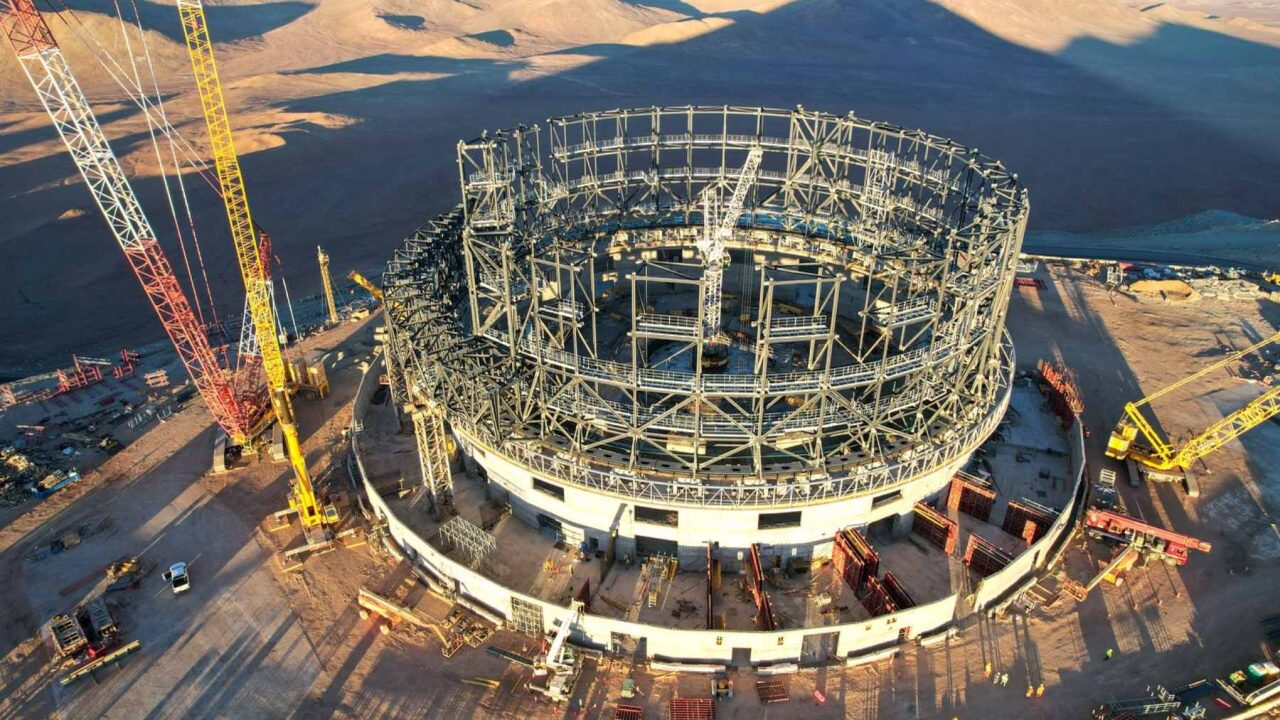
Cerro Armazones, in particular, is the planned site of ESO’s Extremely Large Telescope — a next-generation instrument that will be among the most powerful optical telescopes ever constructed. The integrity of the surrounding sky is not just important for current operations; it is essential for the scientific ambitions that are already being built into the region’s future.
Dark skies, once lost, are extraordinarily difficult to recover. The celebration among astronomers is not just about one project being canceled — it is about a precedent being set that the scientific value of places like Paranal deserves serious protection.
Frequently Asked Questions
What was the INNA project?
INNA was a proposed green hydrogen and green ammonia industrial facility developed by AES Andes, planned to cover more than 3,000 hectares near Chile’s Paranal Observatory.
Why did INNA threaten the Paranal Observatory?
The facility would have been located just 5 to 11 kilometers from major astronomical facilities at Paranal and Cerro Armazones, risking light pollution that could degrade the observatory’s uniquely dark and clear skies.
When was the INNA project officially canceled?
AES Andes announced the discontinuation on January 23, 2026, and a formal letter confirming withdrawal from Chile’s Environmental Assessment Service was submitted on February 6, 2026.
What will AES Andes focus on instead?
According to the company’s announcement, AES Andes will shift its attention to renewable energy and battery storage projects.
Why is Paranal considered so important to astronomy?
ESO has described the area around Paranal and Cerro Armazones as having the darkest and clearest sky of any astronomical observatory in the world, making it uniquely suited for advanced space observation.</p


Leave a Reply