
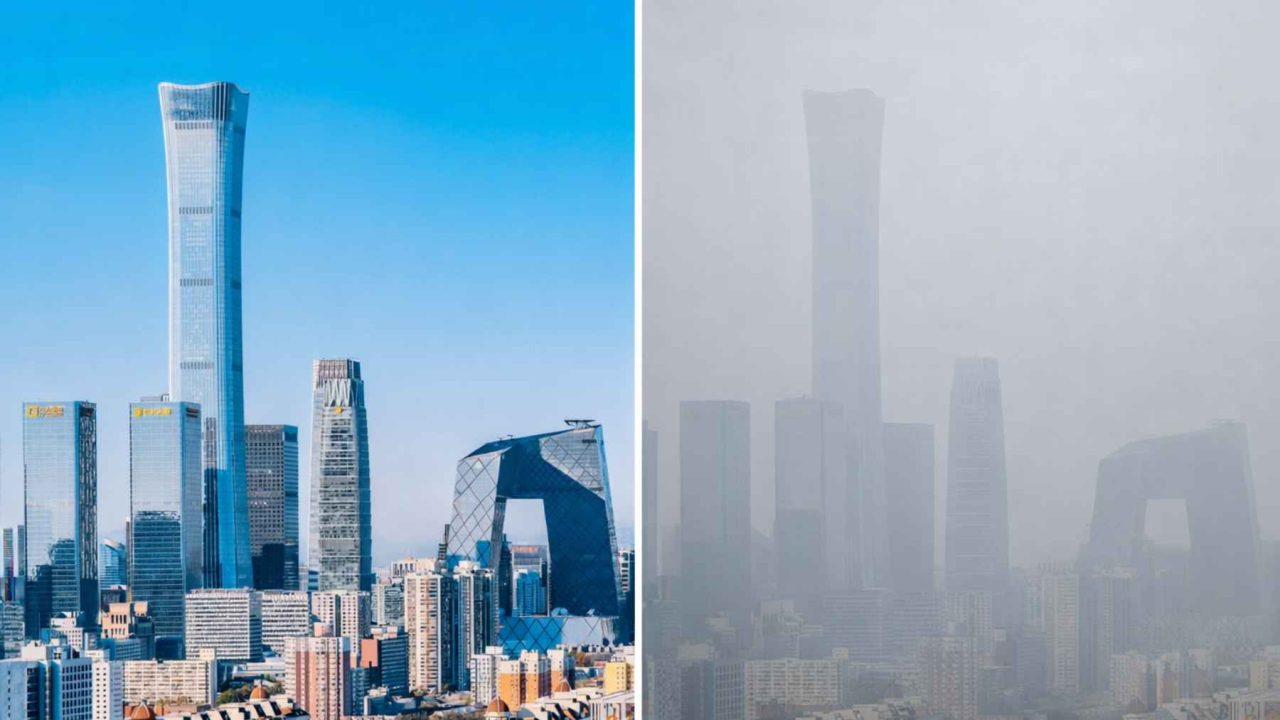
Beijing’s air pollution dropped by roughly 70 percent in just 12 years — and in 2025, the city recorded only a single day of heavy pollution across the entire year. For a metropolis that was once synonymous with choking smog, that number is almost hard to believe.
The city’s annual average concentration of PM2.5 — the fine particulate matter most closely linked to respiratory and cardiovascular disease — fell to 27 micrograms per cubic meter in 2025. That is the lowest figure recorded since air quality monitoring began. Back in 2013, that same number stood at 89.5 µg/m³. The scale of that decline, measured over a little more than a decade, represents one of the most dramatic urban air quality turnarounds anywhere in the world.
Residents also experienced 311 days of good or moderate air quality in 2025, a record high that would have seemed wildly optimistic during the years when a thick grey haze regularly swallowed Beijing’s skyline whole.
How Beijing Went From the World’s Smoggiest City to an Unlikely Clean Air Story
The turning point came in 2013. That year, PM2.5 levels averaged 89.5 µg/m³ annually, and public pressure around the health risks of smog had reached a peak. Images of Beijing residents wearing face masks and visibility dropping to near zero became symbols of industrial-era pollution at its worst.
What followed was a sustained, multi-year push to bring those numbers down. By 2025, the results of that effort were impossible to ignore. The annual PM2.5 average had fallen to 27 µg/m³ — a reduction of approximately 70 percent from the 2013 baseline. The city logged just one day of heavy pollution over the entire calendar year, compared to the dozens that were once routine.
The data comes from Beijing’s official 2025 environmental review, making these figures part of the public record rather than estimates or projections. The shift is real, measurable, and documented.
The Numbers Behind Beijing’s Clean Air Milestone
The headline figures tell a clear story, but it helps to see the full picture laid out plainly. Here is what Beijing’s air quality data shows across the key markers:
| Metric | 2013 | 2025 | Change |
|---|---|---|---|
| Annual average PM2.5 (µg/m³) | 89.5 | 27 | ↓ ~70% |
| Days of heavy pollution | High (routine) | 1 | Historic low |
| Days of good or moderate air quality | Not recorded as record | 311 | Record high |
A few things stand out when you look at this data together:
- The reduction in PM2.5 over 12 years is not a gradual drift — it is a steep, consistent decline that accelerated over time.
- Recording only one day of heavy pollution in an entire year is a milestone that would have been considered unreachable in the early 2010s.
- 311 days of clean or acceptable air means Beijing residents now breathe healthy air for roughly 85 percent of the year.
The Part of This Story Most Reports Are Missing
Here is where the Beijing story gets more complicated — and more relevant to every major city on earth.
Just as Beijing has brought conventional air pollution under meaningful control, researchers are detecting a new and different kind of urban haze forming above big cities. This emerging concern involves microplastics and nanoplastics — particles so small they float through the air, drift over urban centers, and may travel far greater distances than anyone previously anticipated.
Beijing’s achievement with soot and tailpipe emissions is genuine and significant. But it also highlights a broader truth that environmental scientists have been raising: “clean air” is no longer a single problem with a single solution. The pollutants that regulators learned to measure and target over the past few decades are not the only ones that matter to human health.
Microplastics in the atmosphere are still being studied, and the full picture of their health impact remains an active area of research. What is already clear is that cities cannot declare victory on air quality simply by reducing PM2.5 readings, however important that progress genuinely is.
Why This Matters Beyond Beijing’s City Limits
Beijing is one of the world’s most populous cities, and its air quality has historically affected not just its own residents but surrounding regions. A 70 percent reduction in PM2.5 over 12 years carries real consequences for public health at scale — fewer hospital admissions, lower rates of respiratory illness, longer life expectancy for millions of people.
For other cities still struggling with industrial smog and vehicle emissions, Beijing’s documented trajectory offers something concrete: proof that the numbers can move dramatically in the right direction within a single generation. The decline from 89.5 µg/m³ to 27 µg/m³ happened within living memory for most of the city’s adult residents.
At the same time, the emerging research on airborne microplastics serves as a reminder that environmental progress tends to reveal new layers of complexity. Solving one problem does not mean the air is fully safe — it means the definition of “safe air” keeps evolving as science advances.
What Comes Next for Beijing’s Air Quality Goals
The 2025 figures represent a historic low, but they do not represent the finish line. The World Health Organization’s guideline for annual average PM2.5 is 5 µg/m³ — meaning Beijing’s current reading of 27 µg/m³, while dramatically improved, is still more than five times that benchmark.
The city’s environmental review confirms the progress made, but the gap between current performance and international health guidelines remains wide. Continued improvement will require addressing not just the sources that have already been targeted, but also the newer atmospheric threats — including airborne plastics — that monitoring systems are only beginning to track systematically.
Beijing’s story so far is one of serious, sustained effort producing real results. The next chapter will test whether that same commitment can extend to pollutants that are harder to see, harder to measure, and not yet fully understood.
Frequently Asked Questions
What was Beijing’s PM2.5 level in 2025?
Beijing’s annual average PM2.5 concentration fell to 27 micrograms per cubic meter in 2025, the lowest level recorded since air quality monitoring began in the city.
How much has Beijing’s air pollution improved since 2013?
PM2.5 levels dropped from 89.5 µg/m³ in 2013 to 27 µg/m³ in 2025, a reduction of approximately 70 percent over 12 years.
How many days of clean air did Beijing record in 2025?
Beijing logged 311 days of good or moderate air quality in 2025, a record high, and experienced only one day of heavy pollution during the entire year.
What is the new air pollution concern researchers are raising?
Researchers are detecting airborne microplastics and nanoplastics floating above major cities, including Beijing, which may travel farther than expected and pose health risks that current monitoring does not fully capture.
Does Beijing’s air quality now meet WHO guidelines?
Not yet. The WHO guideline for annual average PM2.5 is 5 µg/m³, meaning Beijing’s 2025 reading of 27 µg/m³, while a historic improvement, is still well above the international health benchmark.
Where does the 2025 air quality data come from?
The figures are drawn from Beijing’s official 2025 environmental review, making them part of the city’s documented public record rather than independent estimates.




Leave a Reply