
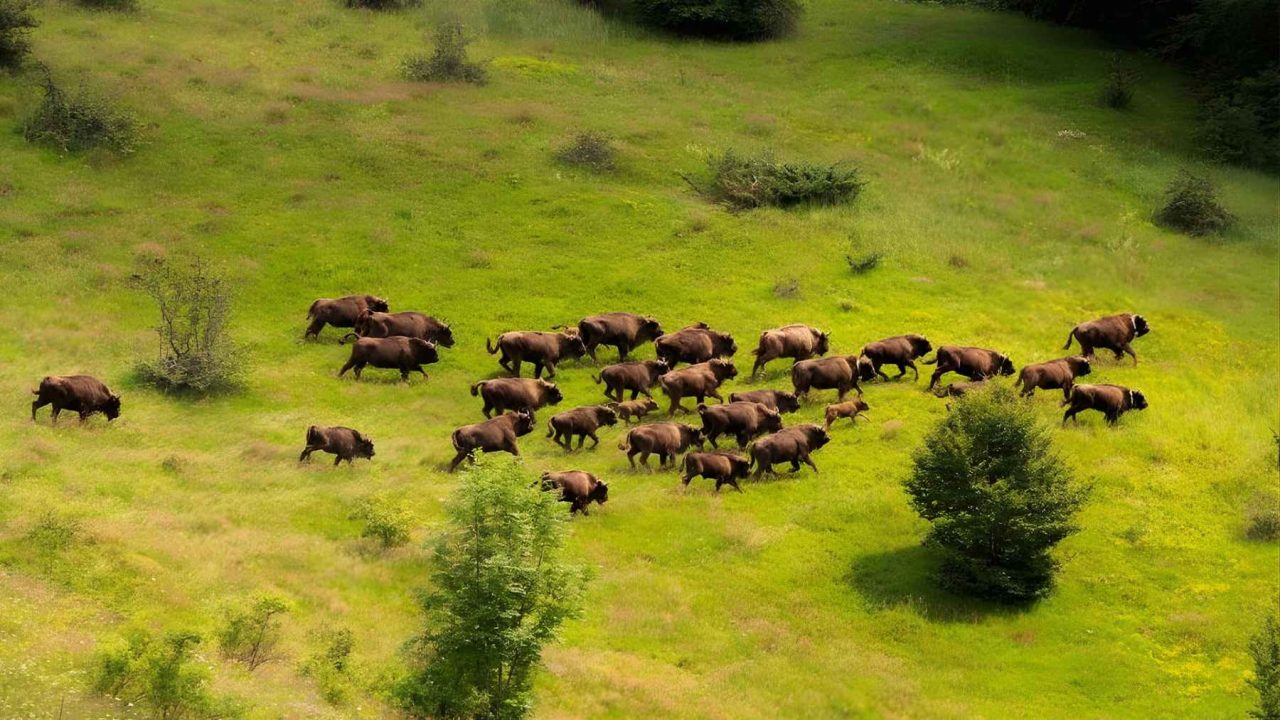
Plant biomass in parts of Romania’s Tarcu Mountains has increased by around thirty percent — and the unlikely cause is a herd of large, shaggy animals that hadn’t roamed freely in that region for generations. The European bison is back, and what it’s doing to the landscape is turning heads even among scientists who expected good results.
Conservation teams working on rewilding efforts in western Romania report that after roughly a decade of work, vegetation in some areas has grown not just in volume but in variety. More grass, more shrubs, more wildflowers, and a richer patchwork of habitats have emerged across the same land where forests were closing in and plant life was becoming increasingly uniform.
For both scientists and local communities, the return of Europe’s largest land mammal is becoming a real-world demonstration of something ecologists have long theorized: that bringing the right animals back to a landscape can help that landscape heal itself.
How Bison Rewilding in Romania Became a Conservation Milestone
The European bison — known scientifically as Bison bonasus — once ranged widely across the continent. Centuries of hunting and habitat loss took a severe toll, and by the early twentieth century, the species had been pushed to the edge of existence. The last wild individuals disappeared in the 1920s, and by 1927, fewer than sixty animals remained alive, all of them in zoos and private parks.
Only intensive captive breeding programs kept the species from disappearing entirely. It was one of the closest calls in European wildlife history — a megafauna species reduced to a handful of survivors, sustained entirely by human intervention.
The work to bring bison back to the wild began in earnest in the latter half of the twentieth century, and organizations like Rewilding Europe have since been central to restoring populations across several countries. Romania’s Tarcu Mountains became one of the focal points of that effort, and the results now emerging from that site are drawing significant attention.
What the Numbers Actually Show
The headline figure — a thirty percent increase in plant biomass — covers both the quantity and the diversity of vegetation in affected areas. That distinction matters. It’s not simply that more grass is growing where bison graze. The landscape itself is becoming more complex, with a wider mix of plant species and habitat types emerging across the same terrain.
Before the bison’s return, conservation teams noted that forests in the area were becoming denser and more uniform, crowding out open grasslands and the species that depend on them. Bison, through their grazing and movement patterns, are disrupting that uniformity in ways that appear to benefit the broader ecosystem.
| Factor | Before Rewilding | After Rewilding |
|---|---|---|
| Plant biomass | Baseline level | Increased by ~30% |
| Vegetation variety | Increasingly uniform | Greater mix of species |
| Habitat types | Forest encroachment | Richer patchwork of habitats |
| Wild bison population (global, 1927) | Fewer than 60 individuals | Now recovering across Europe |
The results have surprised even zoologists involved in the project — not because recovery was unexpected, but because the scale and speed of the ecological response went beyond initial projections.
Why Large Herbivores Matter More Than Most People Realize
Bison aren’t just large animals wandering through a forest. They are what ecologists call a keystone species — one whose presence shapes the environment around it in ways that ripple outward to dozens of other species.
When bison graze, they don’t strip an area clean. They create patches of short grass next to taller vegetation, open clearings within woodland edges, and disturbed soil where new plants can take hold. Their movement and behavior essentially act as a natural landscaping force, maintaining the kind of varied terrain that supports a wide range of insects, birds, and smaller mammals.
This is the core logic behind rewilding as a conservation strategy: rather than managing ecosystems by hand, the goal is to restore the animals that once did that work naturally. The Tarcu Mountains results suggest that, at least in this case, the approach is working.
The Broader Picture for European Rewilding
Romania’s experience fits into a wider pattern of rewilding projects gaining momentum across Europe. The return of large herbivores and predators to degraded landscapes has become one of the more promising areas of conservation science, partly because the results tend to be visible and measurable within years rather than decades.
According to Rewilding Europe, the comeback of the European bison is now considered one of the more significant conservation success stories on the continent. Starting from fewer than sixty individuals a century ago, the species has been reintroduced to multiple countries, with wild and semi-wild populations now established in Poland, Germany, the Netherlands, and Romania, among others.
The Tarcu Mountains project represents one of the more closely monitored of these reintroductions, which is part of why the vegetation data has attracted attention. The thirty percent biomass increase gives researchers a concrete, quantifiable outcome to point to when making the case for rewilding in other regions.
What This Means for the Future of Rewilding Projects
The results from Romania are likely to inform how future rewilding projects are designed and evaluated. Conservationists argue that measurable ecological outcomes — like the vegetation changes documented in the Tarcu Mountains — are essential for building public and political support for reintroduction programs, which often face resistance from farming and land-use communities.
Supporters of rewilding point to evidence suggesting that the benefits extend beyond biodiversity. Healthier, more varied ecosystems tend to be more resilient to drought, flooding, and disease — outcomes that matter to local communities as much as to conservationists.
The bison’s return to Romania isn’t just a wildlife story. It’s a demonstration that ecosystems, given the right conditions and the right animals, can recover in ways that surprise even the people who made it happen.
Frequently Asked Questions
Where exactly are the bison being rewilded in Romania?
The rewilding project is located in the Tarcu Mountains in western Romania, where conservation teams have been working for roughly a decade.
How much has plant life increased since the bison were reintroduced?
Conservation teams report that vegetation in some areas has increased by around thirty percent, in both volume and variety of plant species.
How close did European bison come to extinction?
By 1927, fewer than sixty European bison survived, all of them in zoos and private parks, after the last wild individuals disappeared in the early twentieth century.
Why do bison have such a strong effect on plant life?
Bison are considered a keystone species — their grazing and movement patterns create varied terrain and habitat types that support a wider range of plants and animals than uniform landscapes do.
Is the thirty percent figure confirmed by scientists?
Yes, conservation teams working on the Tarcu Mountains rewilding project report this figure, and the results are described as surprising even to zoologists involved in the work.
Are bison being rewilded in other European countries besides Romania?
According to Rewilding Europe, European bison have been reintroduced to multiple countries, though specific national programs beyond Romania are not detailed in the available source material for this report.



Leave a Reply