
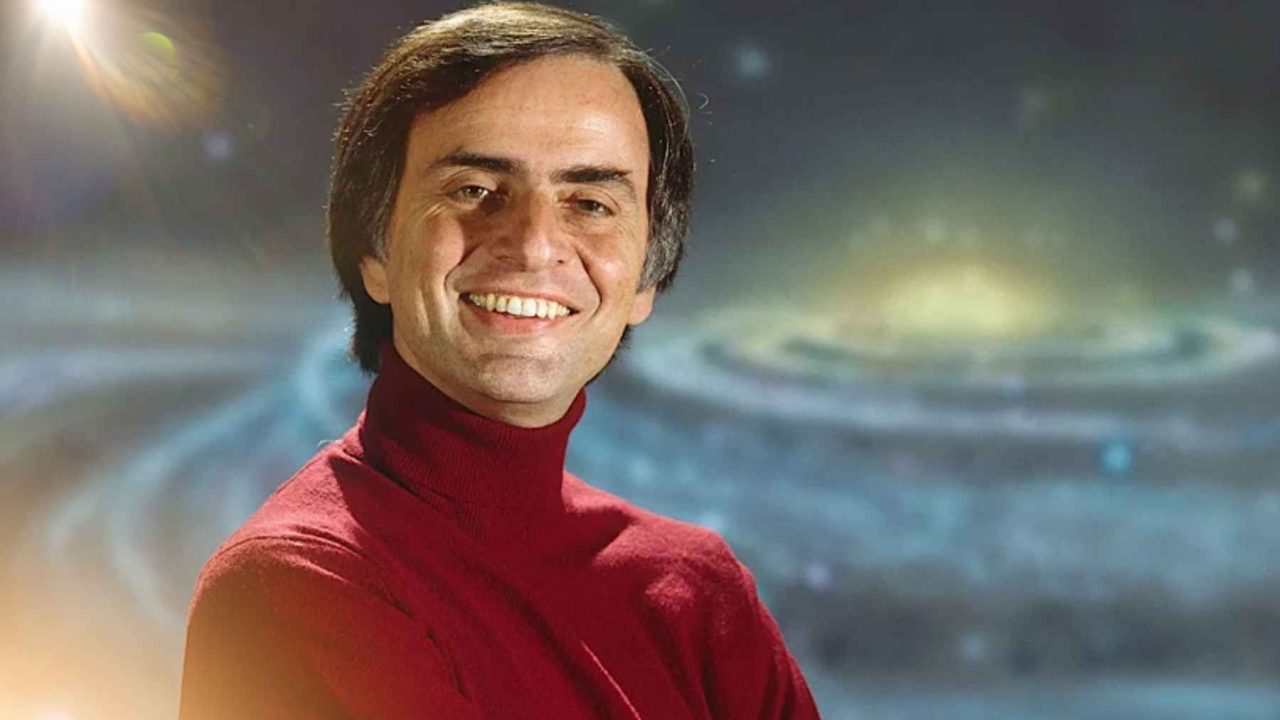
More than 500 million people in 60 countries watched Carl Sagan explain the cosmos through their television screens in 1980 — and the message he kept returning to was one most of us find genuinely uncomfortable: the universe was not built with us in mind.
That single idea sat at the heart of everything Sagan did as a scientist, a writer, and a communicator. The universe, he argued, is not hostile to human beings. But it is not friendly either. It simply does not care. And understanding that, he believed, was not a reason for despair — it was a reason to think more clearly.
Decades after his death, that message still travels. His words, his essays, and the television series that made him a household name continue to shape how millions of people think about science, humanity, and our place in something far larger than ourselves.
What Carl Sagan Actually Meant by an Indifferent Universe
The quote attributed to Sagan — that the universe was not created to accommodate man, nor is it hostile to him, but simply indifferent — sounds bleak on first reading. It isn’t, at least not the way he intended it.
The core of his argument was straightforward: the universe operates according to natural laws, not human wishes. Stars are born and collapse. Planets form and cool. Worlds are destroyed. None of it waits for an audience, and none of it is arranged for human comfort.
This was a direct challenge to the older, human-centered view of the cosmos — the idea that the sky above us was somehow arranged for our benefit, that we occupy a special position in the order of things. Sagan spent much of his career pushing back against that assumption, not to diminish humanity, but to replace a comforting myth with something he considered more honest and ultimately more useful.
A manuscript of his essay A Universe Not Made for Us, preserved by the Library of Congress, demonstrates how seriously he took this line of thinking. It was not a casual observation. It was a position he developed carefully and returned to repeatedly throughout his career.
How Cosmos Brought That Message to Half a Billion People
Sagan’s ideas might have stayed within academic circles if not for the 1980 television series Cosmos. The show became the most-watched program in public television history and reached more than 500 million viewers across 60 countries.
That reach was remarkable for any science program, let alone one that made no attempt to soften its central argument. Cosmos was not science fiction. It was not mysticism. It was science, translated into plain language for people watching from their living rooms — people who had never taken an astronomy class and had no particular reason to care about the scale of the universe until Sagan gave them one.
The series worked because Sagan understood something that many scientists do not: the facts are not enough on their own. People need to feel why something matters before they will listen to how it works. He gave audiences both.
Key Facts About Carl Sagan and His Legacy
| Detail | Information |
|---|---|
| Profession | Astronomer, author, science communicator |
| TV series | Cosmos (1980) |
| Viewership | More than 500 million people |
| Countries reached | 60 countries |
| Historic distinction | Most-watched show in public television history |
| Preserved manuscript | A Universe Not Made for Us, Library of Congress |
- Sagan argued the universe follows natural laws, not human wishes
- His work challenged human-centered views of the cosmos
- He was a consistent defender of evidence over superstition and wishful thinking
- His essay manuscript on this subject is held by the Library of Congress
Why This Still Matters — and Who It Challenges
Sagan’s argument about an indifferent universe was never purely about astronomy. It was also a defense of a particular way of thinking — one that prioritizes evidence over rumor, careful observation over superstition, and honest uncertainty over comfortable myths.
That defense feels at least as relevant now as it did in 1980. We live in a media environment saturated with misinformation, wishful thinking, and confident claims built on very little. Sagan’s broader project was to offer a different model: start with what you can actually verify, hold your conclusions loosely, and be willing to follow the evidence wherever it leads — even if it leads somewhere humbling.
The humbling part is important. Accepting that the universe was not arranged for us does not mean human life has no meaning. Sagan never argued that. What he argued was that meaning we construct honestly, with clear eyes, is worth more than meaning handed to us by a story that doesn’t hold up to scrutiny.
For many readers who encounter his work for the first time, that distinction lands hard. For those who return to it, it tends to feel more like relief than loss.
What Sagan’s Work Leaves Behind
The preservation of his essay manuscript at the Library of Congress is one marker of how seriously the broader culture has come to take his contributions. His writing, his television work, and his public advocacy for scientific thinking left a record that continues to be studied and cited.
Cosmos was later revisited and updated in a new series, a sign of how durable the original concept proved to be. The core questions Sagan asked — where did we come from, what are we made of, how large is the universe, and what does our smallness within it mean — have not gone out of date.
Neither has his central challenge: to look at the night sky without projecting our hopes onto it, and to find that honest view not frightening, but freeing.
Frequently Asked Questions
What did Carl Sagan mean when he said the universe is indifferent to humans?
He meant that the universe operates according to natural laws with no regard for human wishes or comfort — it is neither hostile nor welcoming, simply neutral.
How many people watched Carl Sagan’s Cosmos series?
More than 500 million people across 60 countries watched Cosmos when it aired in 1980, making it the most-watched show in public television history.
What is the essay “A Universe Not Made for Us”?
It is an essay by Carl Sagan that developed his argument about the universe’s indifference to humanity; a manuscript of it is preserved by the Library of Congress.
Was Sagan arguing that human life has no meaning?
Based on his broader body of work, Sagan’s argument was not that life is meaningless, but that meaning should be built on honest evidence rather than comforting myths — though
What was Carl Sagan’s profession?
Sagan was an astronomer who also worked extensively as an author and science communicator, reaching mass audiences through both television and writing.
Is Sagan’s work still considered relevant today?
His work is still widely cited and studied; the original Cosmos series was later revisited in an updated version, reflecting the lasting influence of his ideas and approach to science communication.




Leave a Reply