
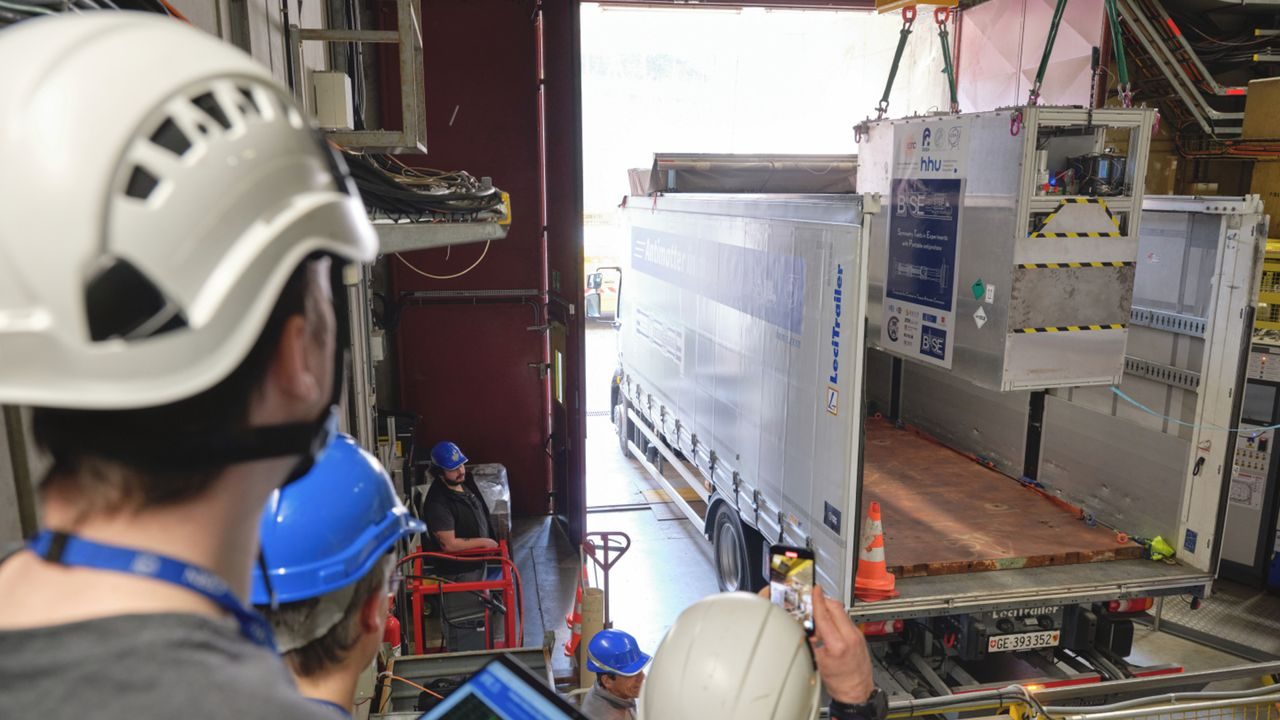
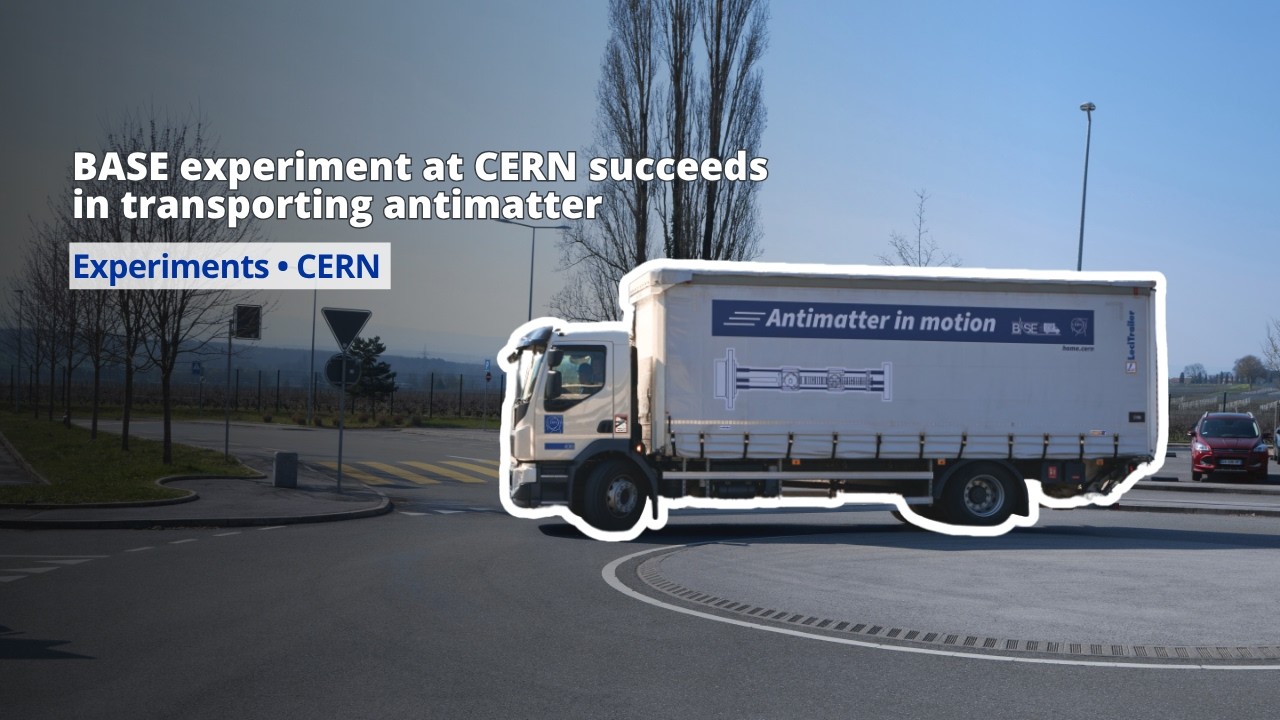
For the first time in history, physicists have successfully transported antimatter by truck — a carefully controlled journey that marks one of the most significant milestones in particle physics research in recent memory. The experiment, carried out on the campus of the European Organization for Nuclear Research (CERN) in Geneva, opens an entirely new chapter in how scientists can study one of the universe’s most elusive and volatile substances.
Antimatter has long been confined to the massive accelerator facilities that produce it, because even the briefest, most minor exposure to ordinary matter causes it to annihilate instantly. Moving it anywhere — even a short distance — was considered extraordinarily difficult. Until now.
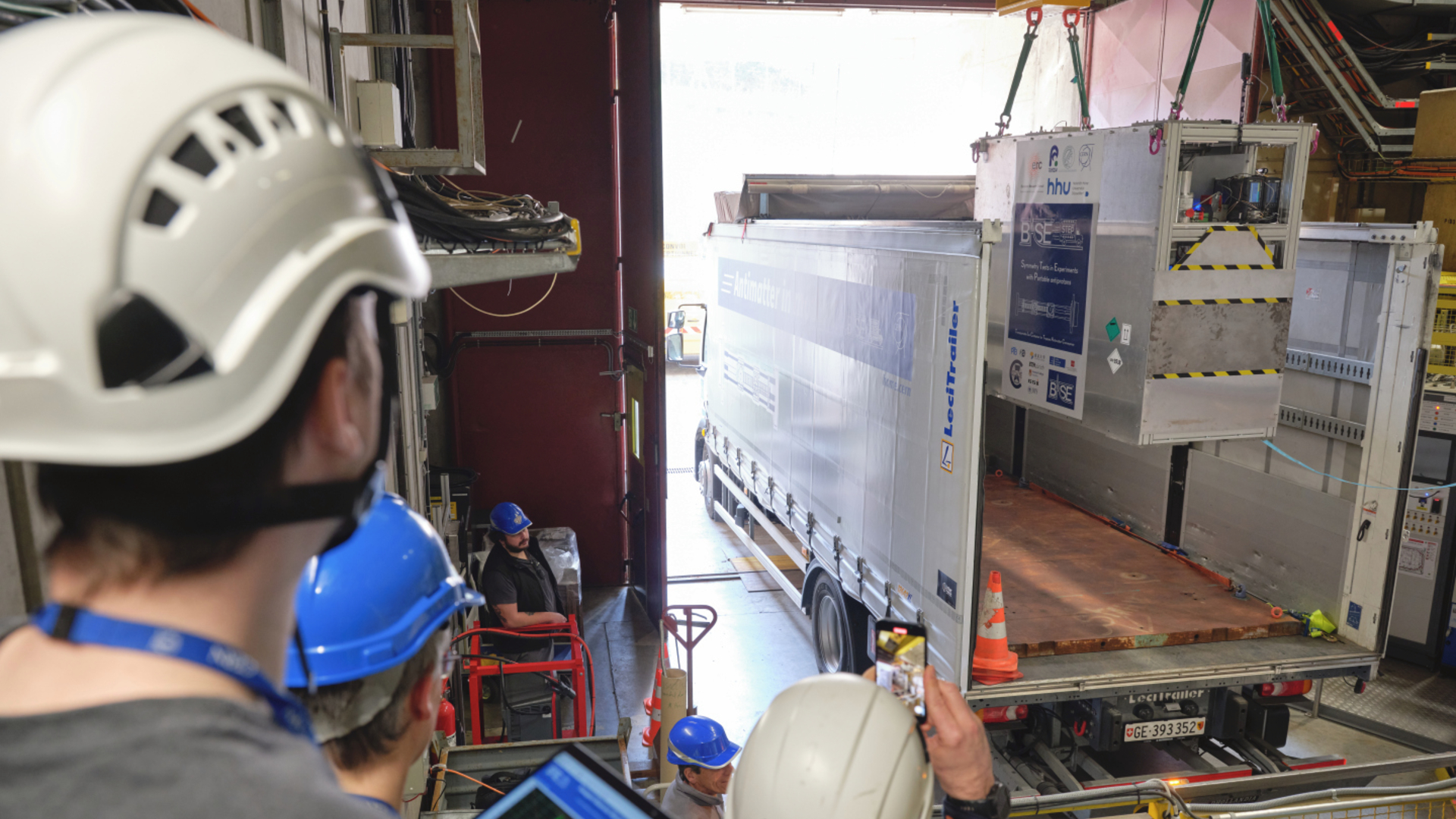
The fact that researchers managed to load antimatter into a specialized trap, place that trap onto a truck, and transport it across the CERN campus without losing it is not just a technical achievement. It is a signal that antimatter research is entering a new era — one where the material might eventually be studied at multiple locations and with far greater precision than ever before.
Why Antimatter Is So Hard to Handle
To understand why this transport milestone matters, it helps to understand what makes antimatter so difficult to work with in the first place. Antimatter is, in the simplest terms, the mirror opposite of ordinary matter. Every particle of matter has a corresponding antiparticle with the same mass but opposite charge. When the two meet, they destroy each other in a burst of energy.
That means antimatter cannot touch the walls of any container. It cannot be held in a glass jar or a metal box. Instead, physicists must use powerful magnetic fields to suspend it in a vacuum, keeping it completely isolated from ordinary matter at all times. These devices — known as traps — are extraordinarily sensitive to vibration, temperature changes, and magnetic interference.
Putting one of those traps on a truck and driving it around is, by the standards of particle physics, a remarkable act of engineering confidence. The fact that the antimatter survived the journey intact is what makes this experiment so significant.
What Actually Happened at CERN
The transport took place at CERN’s Geneva campus, where the organization’s particle accelerators produce small quantities of antimatter for research. Physicists loaded an antimatter trap — a device specifically designed to contain and preserve antiparticles using magnetic fields — onto a truck and completed a short but tightly controlled journey around the facility.
The goal was not simply to move the antimatter from one place to another for convenience. It was to prove that antimatter could survive transport at all — that the trapping technology was robust enough to withstand the real-world conditions of road travel without the delicate magnetic containment failing and the antimatter annihilating.
According to the source reporting, the experiment was successful. The antimatter was transported without incident, and the achievement is now being described as a potential turning point for the entire field of antimatter research.
What This Could Mean for Physics
One of the biggest questions in all of physics is why the universe is made of matter at all. According to the leading theories of the Big Bang, matter and antimatter should have been created in equal amounts when the universe began. If that is true, they should have annihilated each other entirely, leaving nothing behind — no stars, no planets, no people.
Obviously, that did not happen. Matter won. But scientists still do not fully understand why. Studying antimatter with greater precision is one of the most promising paths toward answering that question. If physicists can detect even tiny differences in the behavior of antimatter versus ordinary matter, those differences might explain the imbalance that allowed the universe as we know it to exist.
Until now, that research has been limited to the facilities that produce antimatter — primarily CERN. Being able to transport antimatter, even over short distances, means researchers could eventually study it using equipment and detectors located away from the production source, dramatically expanding the range and precision of experiments.
| Aspect | Detail |
|---|---|
| Location of experiment | CERN campus, Geneva |
| Method of transport | Truck carrying a specialized antimatter trap |
| Type of containment | Magnetic trap suspending antimatter in vacuum |
| First of its kind | Yes — first-ever truck transport of antimatter |
| Primary scientific goal | Enable antimatter research beyond production facilities |
| Broader research aim | Help explain why matter dominates the universe |
The Part of This Story Most Reports Are Missing
It is easy to focus on the spectacle — antimatter on a truck — and miss the deeper implication. This is not just about moving a dangerous substance safely. It is about the future architecture of physics research itself.
Right now, studying antimatter means going to CERN. The detectors, the researchers, the experiments — everything has to be built around the place where the antimatter is made, because the antimatter cannot go anywhere else. That constraint shapes the entire research program.
If antimatter can be transported, even over modest distances, that constraint begins to loosen. Specialized detectors could be built in locations optimized for sensitivity rather than proximity to a particle accelerator. Collaborative experiments between institutions could become feasible. The science itself could expand in ways that are currently impossible.
Researchers have noted that this first truck transport, short as it was, is a proof of concept for exactly that kind of future — one where the study of antimatter is no longer tethered to a single point on the map.
What Happens Next
This first transport was deliberately kept short and controlled, carried out within the familiar environment of the CERN campus. The immediate next steps are likely to involve refining the transport technology, testing the stability of antimatter traps under a wider range of conditions, and gradually extending the distance over which antimatter can be safely moved.
Longer-term, the ambition is to use this capability to conduct antimatter experiments with unprecedented precision — experiments that could bring physicists closer to understanding the fundamental asymmetry between matter and antimatter that made the universe possible. Specific timelines for those future experiments have not yet been confirmed, but the successful truck transport represents the critical first step that makes them conceivable.
Frequently Asked Questions
What is antimatter?
Antimatter consists of particles that are the mirror opposites of ordinary matter particles — same mass, but opposite charge. When antimatter and matter meet, they annihilate each other in a release of energy.
Where did this antimatter transport take place?
The transport took place on the campus of CERN, the European Organization for Nuclear Research, located in Geneva.
How was the antimatter kept from being destroyed during transport?
The antimatter was held inside a specialized trap that uses powerful magnetic fields to suspend the antiparticles in a vacuum, preventing them from contacting ordinary matter.
Why does it matter that antimatter was transported by truck?
Previously, antimatter research was confined to the facilities that produce it. Being able to transport it opens the possibility of conducting experiments at different locations, with more specialized equipment and greater precision.
Could this help explain why the universe exists?
Researchers believe so — studying antimatter more precisely could help scientists understand why matter came to dominate the universe after the Big Bang, which is one of the deepest unsolved questions in physics.
Has antimatter ever been transported over longer distances?
This has not yet been confirmed in The CERN campus transport is described as a first-of-its-kind milestone, with longer-distance transport likely a goal for future research.




Leave a Reply