
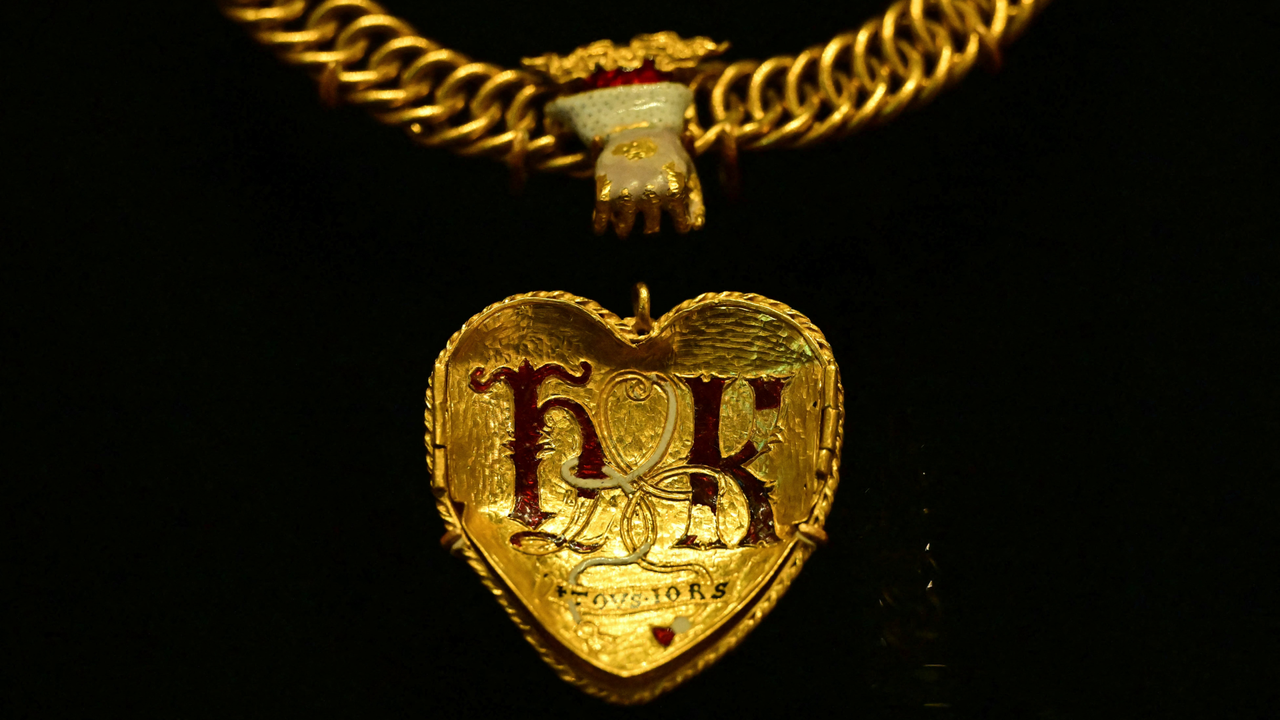
Half a millennium ago, a skilled goldsmith crafted a small but extraordinary object — a heart-shaped gold pendant bearing the initials of two of the most famous people in Tudor England. It disappeared from history, likely lost or hidden, and spent roughly 500 years buried beneath the English countryside. Then, in 2019, a metal detectorist spotted it poking out of a dried-up pond in Warwickshire, central England.
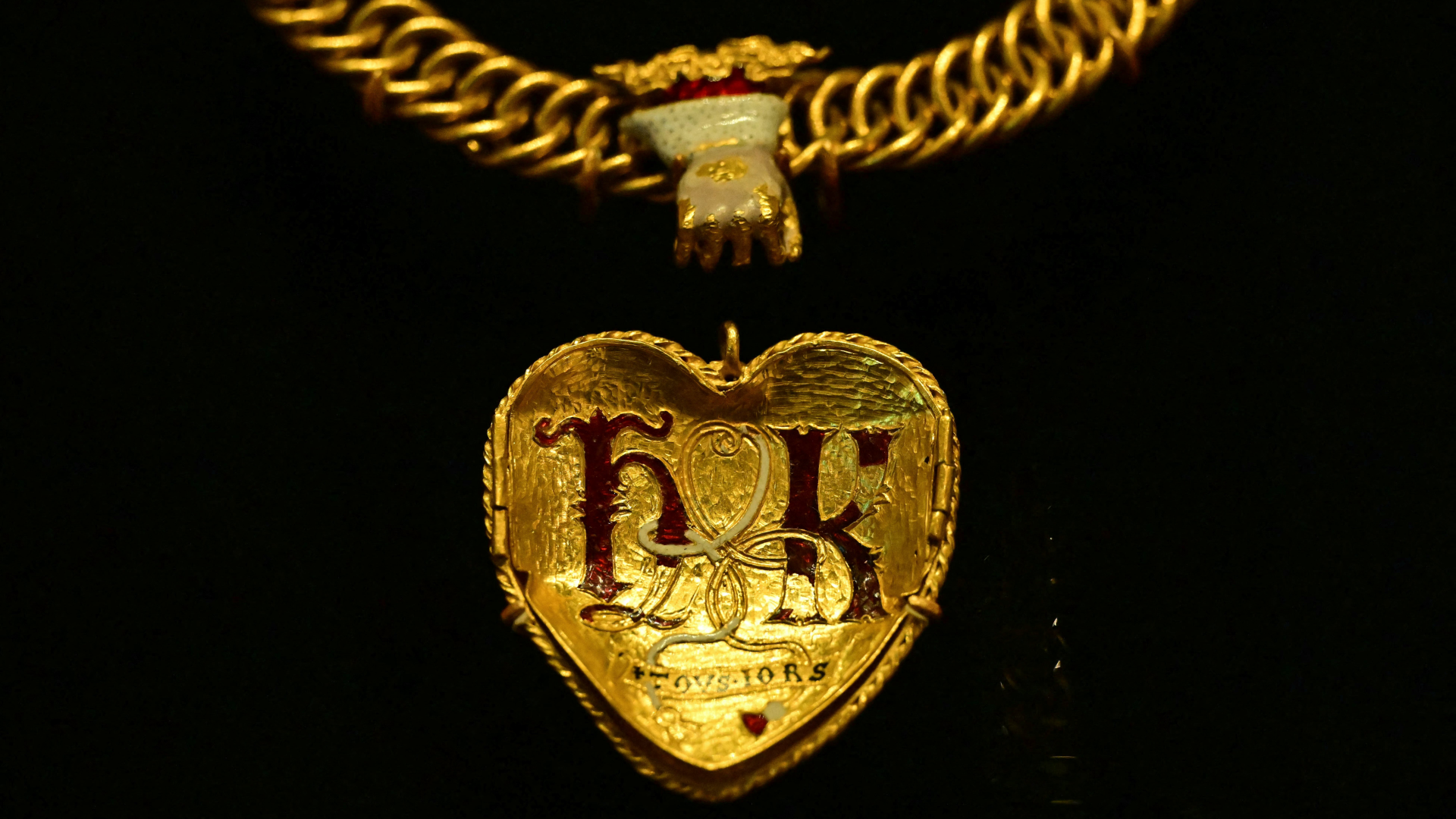
What that detectorist had found was no ordinary piece of old jewelry. The pendant — now known as the Tudor Heart — is a rare, red-enameled gold necklace believed to date to around 1518, during the reign of Henry VIII. Its symbols point directly to one of the most consequential royal marriages in English history: the union between Henry VIII and his first wife, Katherine of Aragon.
The object is small. The story it tells is enormous.
What the Tudor Heart Actually Is
The Tudor Heart is a gold necklace with a heart-shaped pendant at its center. The pendant is decorated with red enamel and features two initials: H and K — widely interpreted as standing for Henry and Katherine. Alongside the initials, the pendant carries two deeply symbolic motifs: a rose and a pomegranate.
Neither symbol is accidental. The rose was the emblem of the Tudor dynasty, adopted by Henry VII after the Wars of the Roses and carried forward by his son Henry VIII. The pomegranate, by contrast, was the personal emblem of Katherine of Aragon, who had brought it with her from Spain as a symbol of her royal heritage and, some historians note, of fertility and hope.
Together, the two symbols on this pendant represent the joining of two royal houses — English and Spanish — in a marriage that, at least in 1518, was still very much intact and publicly celebrated.
The French-English Pun Hidden in Plain Sight
What makes the Tudor Heart especially fascinating to historians and linguists is a clever piece of wordplay embedded in its design. The pendant is believed to feature a French-English pun relating to the love between Henry and Katherine — a bilingual joke that would have been immediately understood by the educated courtiers of the Tudor court, where French was commonly spoken alongside English.
This kind of learned, multilingual wit was entirely typical of Renaissance court culture. Objects given as gifts between royals and nobles were often layered with meaning — visual symbols, mottoes, and puns that signaled intelligence and affection simultaneously. A gift that made you smile and think was worth more than one that simply looked expensive.
The Tudor Heart appears to be exactly that kind of object: a love token designed to delight as well as impress, crafted at a moment when Henry and Katherine’s marriage was still a symbol of dynastic strength and personal devotion.
Key Facts About the Tudor Heart at a Glance
| Detail | Information |
|---|---|
| Name | Tudor Heart |
| What it is | A gold necklace with a red-enameled pendant |
| Where it was found | Warwickshire, central England |
| When it was discovered | 2019, by a metal detectorist |
| Estimated date of creation | Circa 1518 |
| Initials on pendant | H and K (Henry and Katherine) |
| Symbols depicted | A rose and a pomegranate |
| Material | Solid gold with red enamel |
- The rose represented the Tudor royal dynasty of England.
- The pomegranate was Katherine of Aragon’s personal emblem, brought from Spain.
- The pendant features a bilingual French-English pun referencing their love.
- The piece dates to a period when Henry and Katherine’s marriage was still celebrated and intact.
Why This Discovery Matters Beyond the Romance
It would be easy to reduce the Tudor Heart to a story about a famous king and his ill-fated first wife. But the object matters for reasons that go well beyond royal gossip.
Finds like this one offer historians a rare physical window into the material culture of the early Tudor court — the objects that real people made, gave, wore, and eventually lost. Written records from this period survive in abundance, but they were largely created by men writing for posterity. A personal love token, buried in a Warwickshire field, tells a different kind of story.
The year 1518 was a significant moment. Henry and Katherine had been married for nearly a decade. Their marriage had already been tested by multiple pregnancies that ended in tragedy, but Katherine remained queen, and Henry had not yet begun to pursue Anne Boleyn in any serious way. The Tudor Heart, if it does date to this year, captures a marriage at a particular and poignant moment — still hopeful, still publicly devoted, still symbolically powerful.
The fact that it was found in a dried-up pond also raises questions historians may never fully answer. Was it lost accidentally? Hidden deliberately? Discarded? Objects like this rarely come with explanations, which is part of what makes them so compelling.
What Happens to the Tudor Heart Now
The discovery of the Tudor Heart in 2019 triggered the standard process under English law for significant archaeological finds. Metal detector discoveries of this kind — particularly those involving precious metals and objects of historical significance — are subject to the Treasure Act in England and Wales, which requires finders to report such items to local authorities.
From there, objects are typically assessed by experts, valued, and offered to museums. The finder and landowner are generally entitled to a share of the valuation if a museum acquires the piece.
The Tudor Heart, given its rarity and its direct connection to one of England’s most studied royal couples, would be considered a significant acquisition for any institution focused on Tudor history. Where it ultimately ends up on public display has not been confirmed in available reporting.
Frequently Asked Questions
What is the Tudor Heart?
The Tudor Heart is a solid gold necklace with a red-enameled, heart-shaped pendant featuring the initials H and K, a rose, and a pomegranate. It is believed to date to circa 1518 and is associated with Henry VIII and Katherine of Aragon.
Where was the Tudor Heart found?
It was discovered by a metal detectorist in 2019, in Warwickshire, central England, in what had been a dried-up pond.
What do the symbols on the pendant mean?
The rose was the emblem of the Tudor royal dynasty, while the pomegranate was the personal symbol of Katherine of Aragon, representing her Spanish heritage.
What is the French-English pun on the Tudor Heart?
The pendant is believed to contain a bilingual pun referencing the love between Henry and Katherine, though the full details of the wordplay have not been confirmed in available reporting beyond this description.
Who made the Tudor Heart and for whom?
The exact maker is not confirmed in available reporting. Based on its symbols and initials, it is believed to have been made as a love token connected to Henry VIII and Katherine of Aragon around 1518.
Where is the Tudor Heart now?
Its current location or final museum placement has not been confirmed in available reporting at this time.



Leave a Reply