
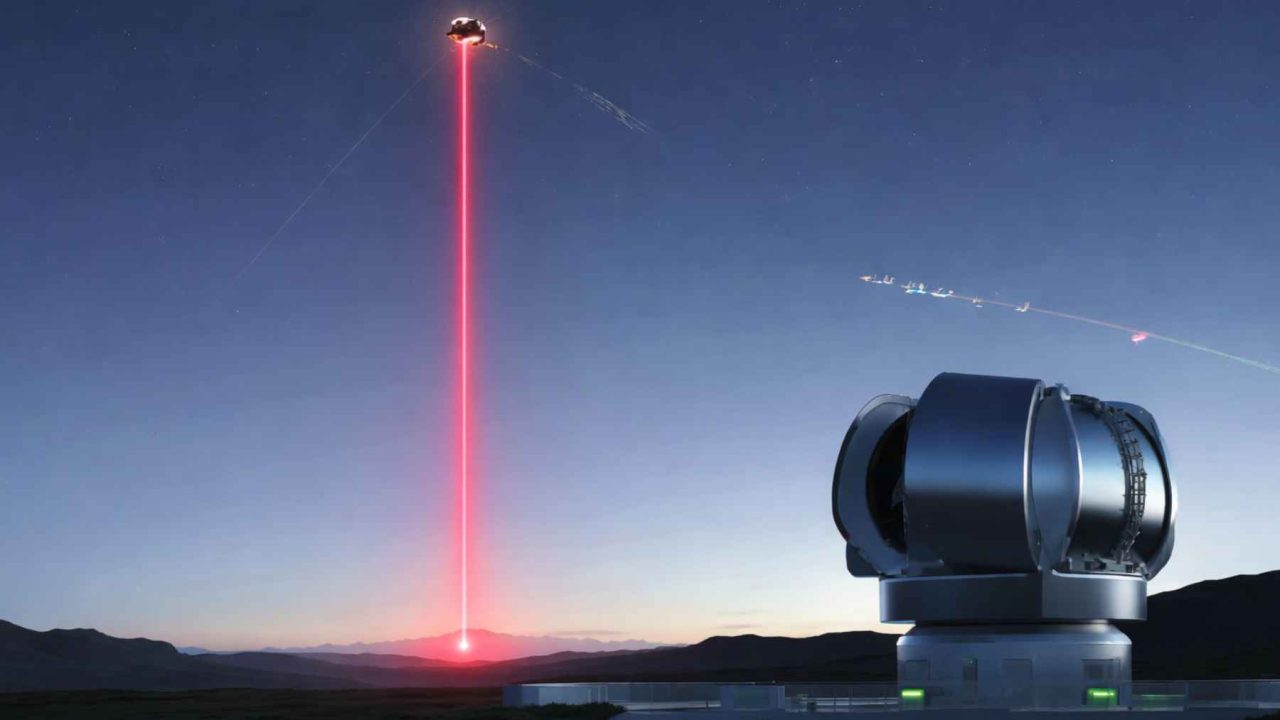
A laser no more powerful than a small LED bulb has just transmitted data from the edge of geostationary orbit — roughly 36,705 kilometers above Earth — at a speed of 1 gigabit per second. That is 1,000 megabits every second, traveling across nearly 23,000 miles of space and atmosphere on just 2 watts of power.
The achievement, reported in April 2026, comes from a Chinese satellite-to-ground optical communication experiment. It is the kind of result that sounds almost implausible until you sit with it: a beam of light, drawing less energy than a nightlight, moving data fast enough to transfer an HD video file across the globe in a matter of seconds.
But the raw speed figure is only part of the story. The harder problem — the one that has stalled space-based laser communication for years — is keeping that beam coherent and usable after it has fought its way through Earth’s atmosphere. That is where this experiment gets genuinely interesting.
Why Sending a Laser From Space Is Much Harder Than It Sounds
When people think about transmitting data from a satellite, they usually picture radio waves — the same basic technology that powers GPS, satellite television, and traditional broadband from orbit. Radio has served us well, but it has real limits on how much data it can carry.
Lasers, or optical communication systems, operate at much higher frequencies and can theoretically carry far more data through a much narrower beam. The physics are favorable. The engineering, however, is brutal.
The core challenge is atmospheric turbulence. The same shimmering effect you see rising off hot pavement — or the reason distant objects on a summer horizon seem to wobble — happens to laser light passing through the atmosphere. That turbulence scatters and distorts the beam, degrading the signal before it ever reaches a ground receiver.
From geostationary orbit, the beam is traveling through the full depth of Earth’s atmosphere at a distance of over 36,000 kilometers. The margin for error is extraordinarily small. Researchers in this experiment specifically addressed that turbulence problem, and their ability to maintain a stable 1 Gbps link despite it is what makes the result noteworthy beyond the headline number.
The Numbers Behind China’s Laser Communication Test
Here is a clear breakdown of what the experiment involved, based on the confirmed details from the test:
| Parameter | Value |
|---|---|
| Transmission distance | 36,705 kilometers (approx. 22,800 miles) |
| Laser power output | 2 watts |
| Data transmission speed | 1 gigabit per second (1,000 Mbps) |
| Orbit type | Geostationary (satellite appears stationary over a fixed region) |
| Receiving equipment | Ground-based telescope |
The 2-watt optical transmitter is a striking detail. For context, a standard incandescent nightlight draws about 4 to 7 watts. The transmitter used in this test draws roughly half that — and yet it pushed a gigabit of data per second across a distance that spans nearly a tenth of the way to the Moon.
- 1 Gbps equals 1,000 megabits per second — significantly faster than the average home broadband connection in most countries
- Researchers described the practical capability as being able to move an HD video file across the globe in a few seconds
- The satellite sits in geostationary orbit, meaning it remains positioned over the same region of Earth continuously — an important operational advantage for communication infrastructure
What This Could Mean for Global Data Infrastructure
If space-based laser communication can be made reliable at scale, the implications for how data moves around the planet are significant. Current satellite internet systems — including those using large constellations in low Earth orbit — rely on radio frequency links that face growing congestion as demand for bandwidth explodes.
Optical links from geostationary orbit could offer a high-capacity alternative. A satellite that stays fixed over one region and delivers gigabit-speed data to a ground station below could function as a backbone node — feeding high-speed connectivity to areas where laying fiber cable is impractical or impossible.
The low power requirement matters too. Satellites have strict energy budgets. Every watt saved on a transmitter is a watt available for other systems, or a reduction in the size and cost of the solar panels needed to power the spacecraft. A 2-watt transmitter hitting gigabit speeds is an efficient result by any measure.
Observers have noted that if atmospheric turbulence can be managed consistently — not just in a single experiment but across varying weather conditions, seasons, and geographic locations — low-power space lasers could realistically become a serious component of future global communications networks.
The Atmospheric Problem Is Not Solved Yet — But Progress Is Real
It would be overstating the result to say that the turbulence challenge has been fully conquered. A successful test under specific conditions is not the same as a deployable, all-weather system. Real-world optical links from geostationary orbit will need to perform reliably through clouds, storms, and the full range of atmospheric conditions that vary by location and season.
Ground stations may need to be positioned in locations with favorable atmospheric conditions, or networks of stations may need to be distributed so that at least one has a clear line of sight at any given time. These are known engineering problems in the field, and they remain unsolved at a commercial scale.
Still, demonstrating a stable gigabit link at this distance and power level is a meaningful step forward. It shows the underlying technology is capable of performing at the threshold needed to be useful — which is the necessary precondition for all the harder engineering work that follows.
What Comes Next for Space Laser Communication
What the experiment establishes is a proof of capability — that a 2-watt optical system can maintain a 1 Gbps downlink from geostationary orbit to a ground telescope, with atmospheric turbulence accounted for.
Further testing under varied conditions, development of adaptive optics systems to compensate for atmospheric distortion in real time, and eventual integration into operational satellite architectures would all be necessary steps before this technology moves from experiment to infrastructure.
For now, the result stands as a demonstration that the physics and engineering can work together at the scale required — a meaningful signal that space-based optical communication deserves serious attention as a component of tomorrow’s global data networks.
Frequently Asked Questions
How far did the laser signal travel in this experiment?
The signal traveled approximately 36,705 kilometers, or about 22,800 miles, from a geostationary satellite down to a telescope on Earth.
How much power did the laser transmitter use?
The optical transmitter used just 2 watts of power — roughly equivalent to a small LED bulb or about half the draw of a standard nightlight.
What data speed was achieved?
The downlink reached 1 gigabit per second, which equals 1,000 megabits per second — fast enough to transfer an HD video file across the globe in a few seconds, according to the researchers.
What is the biggest technical challenge for space laser communication?
Atmospheric turbulence is the primary obstacle — the same distortion effect that makes distant objects shimmer on a hot day can scatter and degrade a laser beam traveling through Earth’s atmosphere from orbit.
Does this mean satellite laser internet is coming soon?
This has not been confirmed. The experiment demonstrates that the technology is capable of gigabit performance at this distance, but consistent all-weather deployment at a commercial scale involves additional engineering challenges that remain unresolved.
Why does geostationary orbit matter for this kind of communication?
Geostationary satellites remain positioned over the same region of Earth continuously, which makes them well-suited as stable communication nodes that can reliably serve a fixed ground area.




Leave a Reply