
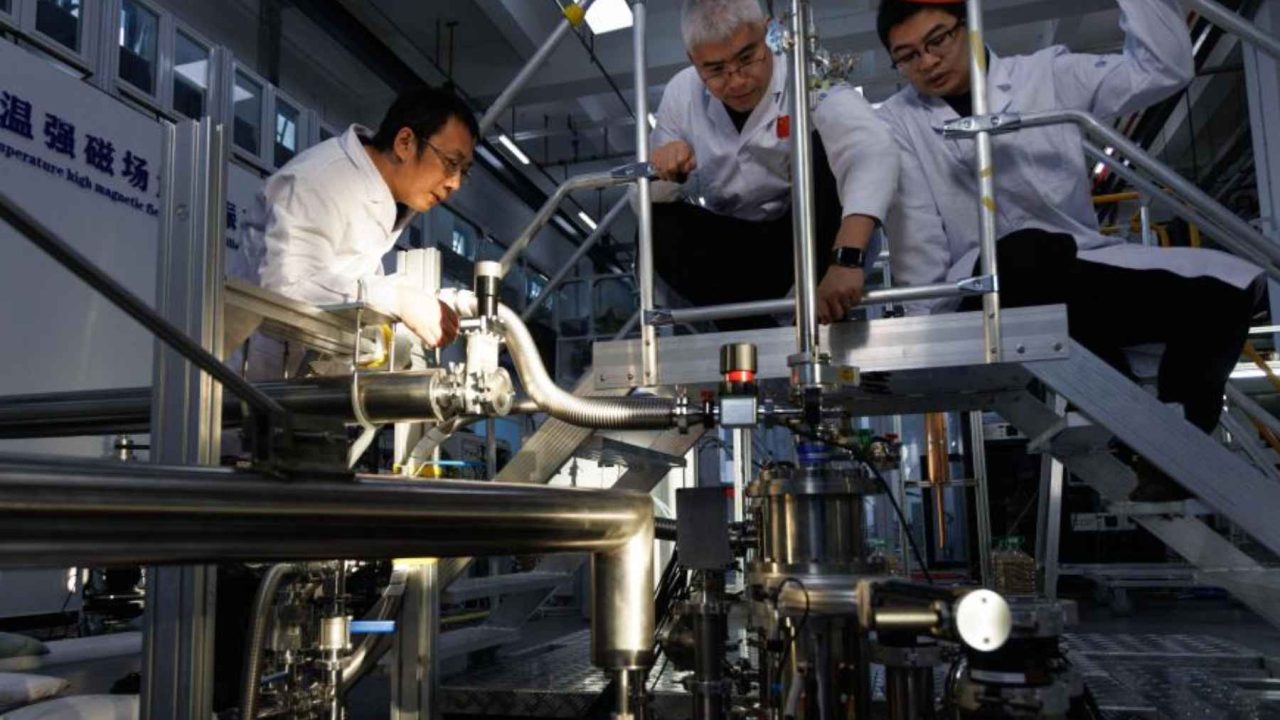
A single magnet in China is now producing a field 700,000 times stronger than the one wrapping around the entire Earth — and scientists are only just beginning to understand what that kind of power makes possible.
The Chinese Academy of Sciences has announced that its new all-superconducting magnet has reached 35.6 tesla, setting a world record in high magnetic fields. To put that number in context, the Earth’s magnetic field at the surface measures just a few tens of microtesla — a tiny fraction of a single tesla. This machine blows past that by an almost incomprehensible margin.
What makes the announcement more than a headline is what comes next. The system isn’t a laboratory curiosity locked behind closed doors. It’s been designed as a shared research tool, and the question now is what happens when scientists from multiple fields get access to it.
Why 35.6 Tesla Is Unlike Anything Built Before
If you’ve had an MRI scan, you’ve experienced what a powerful magnet feels like from the outside — though you wouldn’t know it lying still in that tube. A standard hospital MRI machine runs at roughly 1.5 to 3 tesla. That’s already strong enough to pull metal objects across a room and produce detailed images of soft tissue inside a living body.
The new Chinese magnet runs at more than ten times that strength. And unlike many record-setting magnets that can only sustain their peak field for brief bursts before overheating or requiring enormous energy input, this one is built differently.
According to official reports, the system can hold its maximum field for more than 200 continuous hours while keeping energy consumption relatively low. That combination — extreme strength, long-duration stability, and efficiency — is what separates it from previous record holders. Duration matters enormously in research. Many experiments require sustained field conditions to produce meaningful data, and a magnet that flickers on and off at peak power isn’t nearly as useful as one that holds steady.
What This Magnet Is Actually Designed to Study
The Chinese Academy of Sciences has framed the system as a shared scientific tool rather than a single-purpose instrument. The conditions it creates — extraordinarily intense magnetic fields held over long periods — allow researchers to probe matter in ways that are otherwise impossible on Earth.
The fields produced are described as approaching conditions found in deep space or inside giant planets, environments where matter behaves in ways that challenge our current models of physics. Getting a controlled version of those conditions in a laboratory is exactly what scientists studying exotic states of matter need.
The areas of research the system is intended to support include:
- Quantum materials — substances that exhibit strange behaviors governed by quantum mechanics, which become more visible under extreme magnetic conditions
- Advanced superconductors — materials that conduct electricity with zero resistance, which researchers are still trying to understand and improve
- Biological molecules — high-field magnets can reveal structural details of complex molecules that lower-powered systems cannot resolve
Each of these fields has significant downstream implications — from faster computing and lossless power transmission to new medical diagnostics and drug development.
How This Compares: Putting the Numbers in Perspective
| Source of Magnetic Field | Approximate Strength |
|---|---|
| Earth’s surface magnetic field | ~25–65 microtesla (a fraction of 0.0001 tesla) |
| Standard hospital MRI scanner | 1.5 – 3 tesla |
| China’s new all-superconducting magnet | 35.6 tesla |
| Ratio vs. Earth’s field | More than 700,000 times stronger |
| Sustained operation duration | More than 200 hours |
The scale of the gap between Earth’s natural field and what this machine produces is genuinely hard to absorb. It’s not just a stronger version of something familiar — it’s a different category of physical environment entirely.
The Bigger Picture Behind This Achievement
The fact that this magnet is being offered as a shared tool is significant. High-field magnet facilities are rare globally, and access to them has historically shaped which research institutions can pursue certain lines of inquiry and which cannot. A facility that opens its doors to multiple research teams effectively raises the ceiling for what a broader scientific community can investigate.
The conditions this magnet creates — mimicking environments found inside giant planets or in deep space — also have implications beyond pure physics. Understanding how matter behaves under extreme magnetic conditions feeds into models of planetary formation, helps explain observations made by space telescopes, and could eventually inform the design of future fusion energy systems, which rely on powerful magnetic fields to contain superheated plasma.
Researchers have noted that the combination of strength, stability over 200-plus hours, and relatively low energy consumption is what makes this system genuinely novel. Previous record magnets often required trade-offs that limited their practical usefulness. This design appears to have addressed several of those limitations simultaneously.
What Comes Next in 2026
The magnet’s activation was announced in March 2026, and the system is positioned as a tool for active research use rather than a demonstration project. The Chinese Academy of Sciences has framed it as infrastructure for ongoing scientific investigation across multiple disciplines.
The immediate next step is access — opening the facility to research teams working on quantum materials, superconductivity, and biological molecular structures. Whether this results in specific breakthroughs depends on the experiments that follow, but the instrument itself is now operational and ready.
For the global scientific community, the arrival of a new high-field facility at this level means more teams will have the opportunity to run experiments that were simply not possible before. That’s not a guarantee of discovery, but it is the necessary precondition for one.
Frequently Asked Questions
How strong is China’s new magnet compared to a hospital MRI?
A standard hospital MRI runs at 1.5 to 3 tesla. China’s new magnet reaches 35.6 tesla, making it more than ten times stronger than the most powerful common MRI scanners.
Who built the 35.6-tesla magnet?
The magnet was created by the Chinese Academy of Sciences and is intended to function as a shared research tool for multiple scientific teams.
How long can the magnet hold its maximum field?
According to official reports, the system can sustain its peak magnetic field for more than 200 continuous hours while maintaining relatively low energy consumption.
What will scientists use this magnet for?
The system is designed to support research into quantum materials, advanced superconductors, and biological molecules — areas where extreme magnetic conditions reveal properties that cannot be studied at lower field strengths.
Why does the duration of the magnetic field matter?
Many scientific experiments require sustained, stable conditions to produce reliable data. A magnet that can hold its peak field for over 200 hours is far more practically useful than one limited to short bursts.
Is this magnet open to researchers outside China?



Leave a Reply