
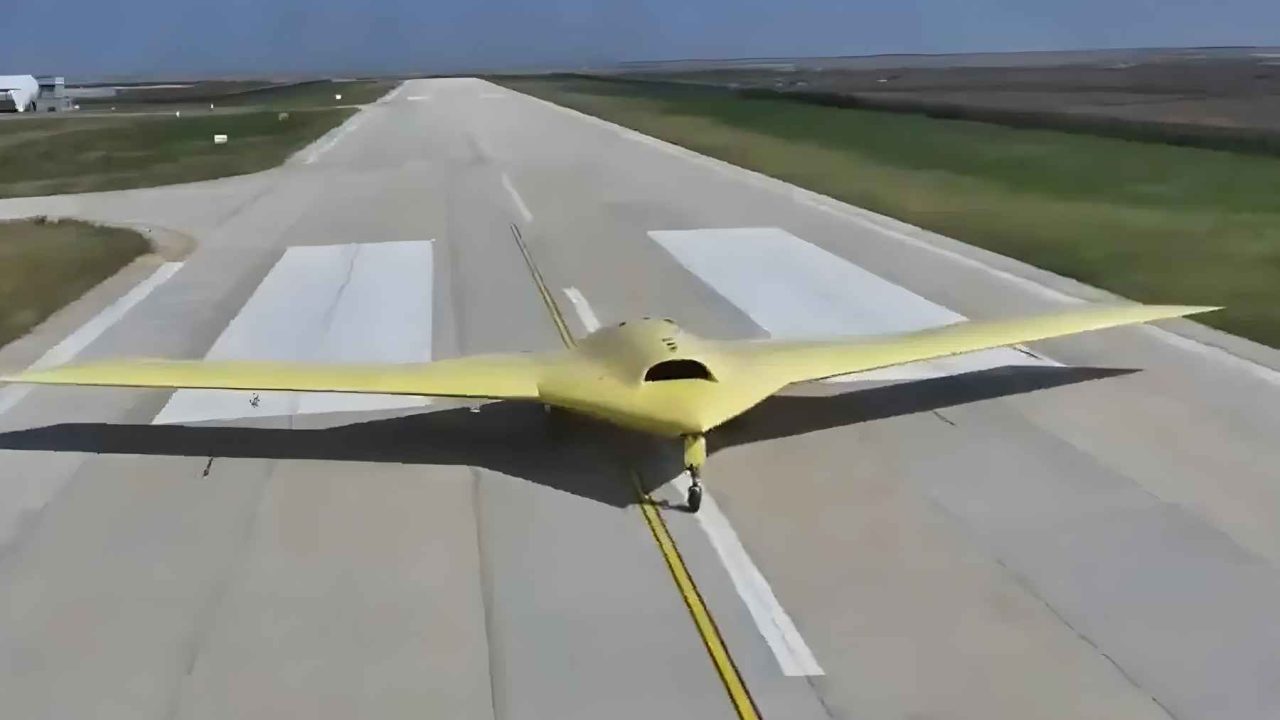
A drone capable of flying at nearly 926 kilometers per hour — faster than most commercial aircraft — just completed its first reported flight test in northwestern China. And while the speed alone is enough to raise eyebrows, the real story is what this aircraft is designed to do and what its successful maiden flight signals to the rest of the world.
China has confirmed the first flight of the CH-7, an uncrewed stealth reconnaissance drone developed by the China Academy of Aerospace Aerodynamics. The test, conducted at an airfield in northwestern China, was focused on fundamentals: autonomous takeoff and landing, in-flight position control, communications, and tracking. Officials say it achieved the “desired results.”
That phrase may sound modest, but for a flying-wing aircraft that relies entirely on computer systems to maintain stability, a clean maiden flight is anything but routine. It means the design works — at least at this early stage.
What the CH-7 Actually Is — and Why It Matters
The CH-7 is described as a long-range stealth drone built primarily for reconnaissance. Its flying-wing design — a shape that blends the fuselage and wings into a single continuous surface — is specifically chosen to minimize radar visibility. That’s the “stealth” part of the equation.
Flying-wing aircraft are notoriously difficult to control. Without a traditional tail structure to provide stability, these aircraft are inherently unstable by design, which is why they require constant, real-time computer corrections to stay level in flight. The fact that the CH-7 completed autonomous takeoff and landing on its first test is a meaningful engineering checkpoint.
Project leader Li Jianhua confirmed the test met its objectives, according to a China Daily report citing the China Academy of Aerospace Aerodynamics. The focus of this initial flight was not pushing speed limits or range — it was proving that the aircraft’s shape and control systems behave as engineers predicted before more demanding tests begin.
The Numbers Behind the CH-7 Stealth Drone
The publicly available specifications for the CH-7, as cited in defense reporting, give a clear picture of what this aircraft is built to do. Here’s what has been confirmed from openly published data:
| Specification | Confirmed Detail |
|---|---|
| Maximum Speed | Approximately 926 km/h (~575 mph) |
| Aircraft Type | Uncrewed stealth drone (UAV) |
| Primary Role | Long-range reconnaissance |
| Design Configuration | Flying-wing |
| Developer | China Academy of Aerospace Aerodynamics |
| Test Location | Airfield in northwestern China |
| Flight Focus | Autonomous takeoff/landing, position control, communications, tracking |
The speed figure — roughly 926 km/h — puts the CH-7 in a class well above most conventional surveillance drones, which typically operate at far lower speeds. For context, that’s approaching the cruising speed of a commercial passenger jet, but in an aircraft designed to be nearly invisible to radar.
What the First Flight Actually Proved
It’s worth being clear about what a maiden flight does and does not confirm. This test was not about breaking speed records or demonstrating long-range endurance. According to officials, the goal was to verify that the aircraft’s aerodynamic shape and autonomous control systems perform as modeled — the kind of baseline validation that must happen before engineers can push the aircraft further.
- Autonomous takeoff and landing — confirmed during the test
- In-flight position control — verified as functioning as predicted
- Communications systems — tested and tracked during flight
- Overall aerodynamic behavior — described as matching expectations
For a flying-wing design, each of these is a real challenge. The shape that makes the aircraft stealthy also makes it harder to fly. Clearing these boxes on the first attempt is a genuine technical achievement, not a formality.
Engineers are now expected to expand what’s known as the “flight envelope” — gradually testing the aircraft at greater speeds, altitudes, and durations to understand its full capabilities and any limitations.
The Message Beyond the Milestone
China’s decision to openly report on this flight — through state media outlet China Daily — is itself part of the story. Defense programs of this sensitivity are rarely publicized unless there’s an intent to signal something. A high-speed stealth reconnaissance drone, successfully airborne and publicly acknowledged, tells other nations something deliberate about the state of China’s aerospace development.
Stealth reconnaissance drones occupy a particularly sensitive niche in military aviation. Unlike combat drones, their value lies in information gathering — the ability to operate deep in contested airspace, at high speed, without being detected. A platform that combines near-jet speeds with a low radar signature represents a significant intelligence-collection capability.
The CH-7’s first flight doesn’t mean the aircraft is operational. There is a long road between a successful maiden flight and a deployed military asset. But it does confirm that the program has cleared a critical early threshold.
What Comes Next for the CH-7 Program
Based on what officials have stated, the program is now entering a more intensive testing phase. Engineers will work to expand the flight envelope, meaning they’ll push the aircraft progressively harder — faster speeds, longer durations, more complex maneuvers — to build a complete picture of how it performs under real conditions.
Each subsequent test will be designed to stress-test different systems: propulsion, avionics, stealth coatings, communications under varied conditions, and eventually the sensors and reconnaissance systems the drone is meant to carry operationally.
Whether and when the CH-7 moves from test program to deployed asset has not been confirmed in available reporting. What is confirmed is that the first flight happened, it went as planned, and the program is moving forward.
Frequently Asked Questions
What is the CH-7 drone?
The CH-7 is an uncrewed stealth drone developed by China’s Academy of Aerospace Aerodynamics, designed primarily for long-range reconnaissance missions.
How fast can the CH-7 fly?
Openly published specifications cited in defense reporting put the CH-7’s maximum speed at approximately 926 kilometers per hour, or roughly 575 miles per hour.
What did the first test flight prove?
According to officials, the maiden flight confirmed that the aircraft’s autonomous takeoff and landing, in-flight position control, communications, and tracking systems all performed as predicted.
Who is leading the CH-7 project?
Project leader Li Jianhua confirmed the test achieved its “desired results,” according to a China Daily report citing the China Academy of Aerospace Aerodynamics.
Is the CH-7 now operational?
No. The maiden flight was an early validation test. Engineers are now expected to expand the flight envelope through more demanding tests before the aircraft could be considered for deployment.
Why is a flying-wing design significant?
Flying-wing aircraft are inherently unstable and require constant computer corrections to fly, but their shape dramatically reduces radar visibility — making them well-suited for stealth reconnaissance roles.



Leave a Reply