
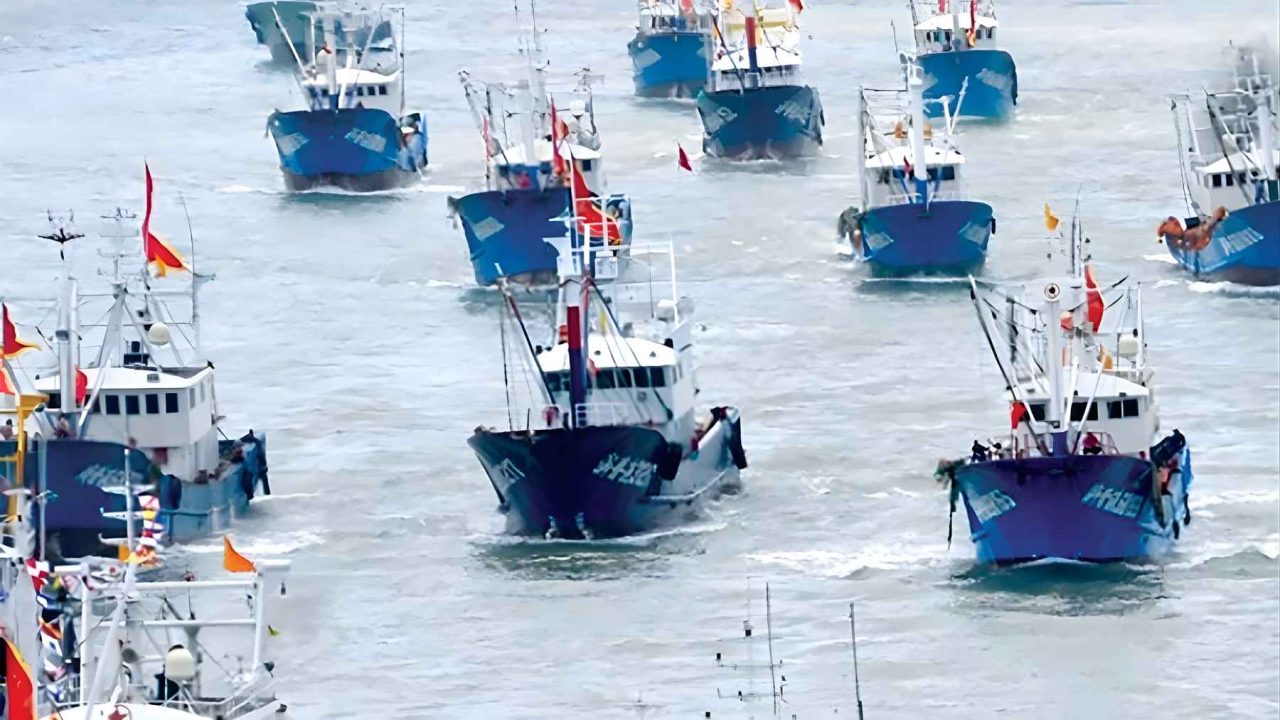
More than 1,400 Chinese fishing vessels assembled into a tightly organized formation stretching roughly 200 miles across the East China Sea — and what made it alarming wasn’t the size of the fleet. It was how they moved.
This wasn’t a scattered cluster of boats working the same fishing grounds. Satellite imagery and ship tracking data showed the vessels converging over several days, holding their position for more than 30 hours, and then dispersing in a coordinated fashion. That’s not how fishing works. That’s how a blockade works.
U.S. congressional analysts later described the January event as a new “gray zone” threat — a category of action designed to apply pressure and restrict movement without triggering a formal military response. No navy ships required. Just fishing boats, organized with military precision.
What Happened in the East China Sea
The January formation wasn’t the first time this kind of maneuver appeared in these waters. On Christmas Day, approximately 2,000 Chinese vessels had already formed long lines in the same region. The January event, involving around 1,400 boats, was described as a follow-up — and analysts say it represents an escalation in how China uses its civilian maritime fleet as a strategic tool.
The term “gray zone” refers to actions that fall between normal peacetime activity and open military conflict. Coordinating fishing fleets into barrier formations fits that description almost perfectly. The boats are civilian. The activity looks, on the surface, like fishing. But the formation — 200 miles long, held in place for over 30 hours — serves a very different purpose.
It can impede the movement of other vessels, signal territorial presence, and create logistical complications for shipping and naval operations, all without a single warship crossing into contested waters.
The Key Facts About China’s 200-Mile Fishing Barrier
| Event | Date | Vessels Involved | Formation Length |
|---|---|---|---|
| First known formation | Christmas Day (late December) | ~2,000 boats | Not specified |
| Second formation | Mid-January | ~1,400 boats | ~200 miles |
What analysts found particularly notable about the January event:
- Vessels converged over several days in a deliberate, staged manner
- The formation held position for more than 30 hours
- The boats then dispersed — suggesting a planned exercise rather than incidental clustering
- U.S. congressional analysts specifically flagged it as a gray zone threat
- No conventional military vessels were required to create the barrier effect
Why This Is Also an Ocean Story, Not Just a Security Story
It’s easy to read this as purely a geopolitical issue — something for defense analysts and foreign policy experts to worry about. But there’s a second dimension here that often gets overlooked.
When a government coordinates thousands of fishing vessels as instruments of state strategy, the boundary between harvesting seafood and projecting power starts to dissolve. And that has real consequences for the ocean itself.
The East China Sea is already one of the most ecologically stressed bodies of water on the planet. Decades of intensive fishing, coastal development, and industrial runoff have put enormous pressure on its marine ecosystems. When fleets of this scale are deployed not for fishing but for strategic positioning, the governance frameworks designed to manage those fisheries — catch limits, protected zones, seasonal restrictions — become harder to enforce and easier to ignore.
Analysts observing these formations have noted that the dual-use nature of these fleets creates more uncertainty for shipping lanes, adds pressure to already strained fisheries governance systems, and deepens the ecological stress on a sea that can ill afford more disruption.
Who Gets Affected — and How
The practical consequences of gray zone fishing formations reach further than most people realize.
Shipping operators face new unpredictability. A 200-mile line of vessels holding position in a major maritime corridor isn’t just a diplomatic signal — it’s a physical obstacle. Rerouting around a formation of that scale adds time, fuel, and cost.
Fishing communities in neighboring countries — Japan, South Korea, Taiwan — operate in the same waters and are directly affected when Chinese fleets mass in formations that overlap contested fishing zones. The displacement of normal fishing activity, even temporarily, has economic consequences for those communities.
Environmental regulators and fisheries managers face a harder job when fleets operate under strategic rather than commercial logic. Coordinated state-directed fishing activity doesn’t respond to the same incentives as commercial fishing, which makes standard governance tools less effective.
And for the broader international community, the gray zone framing matters because it exposes a gap in existing rules. International maritime law was built around the distinction between military and civilian vessels. Formations like these deliberately exploit that gap.
What Comes Next for the East China Sea
What is clear is that U.S. congressional analysts have formally categorized the January formation as a new type of threat — which typically precedes broader policy discussion about how to respond.
The pattern itself suggests these formations are likely to continue. The Christmas Day event was followed by a January repeat. The scale and coordination involved point to an organized capability, not a one-time occurrence. Whether other nations develop a formal response — through diplomatic channels, changes to maritime law, or adjustments to naval posture — remains to be seen.
What’s already certain is that the East China Sea has become a testing ground for a new kind of pressure — one that looks civilian on the surface and operates in the space between peace and conflict.
Frequently Asked Questions
What is a “gray zone” threat in the context of these fishing formations?
A gray zone threat refers to actions that fall between normal peacetime activity and open military conflict. U.S. congressional analysts used this term to describe the January formation because it can impede movement and project power without involving military vessels.
How many Chinese fishing vessels were involved in the January formation?
Approximately 1,400 vessels gathered into a formation stretching roughly 200 miles in the East China Sea in mid-January.
Was there a similar event before the January formation?
Yes. On Christmas Day, around 2,000 Chinese boats formed long lines in the same waters, making the January event a repeat of the same type of maneuver.
How long did the January formation hold its position?
According to satellite imagery and ship tracking data, the vessels held their formation for more than 30 hours before dispersing.
Does this affect the environment as well as security?
Analysts have noted that using large fishing fleets for strategic purposes adds pressure to fisheries governance and increases ecological stress in the East China Sea, which is already considered environmentally strained.
Has any country announced a formal response to these formations?
S. congressional analysts have officially categorized the January event as a new gray zone threat.



Leave a Reply