
What if the secret to protecting astronauts from deadly radiation on the moon is simply a matter of timing — like choosing to go outside in the morning rather than the afternoon? That’s the surprising implication of a new discovery made possible by China’s Chang’e-4 lunar lander, which has identified what scientists describe as a “cavity” of significantly reduced cosmic radiation located between Earth and the moon.
The finding is one of those rare scientific surprises that could have direct, practical consequences for how future lunar missions are planned — and potentially for the safety of every astronaut who sets foot on the lunar surface in the coming decades.
Radiation exposure is one of the most serious and least-discussed hazards of deep space and lunar exploration. Unlike on Earth, where our planet’s thick atmosphere and strong magnetic field deflect much of the harmful radiation streaming in from the cosmos, the moon’s surface offers almost no natural protection. Astronauts on extended lunar missions face cumulative radiation doses that could significantly increase their long-term health risks. Any natural feature that reduces that exposure — even partially — is worth understanding.
What the Chang’e-4 Lander Actually Found
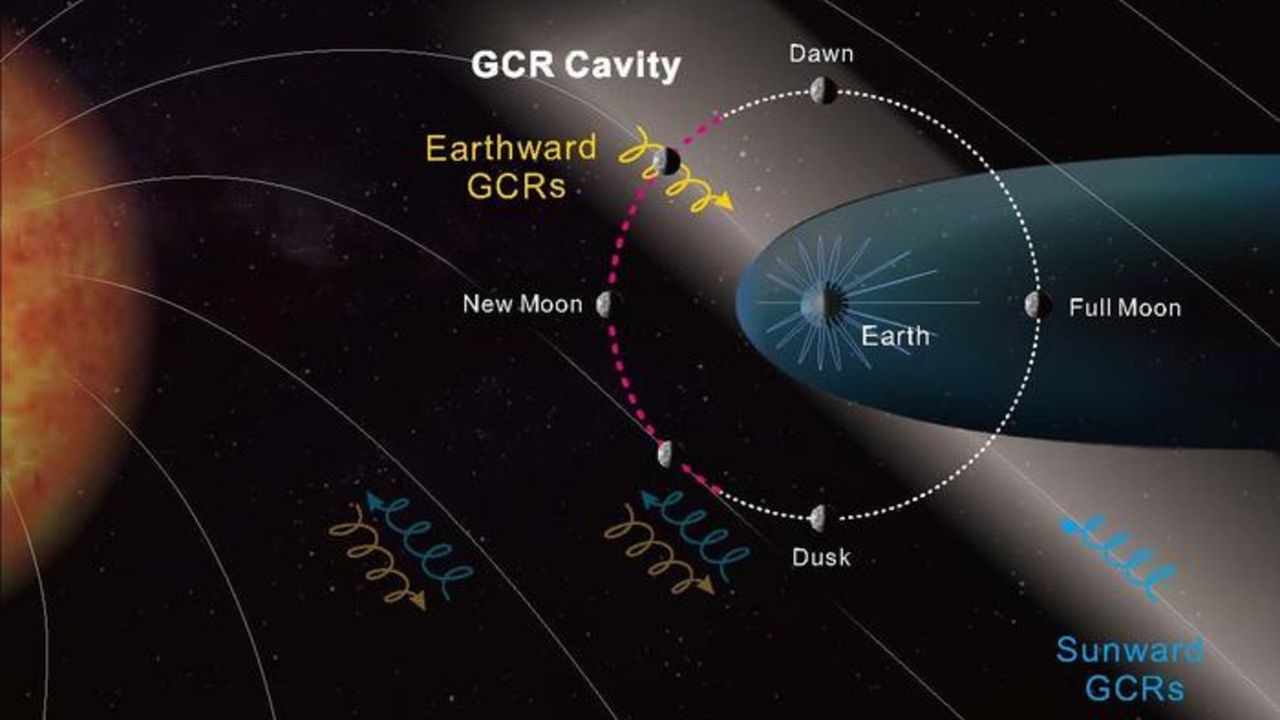
The discovery is based on data collected by China’s Chang’e-4 mission, which made history by landing on the far side of the moon. Researchers analyzing that data identified what appears to be a gamma-ray cavity — a region of reduced cosmic radiation — that forms near Earth’s magnetic field, situated in the space between our planet and its natural satellite.
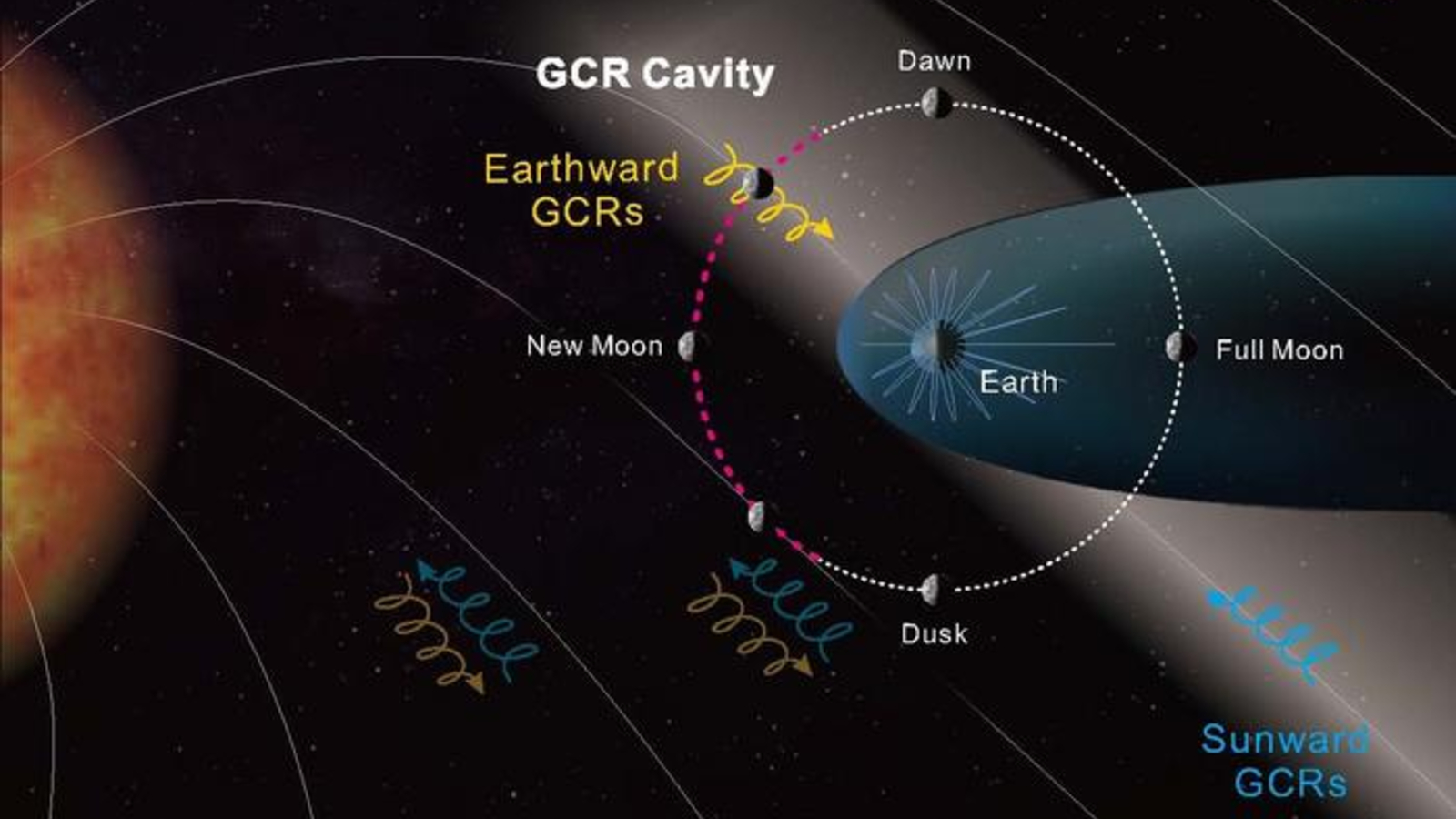
The cavity isn’t a physical structure. It’s more like a zone or pocket where the intensity of certain types of radiation drops measurably, shaped by the interaction between Earth’s magnetic field and incoming cosmic rays. Think of it as a partial radiation shadow cast by Earth’s magnetosphere stretching out toward the moon.
The research, published in the journal Science Advances, is attributed to Shang et al. and includes an illustration showing exactly how this gamma-ray cavity forms near Earth’s magnetic field boundary.
What makes this particularly relevant to space exploration is the timing element. Scientists believe that the moon’s position relative to Earth’s magnetic field changes throughout the lunar day, meaning the level of radiation protection offered by this cavity varies depending on what time it is on the moon’s surface — with local morning hours appearing to offer more favorable conditions.
Why Radiation on the Moon Is Such a Serious Problem
To understand why this matters, it helps to know what astronauts are actually up against. The moon has no global magnetic field and virtually no atmosphere. That means the surface is constantly bombarded by two main types of radiation: galactic cosmic rays (GCRs), which are high-energy particles originating from outside our solar system, and solar energetic particles (SEPs), which are blasted out by the sun during solar events.
Both types can penetrate the human body and damage DNA, increasing the risk of cancer and other long-term health conditions. For missions lasting days or weeks — like the Apollo missions — the exposure is manageable. But for the longer surface stays being planned under NASA’s Artemis program and other international lunar initiatives, cumulative radiation exposure becomes a much more serious concern.
Current strategies for managing radiation on the moon include designing habitats with radiation shielding, using regolith (moon soil) as a natural barrier, and potentially building underground shelters. The new discovery adds a different kind of tool to that toolkit: strategic scheduling.
Key Facts About the Gamma-Ray Cavity Discovery
| Detail | What We Know |
|---|---|
| Data source | China’s Chang’e-4 lunar lander |
| Type of radiation affected | Gamma-ray / cosmic radiation |
| Location of cavity | Between Earth and the moon, near Earth’s magnetic field |
| Published in | Science Advances (Shang et al., eadv1908) |
| Potential benefit | Reduced astronaut radiation exposure during lunar morning hours |
| Mechanism | Interaction between Earth’s magnetosphere and incoming cosmic rays |
- The cavity is linked to Earth’s magnetic field and is not a permanent fixed structure
- Radiation levels appear to vary based on the local time of day on the moon’s surface
- Morning hours on the moon may offer lower radiation exposure than other times
- The discovery could directly influence how future lunar surface operations are scheduled
How This Could Change Lunar Exploration
The practical implications here are significant. If mission planners can confirm that certain times of the lunar day consistently correspond to lower radiation exposure — thanks to the positioning of this gamma-ray cavity — they could schedule high-exposure activities like surface EVAs (extravehicular activities, or spacewalks) during those windows.
It’s a bit like how people are advised to avoid peak UV hours during the summer. You don’t stop going outside — you just plan around the conditions to reduce your risk.
Researchers suggest this finding could genuinely change how lunar exploration operations are conducted. Rather than treating radiation as a fixed, unavoidable background threat, mission planners might be able to treat it more like weather — something variable, partially predictable, and worth scheduling around.
This is especially relevant as space agencies around the world prepare for longer-duration lunar surface missions. NASA’s Artemis program aims to establish a sustained human presence near the moon’s south pole. China has its own lunar ambitions. The European Space Agency has discussed concepts for a permanent “moon village.” For any of these long-term scenarios, every marginal reduction in radiation exposure adds up over weeks and months.
What Researchers Still Need to Confirm
The discovery is compelling, but it’s worth noting that Further research will be needed to fully map the extent and consistency of the gamma-ray cavity, understand how it behaves across different points in the lunar orbit, and determine exactly how much radiation reduction is achievable through timing adjustments alone.
Scientists will also need to assess how the cavity interacts with solar energetic particle events, which can dramatically spike radiation levels during solar storms regardless of Earth’s magnetic field position. The cavity may offer meaningful protection against background cosmic radiation while doing little to shield against acute solar events — an important distinction for mission safety planning.
Still, the discovery represents a meaningful new piece of knowledge about the radiation environment between Earth and the moon — one that the scientific community didn’t have before Chang’e-4 returned its data.
Frequently Asked Questions
What is the gamma-ray cavity discovered near the moon?
It is a region of reduced cosmic radiation located between Earth and the moon, formed by the interaction between Earth’s magnetic field and incoming cosmic rays, as identified through data from China’s Chang’e-4 lander.
How could this discovery protect astronauts on future lunar missions?
Researchers suggest that timing surface activities — particularly EVAs — during lunar morning hours, when the radiation cavity may offer more protection, could help reduce astronauts’ cumulative radiation exposure.
What mission provided the data for this discovery?
The discovery is based on data from China’s Chang’e-4 lunar lander, which famously landed on the far side of the moon.
Where was this research published?
The findings were published in the journal Science Advances, authored by Shang et al., under the reference eadv1908.
Does this mean the moon is safe from radiation?
No. The cavity reduces certain types of cosmic radiation in specific conditions, but the moon still lacks a global magnetic field and atmosphere, leaving the surface exposed to significant radiation overall.
Will this change how NASA and other agencies plan lunar missions?
The research suggests it could influence how surface operations are scheduled, but further studies are needed to confirm the cavity’s consistency and extent before it becomes a formal planning tool.


Leave a Reply