
What if the story of animal life on Earth started earlier than we thought — not with a bang, but with a quiet flourish that scientists are only now beginning to uncover? A newly discovered fossil site in southwestern China is doing exactly that: forcing researchers to reconsider when complex creatures first appeared on our planet.
The site has yielded a remarkable collection of fossils that appear to predate one of the most celebrated events in evolutionary history — the Cambrian explosion. And what those fossils show is that life was already getting complicated long before that famous burst of biodiversity began.
For anyone who has ever wondered how we went from single-celled organisms to the astonishing variety of animals alive today, this discovery offers a striking new piece of the puzzle.
What the Cambrian Explosion Actually Was — and Why This Find Challenges It
The Cambrian explosion is the name scientists give to a period beginning roughly 539 million years ago, when the diversity and complexity of animal life is thought to have increased rapidly. It has long been considered something of a biological big bang — a relatively sudden flourishing of body plans, behaviors, and ecological relationships that set the stage for nearly all animal life that followed.
The conventional picture treated this explosion as the starting gun. Before it, the thinking went, life was simpler, slower, and far less varied.
But the new fossil site in southwestern China is complicating that narrative. According to reporting from Live Science, the fossils suggest that some of that biological complexity was already present several million years before the Cambrian explosion began — during the final stretch of a period known as the Ediacaran.
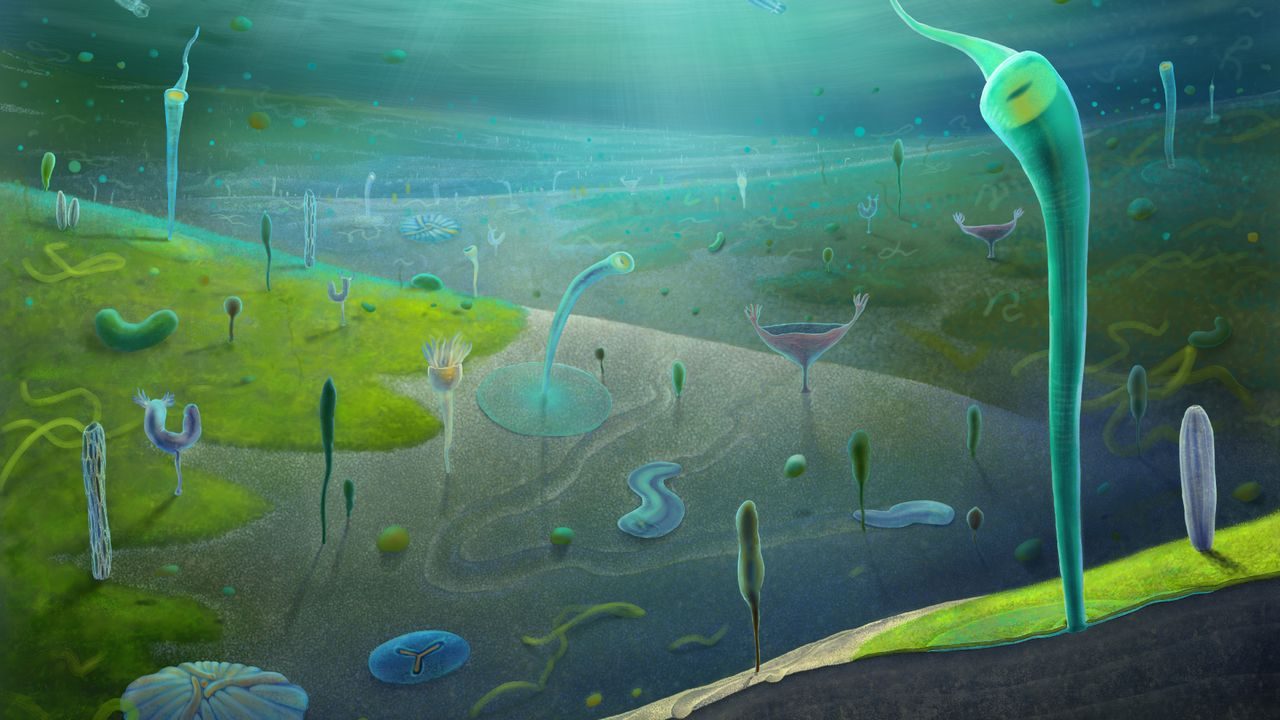
The site has been dated to approximately 554 to 539 million years ago, placing it squarely in the window just before the Cambrian dawn. Among the creatures documented there is what researchers have described as a dune-like sandworm — an evocative detail that hints at the surprising variety of body forms already in existence at that time.
The Jiangchuan Biota: A Snapshot of Pre-Cambrian Life
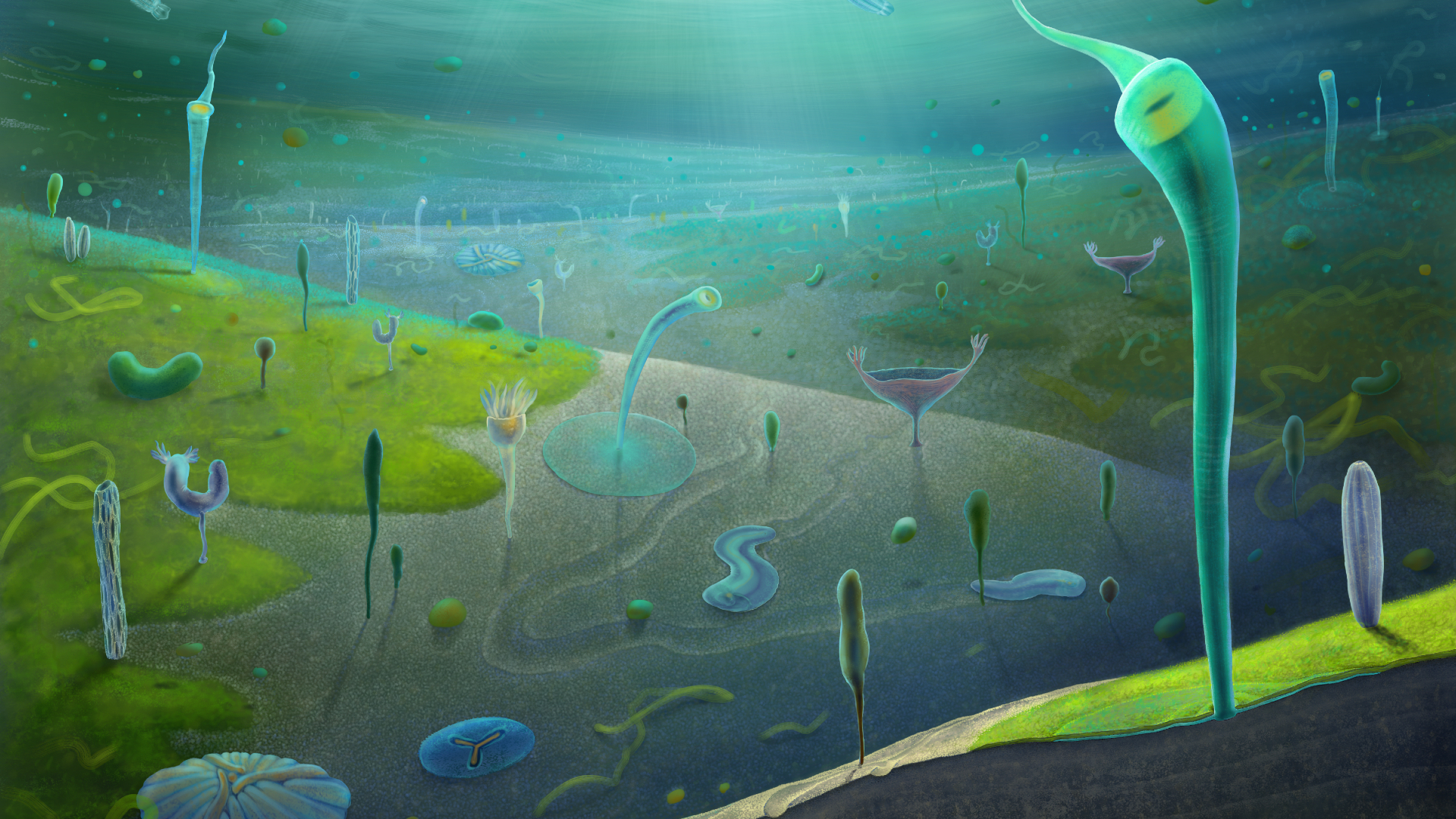
The fossil assemblage has been named the Jiangchuan biota, after the region in southwestern China where it was found. An artist’s reconstruction of the site — credited to Xiaodong Wang — depicts a world teeming with creatures that look far more complex than anything most people would associate with life half a billion years ago.
What makes this site particularly significant is not just the age of the fossils, but their diversity. The sheer variety of complex creatures preserved there suggests that the lead-up to the Cambrian explosion was not a blank slate. Evolution had apparently been doing serious work for millions of years before the explosion officially began.
Here is what If complex animals were already thriving several million years before the Cambrian explosion, it means the explosion itself may not have been quite as sudden or unprecedented as previously believed. Instead of life crossing a threshold overnight, it may have been building toward complexity across a much longer runway.
Researchers have long debated whether the Cambrian explosion reflects a true acceleration in evolution or simply a period when conditions became favorable for fossilization — making animals easier to detect in the geological record. Discoveries like the Jiangchuan biota add weight to the argument that complex life was present earlier, and that our picture of it has been incomplete.
For the broader scientific community, sites like this one are invaluable. Fossil windows into the Ediacaran period — the geological era immediately preceding the Cambrian — are rare, and each new one has the potential to reshape long-held assumptions about how animal life developed on Earth.
What Researchers Will Be Looking For Next
A find of this significance typically opens more questions than it closes. Scientists studying the Jiangchuan biota will likely focus on understanding the relationships between the creatures found there and the animals that proliferated during the Cambrian explosion itself. Were these pre-Cambrian complex organisms direct ancestors of Cambrian life, or were they evolutionary experiments that ultimately left no descendants?
The dune-like sandworm, in particular, is the kind of creature that invites closer scrutiny. Its body form and behavior — as suggested by its fossil record — could offer clues about the ecological conditions that existed in the millions of years leading up to the Cambrian.
Further analysis of the Jiangchuan biota is expected to continue, and additional fossil sites from the same time period may yet be discovered. Each one has the potential to sharpen the timeline of when, exactly, the animal kingdom as we know it began to take shape.
Frequently Asked Questions
What is the Jiangchuan biota?
The Jiangchuan biota is a collection of fossils discovered in southwestern China, dating to approximately 554–539 million years ago, that preserves a variety of complex animal life from before the Cambrian explosion.
What is the Cambrian explosion?
The Cambrian explosion refers to a period beginning around 539 million years ago when the diversity and complexity of animal life is thought to have increased rapidly and dramatically.
How does this discovery challenge existing science?
The fossils suggest that complex animal life existed several million years before the Cambrian explosion was thought to begin, indicating that biological complexity may have developed earlier than previously understood.
What kind of creatures were found at the site?
The source confirms that a variety of complex creatures were found, including what has been described as a dune-like sandworm, though the full catalog of species has not been detailed in the available source material.
Who created the artistic reconstruction of the Jiangchuan biota?
The artist’s reconstruction of the Jiangchuan biota, depicting life at the site approximately 554–539 million years ago, was created by Xiaodong Wang.</p



Leave a Reply