
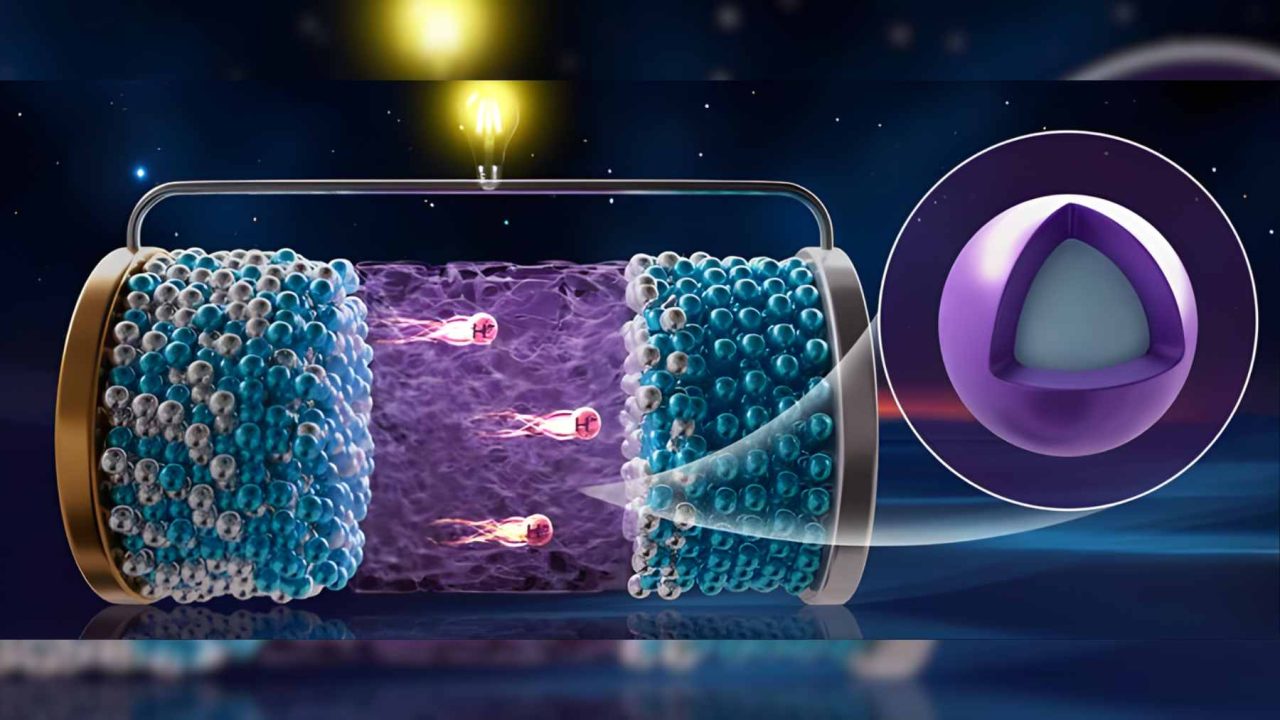
A tiny LED lamp flickering to life doesn’t sound like a historic moment — but when the power source behind it is the world’s first working solid-state hydrogen battery, it changes the picture entirely. Researchers at the Dalian Institute of Chemical Physics, part of the Chinese Academy of Sciences, have done something scientists have theorized about for years: they built a functional battery that moves hydride ions instead of lithium through a solid material, and it actually works.
The findings were published in the journal Nature, putting this breakthrough in front of the global scientific community. And while the prototype is still far from powering your electric vehicle, the underlying achievement is significant enough to make the energy storage world sit up and take notice.
China has been pushing hard on multiple fronts in clean energy technology, and this development adds a genuinely new chapter to that story — one focused not on incremental improvements to existing batteries, but on a fundamentally different approach to how we store electricity.
Why Hydride Ions Change Everything About Battery Design
To understand why this matters, it helps to know how conventional batteries work. Most batteries today — the ones in your phone, your laptop, and most electric cars — move lithium ions between two electrodes through a liquid or gel electrolyte. That liquid is flammable, which is why lithium batteries can catch fire. It also degrades over time, which is why battery performance drops after a few years of use.
The new Chinese prototype takes a completely different approach. Instead of lithium ions, it uses hydride ions — essentially hydrogen atoms carrying a negative charge — to carry electricity through a solid material. There’s no liquid electrolyte involved. That single design change has cascading implications for safety, longevity, and the raw materials needed to build the battery in the first place.
The global energy storage industry has been searching for alternatives to lithium for years, driven by concerns about the cost of lithium, the environmental toll of mining it, and the geopolitical risks of depending on a handful of countries for supply. A battery built around hydrogen — the most abundant element in the universe — sidesteps many of those concerns, at least in theory.
What the Prototype Actually Does — and What It Doesn’t Do Yet
The research team demonstrated their prototype by using it to power an LED lamp. That’s a modest proof of concept by commercial standards, but in the context of battery research, it’s a meaningful milestone. It confirms that the underlying chemistry works in real hardware, not just in computer models or laboratory conditions that don’t translate to the real world.
| Feature | Conventional Lithium Battery | Solid-State Hydrogen Battery (Prototype) |
|---|---|---|
| Charge carrier | Lithium ions | Hydride ions (hydrogen-based) |
| Electrolyte type | Liquid or gel | Solid material |
| Flammability risk | Present (liquid electrolyte) | Potentially reduced (no liquid) |
| Key raw material | Lithium (limited, geopolitically sensitive) | Hydrogen (most abundant element) |
| Development stage | Mature, commercial | Early prototype only |
| Demonstrated output | Powers vehicles, consumer electronics | Powers an LED lamp |
The researchers themselves, and the source reporting on this development, are clear that this technology is at a very early stage. Lighting an LED is a long way from powering a car or storing energy from a solar farm at grid scale. The path from promising prototype to commercial product typically takes years, sometimes decades, and many promising battery chemistries have stalled along the way.
The Bigger Race This Discovery Fits Into
This announcement doesn’t exist in a vacuum. It lands at a moment when countries and companies around the world are pouring resources into next-generation energy storage, driven by the urgent need to make renewable energy reliable and to reduce dependence on fossil fuels.
Solid-state batteries have been a major focus of this race for years. The appeal is straightforward: replace the flammable liquid electrolyte in a conventional battery with a solid one, and you get something safer, potentially longer-lasting, and possibly more energy-dense. Several major automakers and battery companies have announced solid-state programs, but most are still working with lithium as the charge carrier.
What makes the Chinese prototype distinct is that it pairs the solid-state architecture with a completely different charge carrier — hydride ions — rather than just swapping out the electrolyte while keeping the rest of the lithium-ion framework intact. That’s a more radical departure, and it’s why researchers and observers in the energy storage field are paying attention even at this early stage.
What This Could Mean for Electric Vehicles and Grid Storage
The practical applications researchers have in mind are the two biggest challenges in the clean energy transition: powering electric vehicles and storing the output of solar and wind energy so it’s available when the sun isn’t shining and the wind isn’t blowing.
Both applications demand batteries that are safe, long-lasting, affordable, and built from materials that can be sourced reliably at scale. Lithium batteries have made enormous progress on all those fronts, but they haven’t fully solved any of them. A hydrogen-based solid-state battery, if it can be developed to commercial scale, would address the raw material supply question in a fundamental way.
That’s still a significant “if.” But the fact that the chemistry has now been demonstrated in working hardware — published in one of the world’s most rigorous scientific journals — moves it from theoretical possibility to something the broader research community can study, test, and build on.
What Comes Next for Solid-State Hydrogen Battery Research
The immediate next steps in this kind of research typically involve scaling up the prototype, improving energy density, testing how the battery performs over many charge and discharge cycles, and working out how to manufacture it at a cost that makes commercial sense. None of those steps are straightforward.
Publication in Nature means the research is now open to scrutiny and replication by scientists worldwide. Independent verification is a critical part of the process — extraordinary claims in battery research have sometimes failed to hold up when other labs tried to reproduce them.
For now, the Dalian Institute of Chemical Physics has established a credible first. Whether that first eventually becomes a product on the market depends on years of work still ahead. But the LED lamp is on, and the science behind it is real.
Frequently Asked Questions
What is a solid-state hydrogen battery?
It is a battery that uses hydride ions — hydrogen-based charge carriers — instead of lithium ions, and moves them through a solid material rather than a liquid or gel electrolyte.
Who developed this prototype?
Researchers at the Dalian Institute of Chemical Physics, part of the Chinese Academy of Sciences, developed the prototype and published their findings in the journal Nature.
What has the prototype actually been shown to do?
The prototype has been demonstrated powering an LED lamp, which confirms the underlying chemistry works in real hardware, though it remains at a very early stage of development.
Is this battery ready for electric vehicles or consumer electronics?
No. The technology is still at an early prototype stage and is far from the level of development needed for commercial applications like electric vehicles or grid-scale energy storage.
Why does it matter that hydrogen is used instead of lithium?
Hydrogen is the most abundant element in the universe, which could reduce the cost, supply, and geopolitical concerns associated with lithium mining if the technology can eventually be scaled up.
Could this replace lithium batteries entirely?
That has not been confirmed and would require many years of further research, development, and commercial scaling — the current prototype is a proof of concept, not a ready replacement.




Leave a Reply