
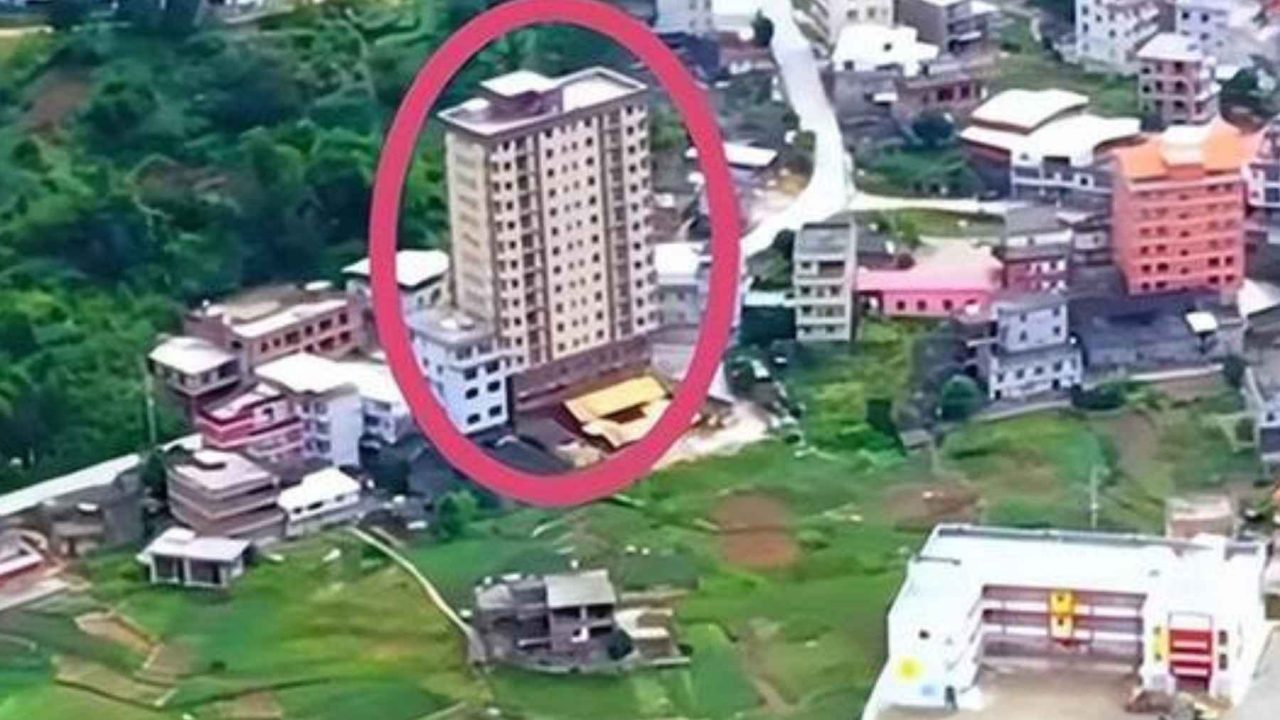
More than 100 relatives from four generations living under one roof sounds like the plot of a quirky family drama. But in Zhuyuan village in China, it is simply reality — and the 15-story tower this family built together is raising questions that go well beyond one unusual housing decision.
The building contains 22 apartments, elevators, underground parking, and shared common spaces. Reports indicate that around 20 related households pooled their resources to make it happen. What started as a practical solution to cramped living conditions has become something much more interesting: a real-world experiment in how families, housing, and sustainability might intersect.
And given that buildings and construction account for 34% of global CO2 emissions and consume 32% of global energy — figures reported by the United Nations Environment Programme — the way people choose to house themselves is no small matter.
Why One Chinese Family Decided to Build Their Own Tower
The story, as reports describe it, grew from a very ordinary problem. The family’s existing homes were cramped, and many younger members had moved to other cities for work. They needed somewhere to return to — a home base that could actually accommodate a sprawling, multigenerational family without forcing anyone to live on top of each other in uncomfortable conditions.
The solution they landed on was ambitious by any standard. Rather than each household going off to build or buy separate homes, the family came together around a single shared structure. The result is something that functions less like a conventional apartment block and more like a small vertical neighborhood — private enough that each household has its own apartment, but connected enough that the generations can remain close.
Reports describe the project as driven by a desire to build new, independent homes while still staying together as a family. That tension — independence and togetherness at once — is exactly what the building’s design seems to have been built around.
What the Building Actually Contains
The tower is not just a stack of apartments. Based on what has been reported, it is a genuinely functional residential complex designed with the full needs of a large family in mind.
- 15 stories rising above Zhuyuan village
- 22 apartments spread across the building
- More than 100 residents from four generations
- Around 20 related households who pooled resources to fund the project
- Elevators for accessibility across all floors
- Underground parking for residents
- Common spaces designed for shared family use
The combination of private apartments and shared amenities is what sets this apart from simply buying flats in the same building. This was a coordinated, intentional act of collective living — designed from the ground up for one extended family.
| Feature | Detail |
|---|---|
| Building height | 15 stories |
| Number of apartments | 22 |
| Residents | More than 100 across four generations |
| Participating households | Around 20 |
| Location | Zhuyuan village, China |
| Shared amenities | Elevators, underground parking, common spaces |
The Climate Angle Most People Are Missing
Here is where this story gets genuinely interesting — and why it matters beyond the novelty factor.
UNEP data confirms that the buildings and construction sector is one of the largest contributors to global energy consumption and carbon emissions, responsible for 32% of global energy use and 34% of CO2 emissions worldwide. That is not a marginal figure. It means the way humanity chooses to house itself has direct consequences for the planet’s climate trajectory.
When a family chooses one shared structure instead of 20 separate homes, the environmental math changes significantly. A single building foundation, one shared roof, communal heating and cooling infrastructure, consolidated parking — these are not trivial efficiencies. Multiplied across cities and countries, the difference between dense shared living and sprawling individual homes adds up fast.
Advocates for denser urban housing have long argued that vertical, shared living reduces land use, limits the energy cost of repeated construction, and cuts long-term demand for heating and cooling. The Chinese family’s tower, whatever its original motivation, is a working example of exactly that principle.
What This Means for How We Think About Housing
It would be easy to dismiss this story as a curiosity — one unusual family doing something no one else would consider. But that framing misses the point.
Housing decisions are not just personal. They carry collective consequences in terms of land consumption, construction emissions, energy use, and urban sprawl. The question this family’s tower quietly poses is whether the default model — each household building or buying its own separate home — is actually the most sensible one, environmentally or economically.
Multigenerational living is not new. For most of human history, it was the norm. What is unusual here is the deliberate, architectural scale of the commitment. This family did not just decide to live near each other — they designed and built an entire vertical community to make it work on their own terms.
Whether that model could translate more broadly is an open question. Zoning laws, cultural expectations, financing structures, and land ownership rules vary enormously across countries. But the underlying logic — that shared structures can serve more people with less environmental cost than scattered individual homes — is one that urban planners and climate researchers have been making for years.
What Happens Next for Stories Like This One
The Zhuyuan village tower is already drawing attention online, and it is easy to see why. It sits at the intersection of several conversations that are not going away: housing affordability, multigenerational family structures, urban density, and the built environment’s role in climate change.
Whether this specific family’s approach inspires others — or remains a one-of-a-kind story from rural China — has not yet been determined. What is clear is that the pressure on housing systems globally is not easing, and the environmental cost of how people choose to live is increasingly impossible to ignore.
This family built a tower because they needed more space and wanted to stay together. They may have accidentally built an argument for rethinking how housing works entirely.
Frequently Asked Questions
Where is the family tower located?
The 15-story building is located in Zhuyuan village in China.
How many people live in the building?
More than 100 relatives from four generations share the building across 22 apartments.
Why did the family decide to build the tower?
Reports indicate the family’s existing homes were cramped and many younger members needed a place to return to after working in other cities, so around 20 households pooled resources to build a shared structure.
What amenities does the building include?
The building includes 22 apartments, elevators, underground parking, and common spaces designed for shared family use.
What does this have to do with climate change?
UNEP data shows that buildings and construction account for 32% of global energy use and 34% of global CO2 emissions, making housing choices directly relevant to environmental impact.
Could this model be replicated elsewhere?
This has not been confirmed by any specific policy or planning initiative, though the concept of dense shared living reducing environmental costs is widely supported by urban planning research.




Leave a Reply