
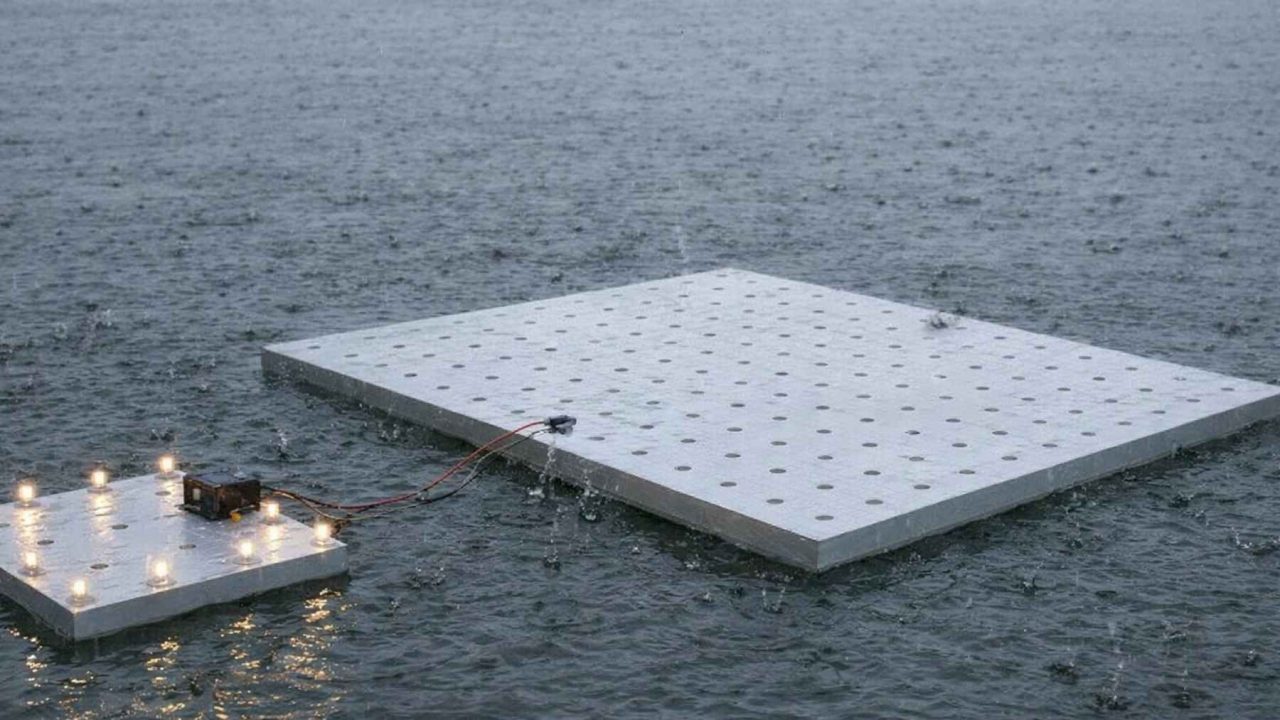
Every raindrop that hits a rooftop, a reservoir, or a puddle carries something invisible with it: kinetic energy. For most of human history, that energy has gone nowhere — absorbed, splashed, and forgotten. Now, a team of researchers in China is working to change that, building a floating generator that converts the simple impact of falling rain into short electrical pulses.
The device won’t power your home. But it might one day power a sensor in a remote wetland, a small monitor on a coastal buoy, or any number of low-power electronics that currently depend on batteries or solar panels that go dark the moment storm clouds roll in. That’s actually the point — and it’s a smarter starting place than it might sound.
Rain falls hardest precisely when solar panels are least useful. If scientists can harvest energy from the same storms that shut down solar generation, they’re not just adding a new source of power — they’re filling a gap that renewables have struggled to address for decades.
How Scientists Are Turning Raindrops Into Electrical Impulses
The research comes from Nanjing University of Aeronautics and Astronautics in China, where a team led by Wei Deng, with corresponding author Wanlin Guo, developed what they describe as a water-integrated droplet electricity generator.
The concept is exactly what it sounds like. When a raindrop strikes the surface of the device, the mechanical energy from that impact is converted into a brief electrical pulse. The generator is lightweight and designed to float on a water surface — think reservoirs, coastal zones, or any open body of water where rain is a regular visitor.
What makes this approach distinct is that the water itself is doing double duty. Rather than sitting on a rigid land-based platform, the generator is built so that water plays both a structural and an electrical role in how the system functions.
“By letting water itself play both structural and electrical roles, we’ve unlocked a new strategy for droplet electricity generation.” — Wanlin Guo, Nanjing University of Aeronautics and Astronautics
Guo has also described the technology as a complement to other renewables — not a replacement. That framing matters. This isn’t a bid to retire wind turbines or solar farms. It’s an attempt to add something useful to the mix, particularly in conditions where those other technologies fall short.
What This Device Actually Does — and What It Doesn’t
It’s worth being honest about the scale here. The researchers are targeting low-power electronics, not household energy needs. The electrical pulses generated by individual raindrops are small. The value of the technology lies in its potential to operate in environments and conditions where other energy sources simply aren’t available or aren’t practical.
The floating design is a meaningful design choice, not just an engineering curiosity. Placing the generator on water rather than land means it can be deployed in locations that are already wet by nature — reservoirs, lakes, coastal areas — without requiring additional infrastructure or taking up usable land.
| Feature | Detail |
|---|---|
| Research institution | Nanjing University of Aeronautics and Astronautics, China |
| Lead researcher | Wei Deng |
| Corresponding author | Wanlin Guo |
| Device type | Water-integrated droplet electricity generator |
| Energy source | Kinetic energy from raindrop impact |
| Intended use | Low-power electronics |
| Deployment environment | Floating on water surfaces — reservoirs, coastal areas |
| Role in energy mix | Complement to existing renewables, per researchers |
Why Rain Energy Could Matter More Than It Seems
The renewable energy conversation has long centered on two dominant technologies: solar and wind. Both are powerful and increasingly affordable. Both also have a well-known limitation — they depend entirely on weather conditions that aren’t always cooperative.
Solar panels produce nothing at night and very little during heavy cloud cover or storms. Wind turbines need consistent airflow to be effective. The result is that renewable grids often require backup systems, storage solutions, or conventional power sources to cover the gaps.
Rain is different. It tends to arrive precisely when solar output drops. A device that generates power from rainfall — even small amounts — could serve as a natural counterbalance, producing electricity during the same weather events that suppress other renewable sources.
- Raindrops carry kinetic energy from motion that is currently wasted in nearly all environments
- The floating generator is designed for deployment on existing bodies of water, requiring no land conversion
- The technology targets low-power electronics, a realistic and immediate application
- Researchers position it as a complement to solar and wind, not a competitor
- Stormy conditions that reduce solar panel efficiency are exactly the conditions where rain energy could be harvested
None of this means rain energy is about to show up on your electricity bill. But the gap between laboratory prototype and real-world deployment has been crossed before, and the logic behind this particular idea is sound.
Who Might Actually Use This Technology First
The most immediate applications are likely to be remote and low-demand. Environmental monitoring stations, for instance, often need small amounts of consistent power to run sensors that track water quality, flood levels, or weather conditions. Those stations are frequently located near water — exactly where this generator is designed to float.
Coastal research infrastructure faces similar constraints. Equipment deployed in marine environments needs power, faces frequent rain and storms, and is often far from the grid. A device that generates electricity from the rain that’s already falling on it has obvious appeal in that context.
For the average energy consumer, the near-term impact is indirect. Technologies like this expand the toolkit available to engineers designing future energy systems — and every addition to that toolkit makes it a little easier to build grids that are more resilient, more distributed, and less dependent on any single source.
What Comes Next for Raindrop Energy Research
The research from Nanjing University of Aeronautics and Astronautics represents an early-stage demonstration of the concept. The team has shown that the approach works at a small scale, with a floating device capable of converting raindrop impacts into electrical pulses.
What hasn’t been confirmed publicly is a specific timeline for scaling the technology, commercializing it, or deploying it in field conditions outside of a laboratory setting. That work — testing durability, optimizing output, and identifying the most practical use cases — typically follows initial proof-of-concept research.
The broader field of droplet electricity generation is an active area of scientific interest, and this study adds a new design approach to it: one that integrates water as both a structural and electrical component, and that floats rather than sitting on land. Whether that approach proves to be the most effective path forward will depend on results that haven’t yet been published.
For now, the idea that a rainy day could one day help run the electronics monitoring that same rain is no longer purely theoretical.
Frequently Asked Questions
What is a water-integrated droplet electricity generator?
It is a lightweight, floating device developed by researchers at Nanjing University of Aeronautics and Astronautics that converts the kinetic energy of falling raindrops into short electrical pulses.
Who led the research on this technology?
The study was led by Wei Deng, with Wanlin Guo serving as the corresponding author, both affiliated with Nanjing University of Aeronautics and Astronautics in China.
Can this technology power a home?
No — the researchers designed it to power low-power electronics, not residential or large-scale energy needs.
Where is the generator designed to be deployed?
The device is designed to float on water surfaces such as reservoirs and coastal areas, using water as both a structural and electrical component of the system.
How does rain energy relate to solar and wind power?
Researchers describe it as a complement to existing renewables, with the potential advantage that rain falls during stormy conditions when solar panel output is typically reduced.
When will this technology be available for real-world use?
A specific commercial timeline has not yet been confirmed — the current research represents an early-stage proof of concept rather than a ready-to-deploy product.


Leave a Reply