
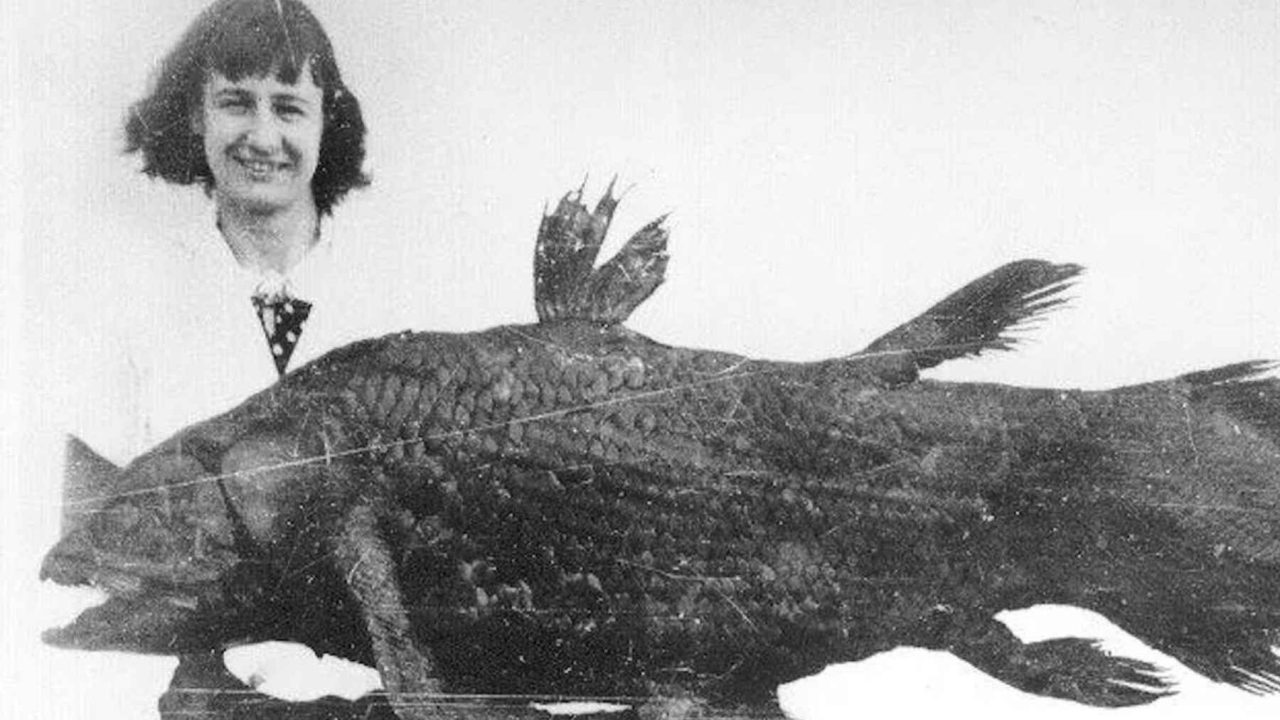
A routine phone call from a fishing boat in December 1938 did something no laboratory expedition had managed to do in decades — it brought a creature back from the dead. Not literally, of course. But when a young museum curator in South Africa walked down to a dock and looked at the strange, blue-scaled fish lying among the day’s catch, she was staring at an animal science had declared extinct for roughly 65 million years.
The fish was a coelacanth. And the curator was Marjorie Courtenay-Latimer. What happened next would permanently change how scientists understand the history of life on Earth.
It’s the kind of discovery that sounds too dramatic to be true — and yet it unfolded because one person paid attention when most others would have walked away.
The Fish That Wasn’t Supposed to Exist Anymore
The coelacanth is an ancient lobe-finned fish. Before December 1938, it was known to science only through fossils. Researchers had studied its remains and concluded that it had disappeared from the planet around the same time as the dinosaurs — approximately 65 million years ago. It was considered gone. Case closed.
Then Courtenay-Latimer, who worked as a curator at the East London Museum in South Africa, got a call from a fishing boat near the coast. She had previously asked local fishers to alert her whenever they pulled up anything unusual — a quiet but effective arrangement that gave the museum access to specimens it never could have found on its own.
When she arrived at the dock and saw the specimen, she recognized immediately that it was unlike anything she had encountered before. The fish was large, oddly shaped, and covered in distinctive scales. She had no idea exactly what she was looking at, but she understood that it mattered. She made sure it was preserved.
The specimen was later formally identified and described as Latimeria chalumnae — named in part to honor Courtenay-Latimer herself. It became one of the most significant zoological discoveries of the twentieth century.
Why the Coelacanth Discovery Matters So Much
Finding a living coelacanth wasn’t just a curiosity. It fundamentally challenged the assumption that the fossil record gives us a complete — or even reliable — picture of what’s alive on Earth at any given moment.
The coelacanth had survived, apparently unchanged, for tens of millions of years, in deep ocean waters where humans rarely looked. Its rediscovery forced scientists to reckon with a simple, humbling question: what else might still be out there?
The specimen quickly became a symbol of how much the planet’s biodiversity can still surprise us when careful observation meets a bit of luck. Courtenay-Latimer’s instinct to preserve the fish — rather than dismiss it or let it go to waste — is what made the difference. Without her intervention, the specimen likely would have been lost.
Key Facts About the 1938 Coelacanth Discovery
| Detail | Information |
|---|---|
| Year of discovery | December 1938 |
| Location | Near the coast of East London, South Africa |
| Discoverer | Marjorie Courtenay-Latimer |
| Her role | Curator, East London Museum |
| Scientific name of specimen | Latimeria chalumnae |
| Previously believed extinct for | Approximately 65 million years |
| Fish classification | Ancient lobe-finned fish |
| Prior knowledge of species | Known only from fossils before 1938 |
- The coelacanth was considered extinct since roughly the time of the dinosaurs
- Courtenay-Latimer had proactively built relationships with local fishers to flag unusual catches
- Her decision to preserve the specimen was critical — without it, the discovery may never have been documented
- The species was formally named Latimeria chalumnae partly in her honor
- The find became a landmark moment in twentieth-century zoology
What This Tells Us About Scientific Blind Spots
One of the most striking things about the coelacanth story isn’t the fish itself — it’s what the discovery reveals about the limits of scientific certainty. A species can survive for tens of millions of years in deep, remote waters and leave almost no trace that would alert researchers on land.
Courtenay-Latimer wasn’t a deep-sea biologist running a government-funded expedition. She was a museum curator who had built informal trust with working fishers. That relationship, more than any expensive research program, is what led to the find.
The broader lesson hasn’t faded. Scientists and naturalists still argue that citizen observation, local knowledge, and informal networks remain some of the most powerful tools for expanding our understanding of what lives on this planet. The coelacanth discovery is often cited as a foundational example of exactly that.
The Legacy Courtenay-Latimer Left Behind
Marjorie Courtenay-Latimer’s role in this story is sometimes overshadowed by the scientific analysis that followed her initial find. But the discovery begins and ends with her judgment call on that December day in 1938.
She saw something she couldn’t fully explain, trusted her instincts that it was important, and ensured it was preserved long enough for experts to examine it properly. The formal scientific naming of Latimeria chalumnae stands as a permanent acknowledgment of that contribution.
Decades later, the coelacanth remains one of the most recognized symbols in natural history — proof that the ocean still holds surprises, and that sometimes the most important scientific breakthroughs start with someone simply paying attention.
Frequently Asked Questions
Who was Marjorie Courtenay-Latimer?
She was a curator at the East London Museum in South Africa who discovered the first known living coelacanth specimen in December 1938.
What is a coelacanth?
A coelacanth is an ancient lobe-finned fish that was known only from fossils before 1938 and was believed to have gone extinct approximately 65 million years ago.
How was the coelacanth discovered?
Courtenay-Latimer received a call from a fishing boat near the South African coast after she had previously asked local fishers to notify her of any unusual catches.
What is the scientific name of the coelacanth she found?
The specimen was formally described as Latimeria chalumnae, a name that honors Courtenay-Latimer herself.
Why is the discovery considered so significant?
It proved that a species believed extinct for roughly 65 million years had survived undetected, fundamentally challenging assumptions about what the fossil record can tell us about living biodiversity.
Are coelacanths still alive today?


Leave a Reply