
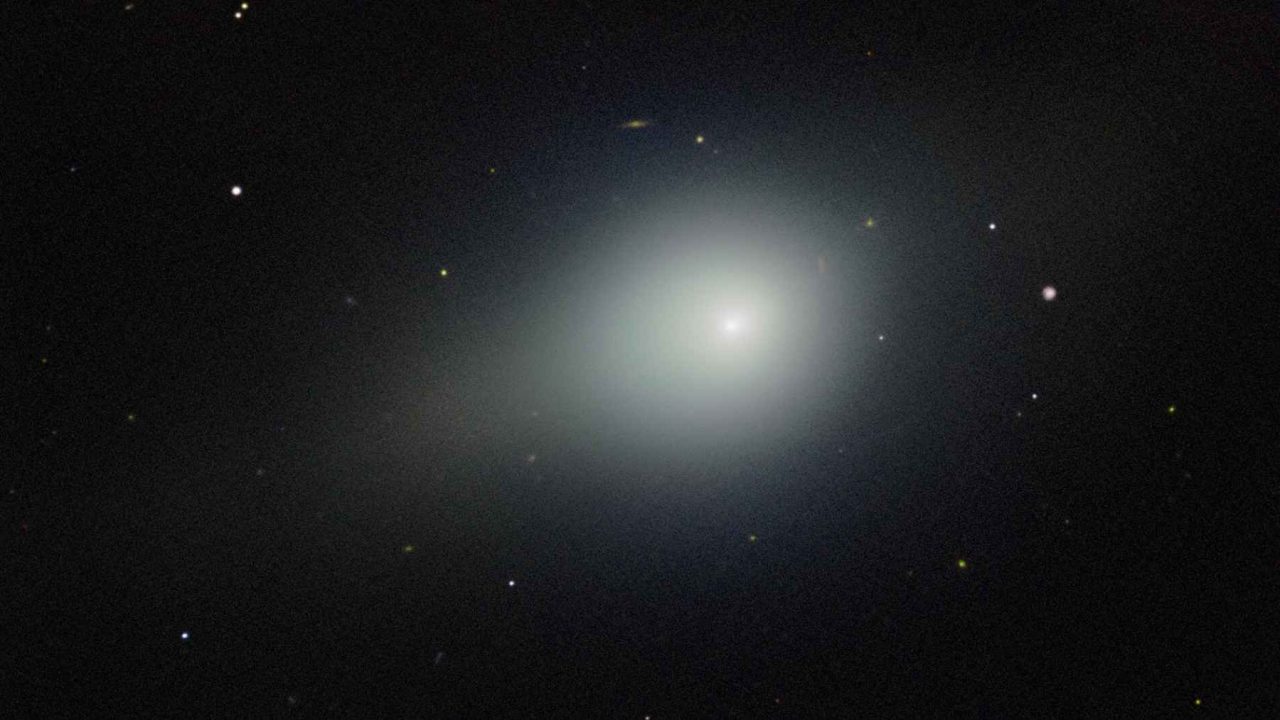
A frozen rock roughly the size of a small city is currently cutting through our solar system — and the more scientists look at it, the less they feel like they understand it. New observations from the Hubble and James Webb space telescopes reveal that the interstellar comet 3I/ATLAS has a solid core approximately 2.6 kilometers wide, making it tens of times more massive than either of the two interstellar objects that preceded it. Its chemical makeup is throwing experts for a loop, and astronomers say the puzzles are only multiplying with each new data set.
This is not a routine comet swinging around the sun. 3I/ATLAS comes from another star system entirely, and it is moving on a hyperbolic path — a one-way trajectory that will carry it back out of our solar system and never return. The window to study it is limited, and scientists are watching closely.
Discovered on July 1, 2025 by the ATLAS survey — a NASA-funded sky monitoring program — 3I/ATLAS is only the third interstellar object ever confirmed to have passed through our solar system. Every new measurement is raising as many questions as it answers.
The Third Visitor from Interstellar Space
To understand why 3I/ATLAS is generating so much excitement, it helps to know what came before it. The first confirmed interstellar visitor was 1I ʻOumuamua, which baffled scientists with its unusual shape and mysterious acceleration. The second was 2I Borisov, a more conventional-looking comet that was easier to characterize. Now 3I/ATLAS has arrived, and it is already proving to be the most substantial of the three by a wide margin.
Where the earlier visitors were relatively small and faint, 3I/ATLAS is a genuinely hefty object. Being tens of times more massive than its predecessors means astronomers have far more material to study — but it also means the object is behaving in ways that don’t fit neatly into existing models of how comets form and evolve.
Orbital models suggest the comet could be around seven billion years old. If that estimate holds, the ice locked inside it may have formed long before Earth existed, before our oceans filled, before the sun even ignited. In a very real sense, 3I/ATLAS is carrying frozen material from a time and place completely alien to our own cosmic neighborhood.
What Makes 3I/ATLAS So Strange
The chemical composition of the comet is one of the most surprising findings so far. Rather than matching the profile of comets that formed in our own solar system, 3I/ATLAS is venting an unusually rich mixture of carbon dioxide and methane. That combination is raising eyebrows among researchers who study how comets form and what their outgassing patterns reveal about their origins.
Comets release gases as they warm up near the sun, and the specific mix of those gases serves as a kind of fingerprint — a chemical record of where and how the object formed. The fingerprint on 3I/ATLAS does not match anything scientists have seen before in our solar system, which is precisely what makes it so scientifically valuable and so difficult to interpret.
Until recently, pinning down the size of the comet’s nucleus was also a challenge. The bright halo of gas and dust surrounding an active comet makes it hard to isolate the solid core. New data from Hubble and James Webb has now allowed astronomers to measure that core at approximately 2.6 kilometers across — comparable in scale to a small city.
Key Facts About 3I/ATLAS at a Glance
| Feature | Detail |
|---|---|
| Discovery date | July 1, 2025 |
| Discovered by | ATLAS survey (NASA-funded) |
| Object type | Interstellar comet |
| Nucleus diameter | Approximately 2.6 kilometers |
| Orbital path | Hyperbolic — one-way, no return |
| Estimated age | Around 7 billion years |
| Key gases detected | Carbon dioxide and methane |
| Previous interstellar visitors | 1I ʻOumuamua, 2I Borisov |
| Telescopes used | Hubble Space Telescope, James Webb Space Telescope |
- 3I/ATLAS is tens of times more massive than either previous interstellar visitor
- Its chemical composition does not match comets that formed in our solar system
- It will never return — this is humanity’s only chance to study it up close
- Its estimated age of seven billion years predates Earth itself
Why This Matters Beyond the Science Headlines
It is easy to read a story about a distant comet and feel like it has nothing to do with life on the ground. But 3I/ATLAS is carrying something genuinely rare: direct physical evidence from another star system. Every gas molecule it vents, every measurement of its core, is data from a place humans have never been and may never reach.
Scientists studying the origins of life have long wondered whether the building blocks of biology — carbon compounds, water ice, organic molecules — might travel between star systems aboard objects exactly like this one. The rich carbon dioxide and methane signature of 3I/ATLAS adds a new data point to that long-running question, even if it does not yet provide a clear answer.
The comet is also a reminder that our solar system is not isolated. Objects from other stellar neighborhoods do pass through, carrying chemical records of entirely different planetary formation environments. 3I/ATLAS is the most substantial example of that phenomenon ever observed.
What Comes Next for 3I/ATLAS Research
Because 3I/ATLAS is on a one-way path out of the solar system, the urgency to collect observations is real. Hubble and James Webb are already pointed at it, and the data coming back is actively challenging researchers to update their models. Scientists note that the more they study this object, the more puzzling it becomes — which suggests the most interesting findings may still be ahead.
Astronomers will continue tracking the comet as it moves through the inner solar system, monitoring changes in its outgassing behavior and refining measurements of its nucleus. Whether those observations will resolve the current mysteries or deepen them remains to be seen. Based on the pattern so far, the smart money is on the latter.
Frequently Asked Questions
What is 3I/ATLAS?
3I/ATLAS is an interstellar comet — only the third confirmed object from outside our solar system ever observed passing through it. It was discovered on July 1, 2025 by the NASA-funded ATLAS survey.
How big is 3I/ATLAS?
New observations from the Hubble and James Webb space telescopes show its solid nucleus is approximately 2.6 kilometers wide, comparable in scale to a small city.
What makes 3I/ATLAS different from previous interstellar visitors?
It is tens of times more massive than either 1I ʻOumuamua or 2I Borisov, and it is venting an unusually rich mix of carbon dioxide and methane that does not match comets formed in our solar system.
Will 3I/ATLAS come back around?
No. It is traveling on a hyperbolic trajectory — a one-way path that will carry it permanently out of our solar system. It will not return.
How old is 3I/ATLAS?
Orbital models suggest the comet may be around seven billion years old, meaning the ice inside it could have formed long before Earth and its oceans existed.
Which telescopes are being used to study it?
The Hubble Space Telescope and the James Webb Space Telescope have both been used to gather the latest observations of 3I/ATLAS, including measurements of its nucleus size and chemical composition.



Leave a Reply