
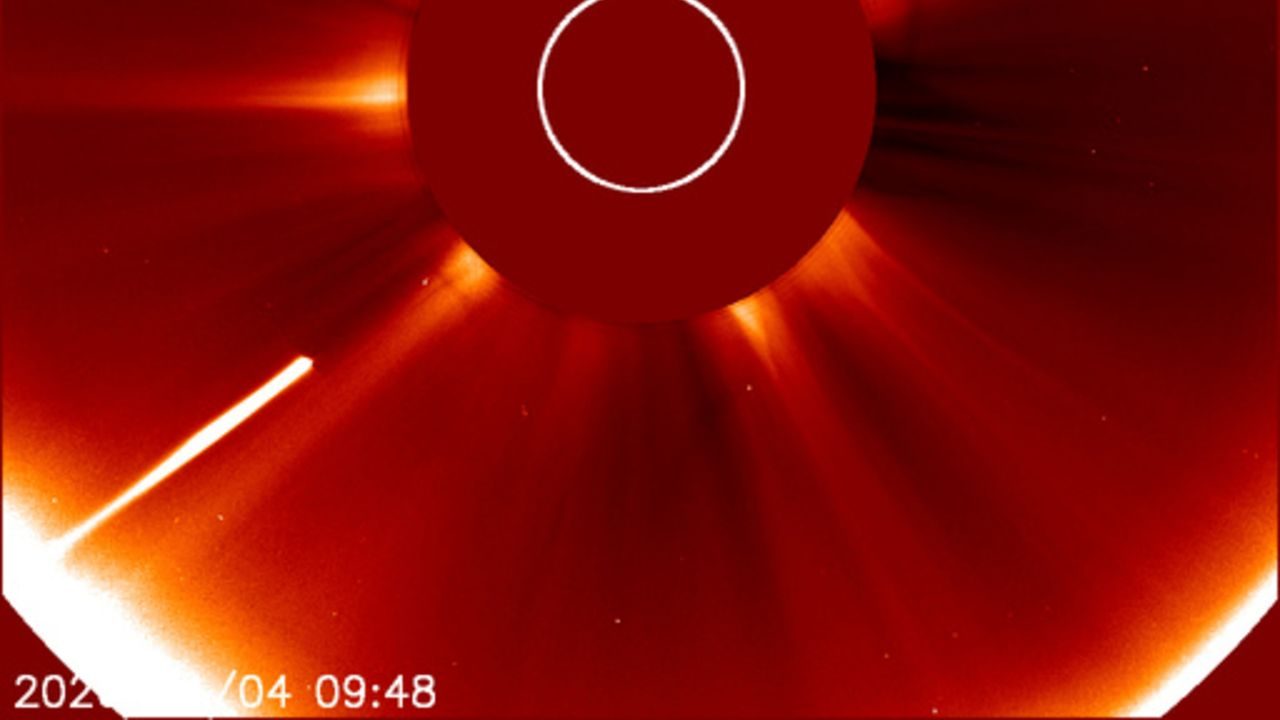
A comet that had astronomers buzzing with excitement — one many believed could become bright enough to see in broad daylight — has instead met a dramatic and violent end. Comet C/2026 A1, nicknamed MAPS, flew too close to the sun and was torn apart, leaving behind only a ghostly, glowing tail with nothing at its core.
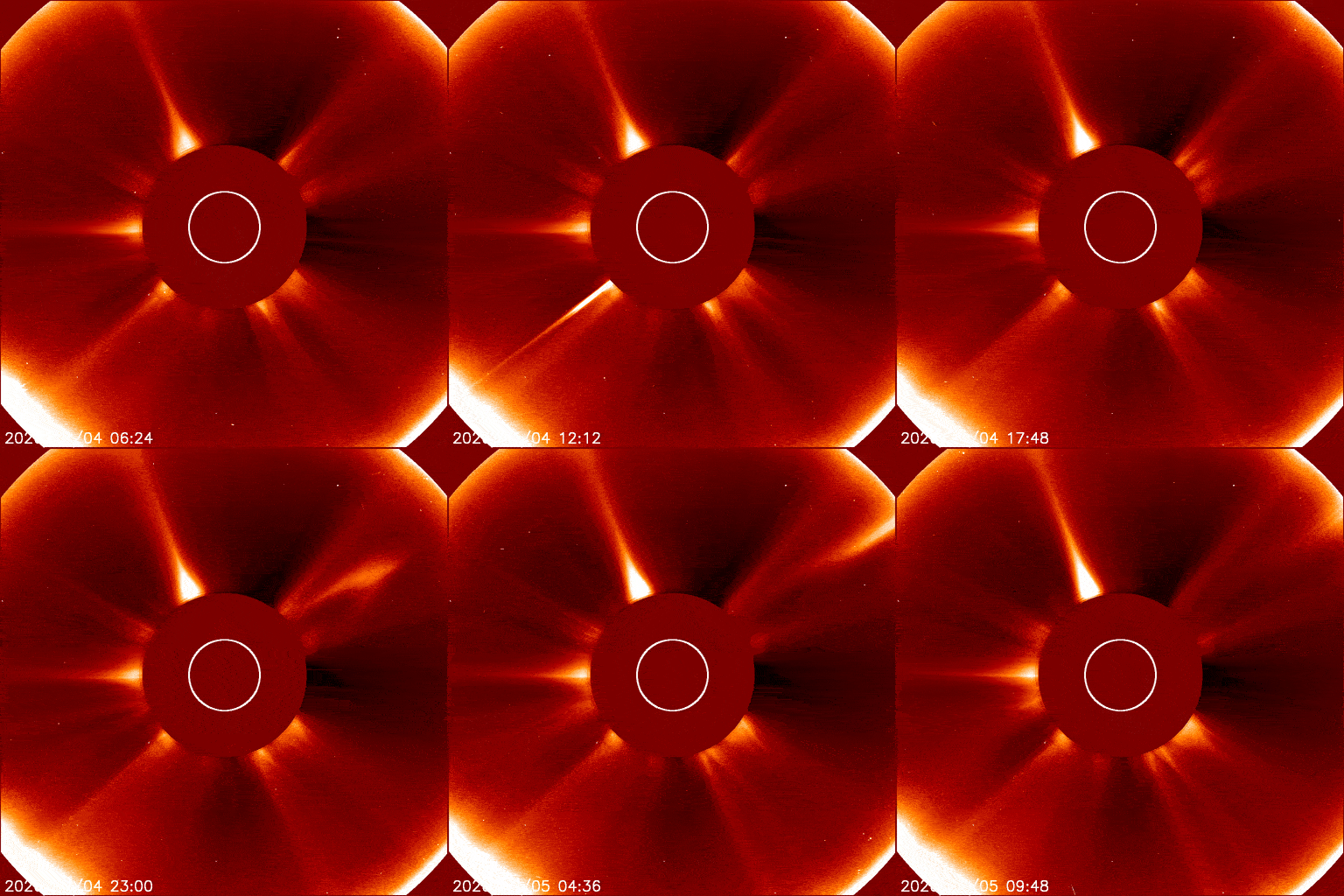
The moment was captured in stunning footage by the SOHO satellite, a joint NASA and ESA spacecraft that monitors the sun. The images show the comet diving into the sun’s outer atmosphere on one side — and emerging from the other side as little more than a diffuse cloud of debris. What had been a hopeful candidate for a once-in-a-generation sky spectacle was reduced to what astronomers call a “headless wonder.”
It’s a remarkable and somewhat heartbreaking turn of events for skywatchers who had circled their calendars. But the science behind what happened is just as spectacular as what was hoped for.
What Is a Sungrazer Comet — and Why Was MAPS So Special?
Sungrazer comets are exactly what they sound like: icy bodies from the outer solar system that follow orbital paths bringing them extraordinarily close to the sun. Most comets keep a respectful distance from our star. Sungrazers don’t.
Comet MAPS, formally designated C/2026 A1, was classified as a sungrazer because its trajectory took it through the sun’s outer atmosphere — the corona — rather than simply passing nearby. That extreme proximity is what made it so exciting and, ultimately, so doomed.
When a comet passes that close to the sun, the intense heat and gravitational forces can either cause it to brighten spectacularly — producing a dazzling display visible even during daylight hours — or simply destroy it. For comet MAPS, it was the latter. The sun’s immense tidal forces and superheated environment ripped the comet apart, scattering its material into space.
The SOHO satellite, which has been watching the sun since 1995 and has discovered more comets than any other observatory in history, caught the entire sequence on camera.
What the SOHO Footage Actually Shows
The footage released from the SOHO satellite tells the story in stark visual terms. On one side of the frame, comet MAPS can be seen entering the sun’s atmosphere — a bright, structured object with a clearly defined nucleus and trailing tail. Then it passes behind the sun’s disk.
What comes out the other side is something very different. Instead of a comet with a solid, icy core, what emerges is a cloud of dispersed debris — no central body, just a glowing smear of dust and gas catching the sunlight. This is the “headless wonder” phenomenon: a comet tail without a comet.
The term describes the eerie visual effect where the comet’s nucleus has been completely destroyed, but the trailing material continues moving along the original orbital path, briefly persisting before it too fades into nothing.
The Science Behind a Comet Being Ripped Apart
When a comet makes a close pass near the sun, several destructive forces work against it simultaneously. Understanding them helps explain why even large, hopeful comets sometimes simply don’t survive.
- Tidal forces: The gravitational difference between the side of the comet closest to the sun and the far side can literally pull the object apart — the same force that creates ocean tides on Earth, but vastly more extreme at such short distances.
- Intense heat: At distances this close, surface temperatures on the comet’s nucleus can reach extreme levels, rapidly vaporizing ice and loosening the structural integrity of the body.
- Solar wind pressure: The stream of charged particles constantly flowing outward from the sun exerts additional physical pressure on the comet’s material.
- Outgassing instability: As ice vaporizes violently and unevenly, jets of gas can cause the nucleus to spin, fragment, or simply disintegrate.
| Feature | Detail |
|---|---|
| Comet designation | C/2026 A1 (MAPS) |
| Classification | Sungrazer comet |
| Observed by | SOHO satellite (NASA/ESA) |
| What was expected | Daytime-visible brightness |
| What actually happened | Disintegrated in the sun’s atmosphere |
| Post-perihelion appearance | “Headless wonder” — debris cloud with no nucleus |
Why This Keeps Happening to “Comet of the Century” Candidates
Comet MAPS is far from the first highly anticipated sungrazer to disappoint hopeful skywatchers. The history of comet watching is littered with objects that promised spectacular naked-eye shows and then fizzled — or in this case, burned.
The challenge is that predicting how a comet will behave near the sun requires knowing the precise composition, size, and structural strength of its nucleus — information that is extremely difficult to obtain from millions of miles away. A comet that appears large and bright when it’s still in the outer solar system may have a fragile, loosely consolidated core that simply cannot survive the sun’s close-range assault.
What makes MAPS notable, despite its destruction, is the quality of the footage documenting its final moments. The SOHO imagery captures the transformation from structured comet to formless debris cloud in remarkable detail, giving researchers a clear record of exactly how and where the object broke apart.
What Researchers Can Learn From MAPS
Even in death, comet MAPS is scientifically useful. The debris cloud left behind carries information about the comet’s original composition. As the material disperses, spectroscopic analysis can reveal what the nucleus was made of — what ices, silicates, and organic compounds were present.
Sungrazer disintegration events also help scientists better understand the physical limits of cometary nuclei. Each destruction event adds data points that can improve future models predicting whether a sungrazer will survive its closest approach or be consumed by it.
For the SOHO mission specifically, observations like this one reinforce the satellite’s extraordinary value. Originally designed with a planned lifespan far shorter than its actual operational history, SOHO continues to deliver front-row footage of some of the solar system’s most dramatic moments.
Frequently Asked Questions
What is comet MAPS?
Comet MAPS, formally designated C/2026 A1, was a sungrazer comet that passed through the sun’s outer atmosphere and was destroyed in the process.
What does “headless wonder” mean?
It describes a comet whose nucleus has been completely destroyed, leaving only a trailing cloud of debris that briefly continues along the orbital path with no solid core at its head.
Which spacecraft captured the footage?
The SOHO satellite, a joint mission operated by NASA and ESA, recorded the comet’s entry into the sun’s atmosphere and its emergence as a debris cloud.
Was comet MAPS supposed to be visible to the naked eye?
Many experts anticipated it could shine brightly enough to be seen in the daytime sky, but the comet disintegrated before that could happen.
Can scientists still study comet MAPS after its destruction?
Yes — the debris cloud left behind can still be analyzed for compositional data, and the event itself adds valuable information about how cometary nuclei behave under extreme solar conditions.
Is it common for sungrazers to be destroyed like this?
It happens frequently enough that scientists are cautious about predicting outcomes for sungrazer comets, as the structural strength of a comet’s nucleus is difficult to determine from a distance.



Leave a Reply