
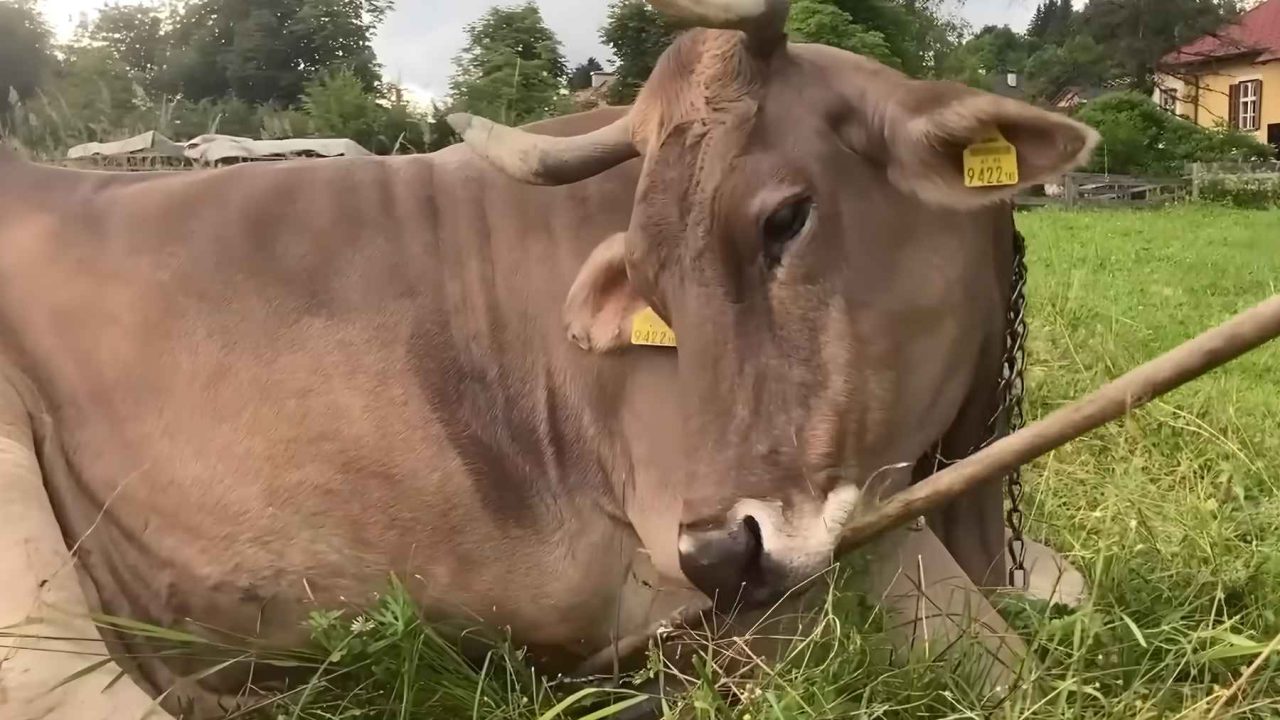
A cow in southern Austria has done something researchers say challenges one of the oldest assumptions in human history — that cattle are passive, instinct-driven animals incapable of deliberate, goal-directed thought. The cow’s name is Veronika, and she taught herself to use a broom.
Not playfully. Not by accident. She picked it up, repositioned it with her tongue, clamped it in her teeth, and used it to scratch the parts of her back she couldn’t reach any other way. When scientists from the University of Veterinary Medicine Vienna saw the footage, they didn’t dismiss it as a quirky farm video. They drove out to the farm and ran controlled experiments.
What they found is forcing a genuine rethink of what we thought we knew about cattle cognition — and about the nature of tool use in animals we have lived alongside for more than 10,000 years.
The Cow, the Farmer, and the Broom That Started Everything
Veronika is a Swiss Brown cow living on the farm of organic farmer Witgar Wiegele in the village of Nötsch im Gailtal in southern Austria. Wiegele had been watching her for years, noticing things that struck him as unusual — not just the object use, but her responsiveness to family voices and the complexity of her social behavior with other cows.
He observed that she would pick up fallen branches or wooden sticks and use them to reach spots on her body she couldn’t scratch otherwise. Over time, her technique seemed to get better. More deliberate. More refined.
When researchers at the University of Veterinary Medicine Vienna were alerted to videos of Veronika’s behavior, a team led by cognitive biologist Antonio J. Osuna-Mascaró made the trip to the farm. They weren’t there to be charmed. They were there to determine whether what Veronika was doing met the scientific definition of tool use — one of the most debated and carefully guarded concepts in animal cognition research.
What the Scientists Actually Tested — and What Veronika Did
The researchers set up controlled experiments on the farm. They placed a broom in different positions around Veronika while she rested or stood in her pasture, varying where it was and how accessible it was to see whether her responses were consistent and intentional.
What they documented was striking. Veronika would reach for the broom with her tongue, maneuver it into a more useful angle, then clamp it between her teeth — She then used it to scratch her back.
This wasn’t random object interaction. The behavior was repeated, targeted, and adapted to the tool’s position. That combination is exactly what separates true tool use from incidental contact with objects.
| Behavior Observed | Significance |
|---|---|
| Used tongue to reposition broom before use | Shows planning, not random contact |
| Clamped broom in teeth to control it | Demonstrates grip and deliberate manipulation |
| Directed broom to specific body areas | Goal-directed behavior, not instinct-driven |
| Technique improved over time | Suggests learning and cognitive adaptation |
| Previously used fallen branches and sticks | Indicates generalized tool-use concept, not one-off event |
The research team, led by Osuna-Mascaró, concluded this met the criteria for spontaneous tool use — behavior that emerged without human training or reward conditioning.
Why This Matters More Than It Might Seem
Tool use is one of the benchmarks scientists have long used to assess cognitive complexity in animals. For decades, it was considered almost exclusively a marker of higher primates — chimpanzees, bonobos, orangutans. Over time, that list expanded to include crows, dolphins, and a handful of other species that surprised researchers.
Cattle were not on that list. They have been domesticated for more than 10,000 years, and in all that time, this kind of deliberate, self-directed tool use had not been formally documented. The assumption — largely unquestioned — was that cows simply didn’t have that level of cognitive flexibility.
Veronika’s case doesn’t just add a species to a list. It raises a harder question: if a cow living on a farm in Austria figured this out on her own, what else have we been missing? How much of what we assumed about cattle intelligence was shaped by the environments we put them in, rather than their actual cognitive capacity?
Researchers in animal cognition have increasingly argued that intelligence in non-human animals is routinely underestimated when animals are studied only in controlled laboratory settings, or when the behaviors being tested don’t align with the animal’s natural motivations and physical abilities.
The Broader Implications for How We Understand Livestock
This discovery arrives at a moment when public and scientific interest in animal sentience and cognition is growing rapidly. Several countries have updated legal frameworks around animal welfare in recent years, partly in response to accumulating evidence that many farm animals have richer inner lives than previously acknowledged.
Cattle in particular have been the subject of growing research into emotional states, social bonding, and memory. Studies have shown they form close friendships, experience stress when separated from companions, and can learn to navigate complex tasks. Veronika’s tool use adds a new dimension to that picture.
For farmers like Witgar Wiegele, who noticed Veronika’s behavior long before any scientist arrived, the research validates something he had been observing quietly for years — that the animals in his care were doing things that didn’t fit the standard model of bovine behavior.
The University of Veterinary Medicine Vienna team’s findings shift the conversation from anecdote to documented science. Whether Veronika’s ability is unique to her or reflects a broader latent capacity in cattle is now a question researchers will likely pursue.
What Comes Next for This Research
The immediate next step is determining whether Veronika’s tool use is an isolated case of individual problem-solving or something that other cattle are capable of but have never had the opportunity — or the right objects — to demonstrate.
Researchers will likely look at whether other cows in varied environments show similar behaviors, and whether the capacity can be observed more widely when animals are given access to appropriate objects in naturalistic settings.
The findings from Nötsch im Gailtal are already prompting wider questions about how animal cognition studies are designed, and whether cattle have been systematically underestimated simply because no one was looking for this kind of behavior before.
Frequently Asked Questions
Who is Veronika, and where does she live?
Veronika is a Swiss Brown cow living on the farm of organic farmer Witgar Wiegele in the village of Nötsch im Gailtal in southern Austria.
What exactly did Veronika do with the broom?
She used her tongue to reposition the broom, clamped it between her teeth, and used it to scratch areas of her back she could not otherwise reach — behavior that researchers identified as deliberate tool use.
Who conducted the scientific research?
A team of cognitive biologists from the University of Veterinary Medicine Vienna, led by Antonio J. Osuna-Mascaró, traveled to the farm and ran controlled experiments after seeing videos of Veronika’s behavior.
Is this the first time a cow has been documented using a tool?
Based on
Did Veronika receive any training to use the broom?
No. The researchers concluded her behavior was spontaneous tool use — it emerged without human training or reward conditioning of any kind.
What did Veronika use before the broom was introduced?
According to farmer Witgar Wiegele, Veronika had previously picked up fallen branches and wooden sticks to scratch herself before the formal experiments with the broom were conducted.


Leave a Reply